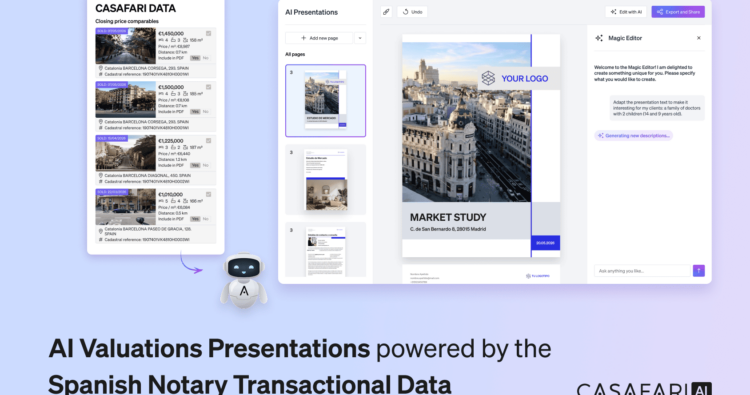
In an increasingly digital world, the true value of a real estate professional lies in human connection, trust, and relationship-building. CASAFARI’s Agentic AI is designed to protect and elevate that value. By taking care of all the complex technical work, data aggregation, and administrative heavy lifting behind the scenes, our intelligent systems allow agents to step away from the screen and focus on what matters most. With an AI Agent operating under the hood, professionals simply state what they need, and the AI handles the rest—making your job easier, smoother, and completely focused on your clients.
Key Highlights
- Shifting the Burden, Not the Control: Agentic AI moves real estate from tedious manual workflows to proactive, autonomous task management, letting the technology handle the heavy lifting while agents make the final strategic decisions.
- Simplifying the Everyday: From complex global portfolio optimization to hyper-local property valuations, AI handles the technical backend so real estate professionals can focus on client relationships and the human touch.
- Unlocking Maximum Efficiency: By eliminating traditional bottlenecks like cross-border compliance and duplicate listings, Agentic AI acts as an invisible partner that makes an agent’s day-to-day job exponentially easier.
Introduction
For global property networks, the pressure to price portfolios accurately and sell them quickly is huge. By moving beyond manual appraisals and embracing process automation, the industry is seeing a major transformation. This evolution ensures every property is perfectly priced for a swift sale, changing how agents and firms operate on a global scale.
The Shift Toward Autonomous Market Intelligence in Real Estate
The real estate industry is experiencing a significant transformation, embracing autonomous systems that offer advanced data analysis and proactive decision-making. This change is all about making processes smarter, faster, and more accurate.
These intelligent systems are game-changers for pricing and selling properties. Below, we’ll explore how this shift from manual work to automated intelligence is revolutionizing the market.
From Manual Appraisals to Automated Pricing

For years, real estate involved gathering information from various data sources and making subjective judgments. While traditional automation has helped with simple repetitive tasks, it often falls short when dealing with the complexities of property valuation.
Agentic AI, however, is fundamentally different from traditional AI. While older AI systems follow pre-defined rules and need step-by-step guidance, agentic AI is proactive. Think of it as an AI that can act independently to achieve a goal.
This means it can analyze countless data points, understand market dynamics, and determine optimal pricing strategies on its own. This move away from manual business processes allows real estate professionals to focus on strategy rather than routine work.
Advantages of Autonomous Intelligence Layers for Real Estate
An autonomous intelligence layer act as a powerful AI agent, using agents to manage and analyze property data with incredible speed and accuracy. One of the main benefits for businesses is the ability to handle vast amounts of information without overwhelming your team, freeing up your employees to focus on more strategic initiatives that drive growth.
Key advantages include:
- Increased Efficiency: Automates complex tasks, simplifying workflows and saving valuable time.
- Cost Savings: Reduces the need for manual labor and minimizes errors that can lead to financial loss.
- Enhanced Data Privacy: Manages sensitive information securely within a controlled system.
- Continuous Improvement: The system learns and adapts, becoming more effective over time.
Impact on Global Property Portfolios
For a global network, managing assets across different international markets presents unique challenges, from varying regulations to diverse market trends. Agentic AI helps unify these operations by integrating with existing business systems to provide a single, connected view of the entire portfolio.
This technology empowers team members with real-time data analysis, enabling them to make faster, more informed decisions. For example, an agentic system can analyze market fluctuations to optimize investment portfolios automatically. In real estate, it can identify emerging trends in one country and apply those insights to another, creating a more agile and responsive investment strategy.
Ultimately, this leads to better-optimized portfolios that are priced for quick sales, regardless of their location – a capability crucial for organizations looking to scale their operations and maintain a competitive edge.
Understanding Agentic AI in Real Estate

These intelligent agentic systems are not just tools; they are proactive partners: by using advanced techniques like reinforcement learning, they continuously improve their performance by learning from outcomes.
This capability to act independently is what makes agentic AI so powerful. In real estate, this translates to systems that can do more than just process data—they can strategize, adapt, and execute tasks. Let’s explore how it’s transforming decision-making.
Agentic AI vs. Traditional AI Agents
Traditional AI operates on pre-defined rules and workflows. It’s reactive, responding only when triggered, and typically requires human oversight to manage complex processes.
Agentic AI, in contrast, is autonomous. It anticipates needs, learns from its environment, adapts to new information, identifies patterns, and takes initiative to achieve long-term goals, making it ideal for dynamic industries like real estate.
How Agentic AI Transforms Decision-Making
Agentic AI revolutionizes decision-making by automating the entire process, from data gathering to execution. The AI model is designed to understand business logic and independently seek out relevant information to solve complex problems.
For instance, instead of an analyst manually sifting through data to identify an investment opportunity, an agentic AI can do it automatically. It perceives the market, reasons through potential strategies, acts on the best one, and learns from the result. This collaborative approach enhances the speed and quality of decisions, allowing businesses to respond to opportunities faster than ever before.
Key Features of Agentic AI Platforms

When evaluating an agentic AI platform, it’s important to look for features that enable true autonomy and seamless integration. A robust platform should be capable of connecting with various external tools and data sources to perform its tasks effectively.
Look for these key features:
- Proactive Behavior: The ability to anticipate needs and act without direct commands.
- Adaptability: Can learn from new data and adjust to changing environments.
- Agent Builder: Tools to create and customize specialized agents for specific business needs (e.g.: enhancing customer support).
- Integration with External Tools: Seamless connection to APIs, databases, and other software.
- Collaboration: Multiple agents can coordinate to solve complex problems.
Agentic AI in Modern Real Estate
The adoption of agentic AI is already making waves in the real estate industry. This technology is proving its value by tackling complex workflows, from valuation to client management, that were previously manual and time-consuming.
An effective automation platform powered by agentic AI can transform how real estate professionals operate daily. Here are a few concrete examples of how this technology is being applied to modernize the property market.
Automated Property Valuations
Automated property valuation is one of the most impactful applications of agentic AI in real estate. In simple terms, an agentic AI system for valuation works through a four-step cycle: perceive, reason, act, and learn. First, it “perceives” by gathering vast amounts of real-time data from diverse sources like market listings, public records, and economic indicators.
Next, it “reasons” by using this data to analyze market trends, compare properties, and determine an optimal price, factoring in nuanced variables that a human might miss. Finally, it “acts” by generating a valuation and can even “learn” from the sale’s outcome to refine its future predictions.
Predictive Analytics for Sellers
Agentic AI excels at predictive analytics, helping real estate agents anticipate market movements before they happen. By applying machine learning algorithms to historical and real-time data, these systems can forecast future seller trends with remarkable accuracy.
This level of data analysis provides a significant competitive advantage, allowing agents to advise their clients more effectively, whether they are looking to buy at the right time or sell for the highest price. This proactive approach turns reactive agents into strategic advisors, ensuring better outcomes for their clients and building stronger, trust-based relationships.
Dynamic Portfolio Optimization
For firms managing a global network of properties, dynamic portfolio optimization is crucial. An agentic AI system can continuously monitor and adjust a property portfolio to maximize returns and minimize risk. It integrates with enterprise systems to pull data on performance, market conditions, and financial metrics.
Agentic AI is focused on making and executing decisions, allowing real-time adjustments that human technical teams would struggle to perform at scale.
AI Workflow Automation and Location Intelligence Use Cases
Leveraging location intelligence alongside AI agents is no longer a futuristic concept; it is the new standard for high-performing real estate professionals. By synthesizing hyper-local data—such as foot traffic, sociodemographics, and inventory levels—with artificial intelligence, agents can transform from transactional facilitators into strategic advisors.
Hyper-Local Precision: The Power of Contextual Intelligence
When an AI agent analyzes resident traffic and sociodemographic shifts, it doesn’t just see numbers; it identifies emerging gentrification or shifts in household income that could signal a spike in property values.
For a real estate professional, this means the quality of advice improves exponentially. Instead of telling a client a neighborhood is “popular,” an agent can use agentic technology to prove that tourist traffic is increasing by 15% annually, suggesting high ROI for short-term rentals. This combination allows for:
- Predictive Site Selection: AI agents can cross-reference available market properties with local business growth to identify “undervalued” pockets before they hit peak pricing.
- Targeted Prospecting: By understanding the local population’s demographics, artificial intelligence can help agents tailor their marketing to the specific needs of the community—whether that’s growing families needing three-bedroom homes or young professionals seeking proximity to coworking hubs.
Automated Workflows: Boosting Speed Without Losing the Human Touch
The most significant bottleneck in real estate is the manual labor of market research and lead qualification. AI agents act as a “digital nervous system” that constantly monitors the market, incorporating location intelligence to analyze regional trends and demographics. While a human sleeps, an AI agent is scanning properties available on the market and comparing them against historical data, as well as evaluating the geographical context to identify the most promising investment opportunities.
This synergy drastically increases work speed:
- Instant Valuation: agents can generate complex property valuations in seconds by factoring in nearby business infrastructure and recent closing prices, a process that used to take days of manual “comp” searching.
- 24/7 Lead Qualification: AI agents can interact with potential leads in real-time, using location data to answer specific questions about local schools or nearby amenities instantly, ensuring no lead goes cold.

The CASAFARI Edge: Global Intelligence, Local Impact
While many AI tools are limited by the data they ingest, CASAFARI’s AI agents operate on a foundation of unparalleled market depth. Spanning over 20 countries globally, CASAFARI provides a “single source of truth” by indexing more than 30,000 sources and tracking 50 million+ unique properties.
This extensive global footprint gives real estate professionals a massive competitive advantage:
- Cross-Border Insights: In an increasingly globalized market, agents can advise international investors with confidence, backed by clean, deduplicated data that spans across Europe and beyond.
- The “Clean Data” Advantage: Artificial intelligence is only as good as its data. CASAFARI’s AI-driven deduplication ensures that professionals aren’t chasing “ghost” listings or outdated prices, allowing them to move faster than competitors who are bogged down by fragmented portal information.
- Agentic Infrastructure: CASAFARI’s tools go beyond simple searches.
CASAFARI empowers agents to scale their business from local experts to global wealth advisors with AI-powered workflows.
Key Benefits of Agentic AI Solutions for Real Estate Professionals
For real estate professionals, these agents offers a suite of benefits that streamline daily operations and boost productivity. From managing transactions to reducing market risks, the advantages are clear. Let’s explore some of the key benefits in more detail.
Greater Efficiency in Property Transactions
An AI system can manage the many routine tasks involved in a property sale, from initial paperwork to final closing. An agentic AI can orchestrate an entire chain of actions, ensuring that documents are sent, signatures are collected, and deadlines are met without any manual follow-up.
By automating these steps, these systems eliminates bottlenecks and reduces the chance of human error. This not only speeds up the transaction but also provides a smoother experience for everyone involved, allowing agents to manage more deals simultaneously and grow their business.
Reducing Risks in Market Pricing
A significant advantage of agentic AI is its ability to reduce the risks associated with market pricing. Incorrectly priced properties can sit on the market for months or sell for less than their true value. This technology mitigates this risk by conducting a deep and objective market analysis based on massive datasets, ensuring prices are always aligned with current conditions.
Agentic AI’s capabilities can even extend to areas like fraud detection by flagging unusual patterns in transaction data, adding an extra layer of security.
By integrating with enterprise software, these systems provide a reliable, data-driven foundation for pricing strategies, removing emotion and guesswork from the equation, leading to more profitable and predictable outcomes.
Enabling Seamless Cross-Border Deals
International transactions are notoriously complex, involving different languages, currencies, and legal frameworks. Agentic systems can navigate this complexity with minimal human intervention.
An agentic system can manage the entire transaction supply chain across borders, translating documents, converting currencies in real time, and ensuring compliance with local regulations, without the need of a team of specialists.
Agentic systems make cross-border deals smoother by:
- Automating communication between parties in different countries.
- Managing regulatory compliance across various jurisdictions.
- Coordinating complex logistics to ensure a timely closing.
How AI Agentic Platforms Accelerate Workflow Automation
Agentic AI platforms are designed to supercharge workflow automation, managing entire end-to-end processes by integrating with various enterprise systems.
This intelligent automation platform can reason, plan, and act to achieve goals, making it a powerful tool for boosting efficiency. Let’s look at how these platforms achieve this acceleration.
Integrating AI Tools with CRM and Listing Systems
A major strength of agentic AI is its ability to integrate seamlessly with the tools you already use, including CRM and listing systems, allowing you to enhance your existing workflows rather than replacing them. An agentic platform can connect with both modern and legacy systems, acting as a bridge between them.
Using an AI agent builder, you can create agents that pull data from your CRM, interact with listing platforms, and update records automatically. This breaks down data silos and ensures that all your systems are in sync.
| Integration Point | Benefit of Agentic AI |
|---|---|
| CRM Systems | Automates lead qualification and updates client records in real time. |
| Listing Platforms | Posts new properties and updates listings automatically across multiple sites. |
| External Tools | Connects with market data providers and legal software for comprehensive analysis. |
Automating Client Communications

An agent is able to identify new FSBO properties on a market, retrieve details from the listing system about it and pre-generate messages to help the professionals get the mandate. This approach ensures that leads receive accurate and informative responses while giving your team the opportunity to refine the communication. By automating the information-gathering process, you can improve the client experience and enable your team to focus on more complex inquiries.
Real-Time Market Analysis and Alerts
One of the latest trends in agentic AI is its growing ability to perform sophisticated real-time market analysis. An agentic AI can continuously monitor the market and performs data analysis on the fly, identifying shifts in pricing, demand, and inventory as they happen.
When the AI detects a significant event—such as a sudden drop in prices in a specific neighborhood—it can instantly send an alert to the relevant team members.
This proactive monitoring allows real estate professionals to react swiftly to opportunities and threats, giving you a distinct advantage in a fast-moving market.
Choosing the Best Agentic AI Platforms and Frameworks
Selecting the right agentic AI platform is a critical step in leveraging this technology. The best platforms provide the necessary building blocks to create powerful, customized solutions.
A key feature to look for is a flexible agent builder that allows you to design agents tailored to your specific business needs. The choice between a pre-built commercial solution and an open-source option will depend on your team’s technical expertise and budget. Let’s examine what to consider.
Leading Agentic AI Companies
As the adoption grows, CASAFARI is leading the charge by offering AI solutions tailored to the needs of real estate professionals. These powerful tools enable and accelerate new deals while empowering professionals to transform their portfolios into fast-moving sales engines. CASAFARI’s platform is recognized for its robust features and scalability, making it an essential resource for those in the real estate sector.
CASAFARI offers comprehensive automation platforms that can integrate with existing business systems, making it easier for real estate firms to get started. They provide the infrastructure and tools that technical teams need to develop custom agents that address unique market challenges.
For real estate agencies across the globe, partnering with an established provider can accelerate their journey toward intelligent automation. CASAFARI offers reliability and the support needed to implement automated workflows successfully and transform their operations.
Essential Features of a Workflow Automation Software
A top-tier platform should offer more than just basic automation; it needs to provide the core capabilities for building a truly intelligent AI agent that can handle complex process automation.
Look for these essential features:
- Intuitive Agent Builder: To create custom agents without deep coding knowledge.
- Strong Integration Capabilities: To connect with your existing software and data sources.
- Advanced Reasoning Engine: To enable agents to plan and solve problems.
- Learning and Adaptation: The ability to improve over time through feedback.
- Scalability: To grow with your business needs.
Trends and Innovations in Agentic AI
The field of agentic AI is evolving at a rapid pace, with new trends and innovations emerging constantly. One of the most exciting developments is the fusion of agentic with generative AI, creating systems that can not only act but also communicate and create in sophisticated ways using natural language.
This convergence is pushing the boundaries of what’s possible, leading to more powerful and versatile applications. As the technology matures, we are seeing a greater focus on creating collaborative agent ecosystems and expanding their use cases into new markets.
Global Network Effects and Intelligence Sharing
A key trend in agentic AI is the development of global network effects. As more businesses within a global network adopt this technology, the entire system becomes smarter. This is achieved through intelligence sharing, where insights and learnings from one agent are distributed across the network.
Imagine a scenario where an agent in the Spanish market learns a new, effective strategy for selling properties in complex environments. This knowledge can be instantly shared with agents in other countries, allowing them to adapt their own business logic and improve their performance. This creates a powerful, self-improving ecosystem.
This trend is leading to:
- Accelerated adoption as the value becomes more apparent.
- Enhanced performance across the entire global network.
- A significant competitive advantage for organizations that can harness collective intelligence.
Agentic AI Use Cases for International Markets
The use cases for agentic AI in international markets are expanding rapidly beyond initial applications. While early real-world examples focused on automation, the next wave involves more sophisticated tasks like hyper-personalized marketing and complex compliance management across different countries.
An agentic system can now tap into diverse data sources, from local social media trends to international regulatory databases, to inform its actions. Using reinforcement learning, it can test different strategies for entering new international markets and learn which approaches are most effective, all without significant upfront investment.
These evolving applications are moving beyond simple process automation. For example, some systems are now capable of dynamic content creation, tailoring marketing materials in real time to suit the cultural nuances of different target audiences, making global expansion more effective than ever.
Conclusion
The future of real estate isn’t about replacing professionals with technology; it’s about liberating them from the desk work that eats up their day. The evolution toward autonomous market intelligence—led by CASAFARI’s Agentic AI—is designed with one primary goal: to make the agent’s job easier.
By running all the complex data analytics, deduplication, and workflow automation under the hood, CASAFARI takes care of the technical heavy lifting. Real estate professionals simply communicate what they need, and the platform delivers the insights, valuations, and updates required to drive fast-moving sales. This seamless synergy between advanced artificial intelligence and human intuition ensures that while CASAFARI handles the global data, agents can focus entirely on the local human touch that seals the deal.
Frequently Asked Questions
What distinguishes agentic from generative AI in real estate?
In real estate, generative AI creates content, like property descriptions. In contrast, agentic AI is about action and decision-making. An agentic model can autonomously perform complex tasks like analyzing market data to set a property’s price and execute the sale strategy, going far beyond content creation.
Which agentic AI platforms are most recommended for property workflow automation?
For property workflow automation, CASAFARI’s Agentic AI solutions are highly recommended. They provide seamless integration with external tools and enterprise systems, and the scalability needed to build a powerful automation platform for real estate, leveraging the largest and cleanest real estate database in over 20 countries globally.
Are there any agentic AI frameworks for the real estate market?
CASAFARI provides agentic AI solutions that transform real estate portfolios into fast-moving sales engines. CASAFARI possesses complete market knowledge, including actual transactional prices and comprehensive historic pricing data of properties in over 20 countries globally. By leveraging this data, they enable the development of powerful agentic systems tailored to the unique dynamics of real estate.