
Investors and funds: find yield and below-market deals across Europe
Cross-border real estate investors source yield and below-market deals across target markets by establishing location-based asking yield baselines, screening deduplicated property listings against fair market valuations, and ranking seller motivation through documented price reduction histories. CASAFARI unifies fragmented portal listings into single deduplicated property records, giving acquisition teams clean data to screen, value and negotiate acquisitions efficiently.
How do you benchmark gross rental yield by area and isolate properties that beat it?
Comparing yield potential across European metropolitan areas is frequently hindered by distorted portal averages. Duplicate listings across multiple estate agencies, unverified floor areas and inconsistent neighbourhood boundaries skew simple portal averages in cities such as Madrid, Lisbon, Milan or Berlin. To set a reliable acquisition target, investment analysts require a clean, single-record baseline built on identical boundaries.
CASAFARI enables a precise two-step yield benchmarking workflow. First, analysts pull the average asking sale price per m² and average asking rent per m² for the exact same location boundary from Area Insights market benchmarks. As detailed in the rental yield by area workflow in the developer documentation (as of October 2026), dividing the annualised asking rent per m² by the asking sale price per m² yields the accurate asking gross yield baseline for that specific zone. Second, acquisition teams run a search in Property Sourcing across that boundary using the gross_yield_from parameter set above the local baseline. This instantly filters individual properties that meet or exceed the hurdle rate required by the investment committee.
By comparing local sub-market yield baselines with individual asset yield filters, funds can systematically allocate capital to zones offering the strongest risk-adjusted income, as demonstrated across major gross rental yields across European cities.
How do you separate genuinely below-market deals from cheap, flawed stock?
Acquisition teams often lose valuable due diligence hours pursuing properties that appear cheap on paper but carry hidden structural, legal or layout flaws. Unrenovated basement units, properties subject to protected tenancies or listings with incorrect floor space frequently masquerade as bargain acquisitions when filtered purely by asking price per square metre.
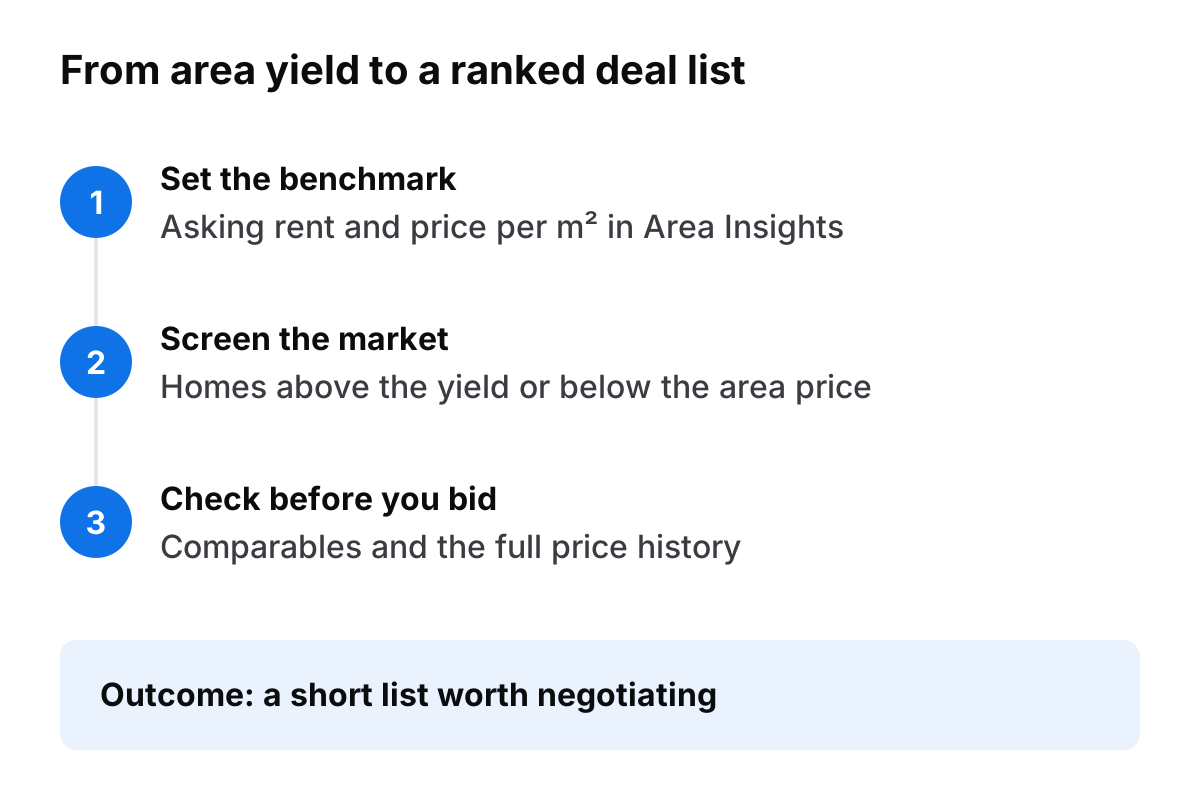
To distinguish genuine value from problematic stock, investors rely on a three-step valuation check. First, analysts establish the benchmark asking price per m² in the target neighborhood using Area Insights. Second, Property Sourcing filters active deduplicated listings offered below that neighborhood average. Third, each shortlisted candidate is run through Comparables to determine its estimated fair market valuation based on like-for-like active and historical properties. According to the finding underpriced properties use case (as of October 2026), candidates with the largest spread between current asking price and estimated fair market price represent the most compelling valuation opportunities.
For institutional client accounts utilizing the REST v2 search API, additional filters for bank-owned (REO) and auction properties can be layered onto this price-spread screen to identify distressed asset stock before standard market distribution.
How do you run one consistent value and short-let screen across multiple European countries?
Cross-border investment managers and family offices waste substantial time reconciling disparate portal taxonomies across Spain, Portugal, France, Italy or Germany. Standardising acquisition screens across international jurisdictions requires normalized data attributes applied across every listing.
Using a unified property graph, analysts apply identical value screens regardless of country borders. Parameters combining price-per-m² caps, Energy Performance Certificate (EPC) ratings, property condition (distinguishing to-renovate from turnkey stock) and cumulative price history can be deployed seamlessly. Detailed parameters are outlined in the cross-market price-per-m² value screen guide.
For hospitality investors and short-let operators, Property Sourcing provides targeted attribute filtering. Analysts can require a tourist rental licence, dedicated outdoor terrace or private parking space before an asset enters the underwriting funnel, as shown in the short-let investor filter documentation.
How do you rank seller motivation and negotiate from evidence before submitting a bid?
Sourcing an attractive asset is only half of the acquisition process; securing it at a target cost basis depends on understanding seller motivation. Knowing how long an asset has sat on the market and tracking historical price adjustments gives buyer's agents and transaction managers a clear advantage in price negotiations.
In covered markets, High Potential Seller Leads alongside full property listing histories reveal total days on market, agency representation changes, delistings and cumulative asking-price erosion across every portal where the asset was listed. As explained in the investor negotiation ranking with Seller Leads, acquisition teams rank targets by total price reduction percentage and enter negotiations armed with complete, verifiable timeline records.
How to start sourcing deals in the web app, API or Casafari MCP
Investment teams can access CASAFARI's deduplicated property graph across three deployment channels depending on workflow requirements:
- Web Application: Perform interactive deal sourcing and market benchmarking using CASAFARI solutions for property investors.
- REST API: Automate custom property filtering and portfolio screening programmatically via CASAFARI Property Data APIs.
- Casafari MCP: Query market data directly inside AI agent platforms such as Claude, ChatGPT, Cursor or Gemini CLI using Casafari MCP for AI agents.
To begin testing acquisition workflows, real estate professionals can set up a Free plan containing 1,000 tokens valid for 30 days without entering a credit card, or select the Agent plan at EUR 70 per month (EUR 49 per month billed annually), by completing sign in to the CASAFARI platform.
Frequently asked questions
How do property investors calculate gross rental yield by area across European cities?
CASAFARI calculates yield metrics based on active asking prices rather than closed transaction or notary registry figures. To benchmark a specific location, divide the annualised asking rent per m² by the asking sale price per m² on the same geographic boundary within Area Insights. Individual properties exceeding that yield baseline can then be isolated in Property Sourcing using the gross_yield_from filter.
How do you find genuinely underpriced properties rather than low-quality listings?
Genuinely underpriced properties are identified through a three-step valuation screen. Analysts benchmark the neighbourhood asking price per m² using Area Insights, search for active listings below that baseline in Property Sourcing, and evaluate each candidate against Comparables to obtain an estimated fair market value. Assets showing the widest gap between asking price and estimated fair market price represent verified acquisition opportunities.
Which countries are covered for cross-border property deal sourcing?
CASAFARI's property graph covers 16 countries: 14 in Europe (Andorra, Austria, Belgium, Switzerland, Germany, Spain, France, Greece, Italy, Luxembourg, Monaco, Poland, Portugal, San Marino), the United Arab Emirates, and entering the US now: selected states, commercial real estate only, via Claro AI. Across these markets, listings from multiple portals are consolidated into a single deduplicated property record.
Can we search for bank-owned or auction properties through the platform?
Bank-owned (REO) and auction filters are available to CASAFARI client accounts via the REST v2 search API. These specific criteria are not included in the standard self-serve Property Sourcing search interface.
How much does it cost to test the API and MCP workflows for deal sourcing?
New users receive a Free plan with 1,000 tokens valid for 30 days with no credit card required upon signing in at platform.casafari.com/signin. Continuous self-serve platform access starts with the Agent plan at EUR 70 per month (or EUR 49 per month when billed annually), with enterprise options detailed in the developer documentation.
See it on your own market
1,000 free tokens for 30 days, no card. Then the Agent plan or prepaid tokens.