
Casafari REST API Use Cases: What to Build and When to Choose REST over MCP
CASAFARI exposes its clean, deduplicated property graph across 16 countries (US: entering now, selected states, commercial real estate only, via Claro AI) through dedicated REST APIs on platform.casafari.com. Each API maps to a concrete build: place name resolution, price-per-square-metre trends, property search, lead feeds, automated valuations, and commercial site selection. Calls consume platform tokens, though Location Lookup costs zero. While CASAFARI MCP servers cater to interactive AI agents, REST provides the deterministic execution required for backend software.
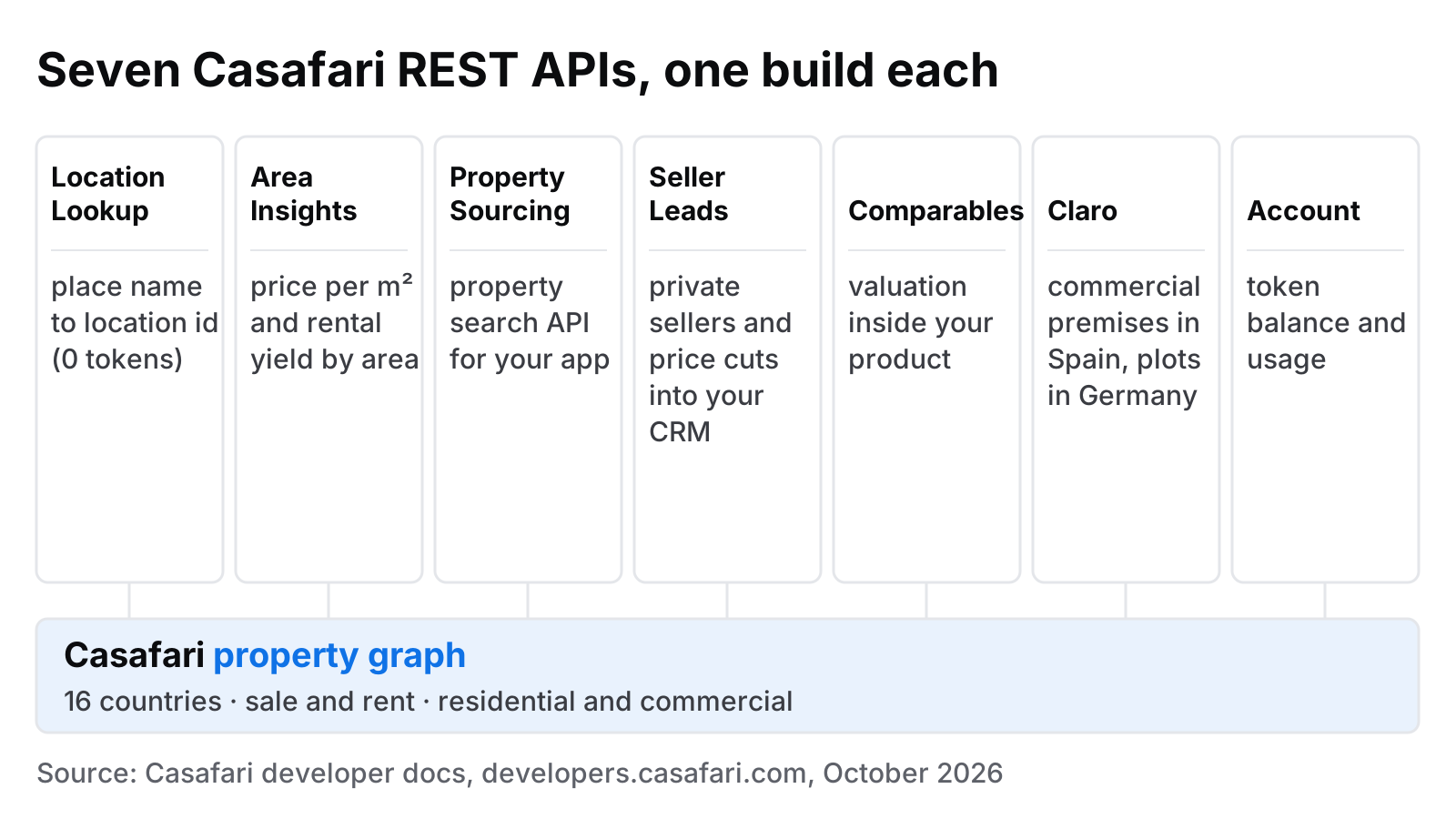
Imagine a Monday morning sprint planning session at a proptech firm. The product backlog contains items for automated valuations, local price trends, and motivated-seller leads. A developer asks the central architectural question: should the system wire these features into the core backend using a REST API, or delegate the logic to an AI agent? Knowing what a real estate API is provides the foundation, but deciding how to implement each specific service requires examining each API individually.
Start with Location Lookup: turn a place name into a location id
Every analytical API on the platform requires a structural location identifier rather than a free-text string. Location Lookup resolves place names or postcodes such as “Chamberí”, “Cascais” or “Schwabing” into a location id with its parent places.
To build a location search box that autocompletes places across 16 countries, your backend calls GET /v1/locations/search. The endpoint returns matching locations with their ids and parent places, which are then passed directly to subsequent analytical requests.
Because Location Lookup calls consume zero tokens, application backends can debounce input and call the endpoint on every keystroke without incurring usage costs.
Area Insights: a price per square metre trend for any neighbourhood
Product managers at mortgage lenders and property portals frequently need localised pricing market dynamics. A mortgage underwriting system, for instance, can query monthly asking price movements per square metre in target postcode districts to flag inflated collateral valuations before approving a loan.
Using the endpoints detailed in the Area Insights developer docs, your service submits a location identifier to retrieve historical price per square metre time series and distributions by price, bedrooms and time on market. Because data originates from CASAFARI’s deduplicated property graph, every listing is cleaned and counted once, preventing multi-listing bias from distorting local figures. You can integrate these market metrics directly through Area Insights or learn more about why rental yield matters and how to find it.
Property Sourcing: a property search API for your own app
When building a client-facing portal or an investment analysis platform, sourcing clean residential and commercial listings across multiple European markets can present significant integration challenges. Property Sourcing provides a single consolidated query interface for for-sale and for-rent inventory.
By passing location identifiers, property types, price thresholds, and floor area parameters to the search endpoints, your backend receives a unified feed of listings across 16 countries. Each entry retains its complete price adjustment history and delisting timeline. Developers building custom real estate portals can review a mobile-first property app built on the Property Data API as a practical reference implementation, alongside the detailed Property Sourcing developer docs.
Seller Leads: homes with repeated price cuts, pulled into your CRM
Estate agency teams rely on timely market signals to identify prospective vendor inventory. Instead of manually monitoring portal listings, engineering teams build automated ingest routines that synchronise daily market opportunities directly into their CRM system.
Following the architectural patterns outlined in the Seller Leads developer docs, a scheduled cron job executes each morning to list the homes within 300 metres of each office whose asking price was cut repeatedly, with since set to the previous run, in Spain, France, Italy, Germany, Greece or Andorra. The CRM backend processes the payload, scores the leads based on localised criteria, and assigns follow-up tasks directly to acquisition agents.
Comparables: a valuation inside your product
Integrating property valuation engines directly into mortgage origination flows or portal landing pages requires real-time access to comparable property transactions and current market listings.
Calling the valuation endpoints described in the Comparables & Valuation developer docs with a target property’s coordinates, address or Spanish cadastral reference, its property type, surface area and bedroom count returns an estimated market value alongside a curated set of comparable properties. The underlying model draws on currently active listings, past sales and rentals, and official registry records to deliver balanced valuation benchmarks.
Claro: site selection for commercial premises in Spain and Germany, and plots in Germany
Commercial real estate expansion demands structured inventory analysis tailored specifically to site selection workflows. Claro covers commercial premises across Spain and Germany and, as a separate set, commercial plots in Germany.
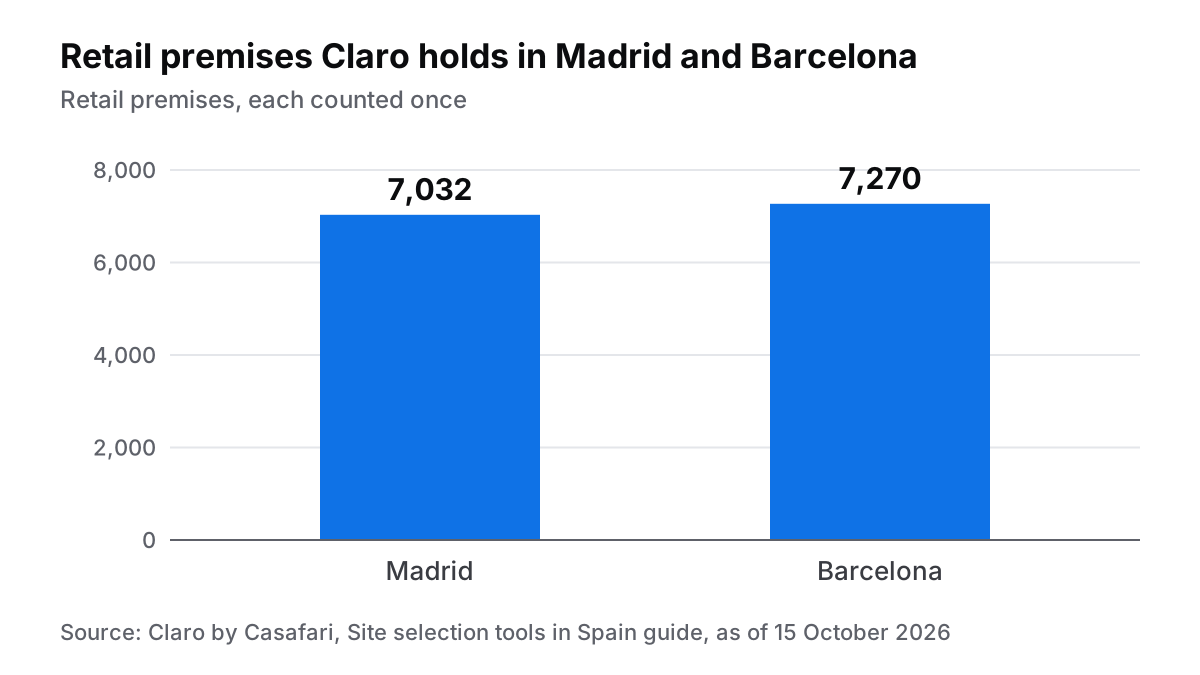
Expansion teams send plain-language specifications to retrieve structured inventory data. According to Claro’s service status snapshot of 21 October 2026, the engine tracked 232,069 active commercial premises, with each property recorded once. Development teams query the API using platform Bearer key authentication to execute batch evaluations across hundreds of expansion briefs, streaming structured results into corporate location models. Technical teams can reference the Claro developer docs and explore how Casafari for Business Expansion supports corporate real estate strategy.
Account: watch your token balance from code
To ensure operational transparency across production and staging environments, engineering teams can monitor system token consumption programmatically.
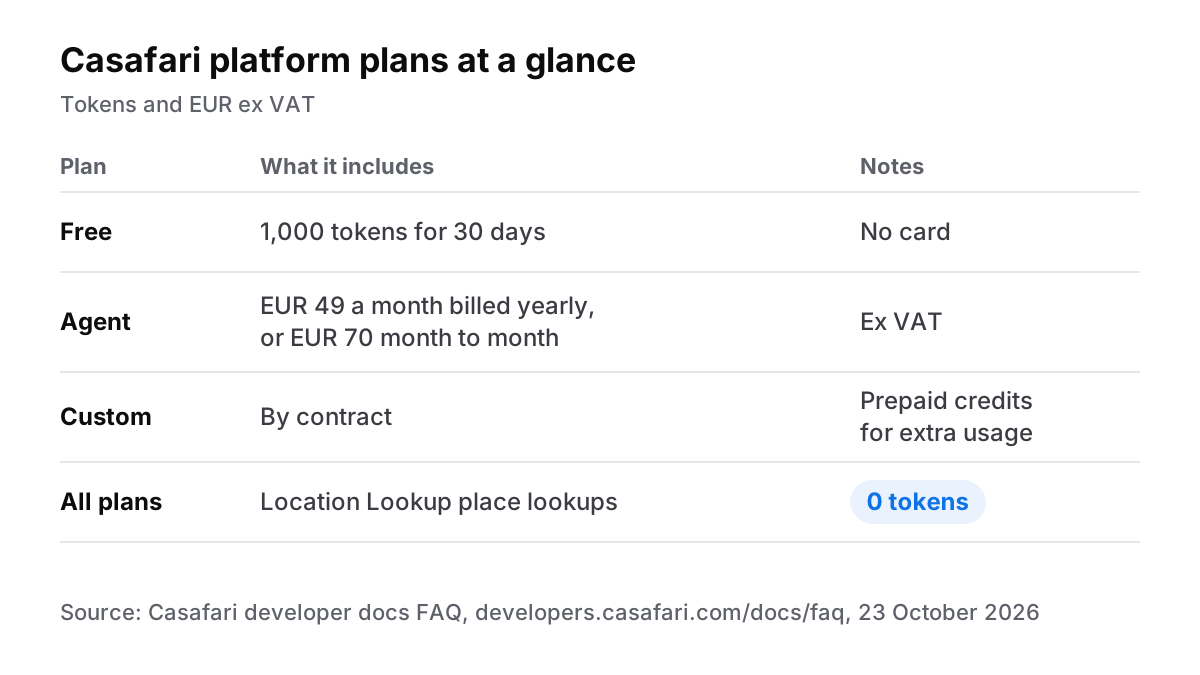
All platform requests draw from a unified token balance. According to the developer documentation as of October 2026, the Free plan provides 1,000 tokens for 30 days without requiring a credit card. The Agent plan offers ongoing allocation at €49 per month billed annually or €70 month-to-month (excluding VAT), while Custom plans are set by contract; extra usage on any plan is paid with prepaid credits. Developers can read account metrics from code with GET /v1/account, review them in the platform console or read billing and subscription help for subscription details.
REST or MCP: which one for your build?
Both interfaces query the same deduplicated property graph using the same platform token pool, though not every product exists on both: Property Sourcing and Seller Leads are REST only and AgentGraph AI is MCP only, as documented in the guide to REST and MCP parity.
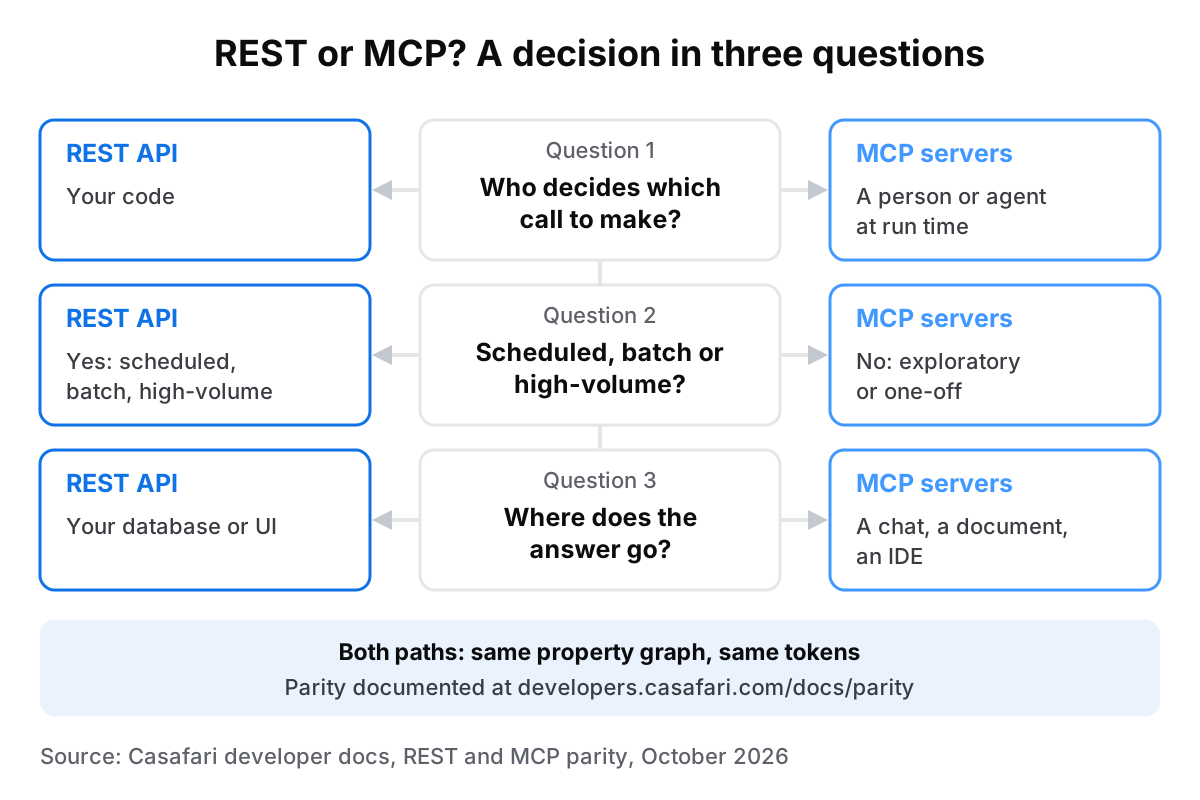
Select the REST API surface when:
- Your backend code deterministically controls application flow, such as scheduled lead pipelines, batch valuation models, or user search forms.
- You require strictly typed JSON responses mapped into your internal database schemas.
- You need precise cost governance per backend microservice.
Select CASAFARI MCP, the same data for AI agents, when:
- An AI model or human operator queries property data conversationally inside supported environments like Claude, ChatGPT, Cursor, or Claude Code.
- You are rapidly prototyping business logic before committing to a backend architecture.
- The target output format is a conversational response, generated report, or natural language summary.
A proven pattern involves prototyping analytical prompts inside an MCP client, establishing data requirements, and then implementing the production workflow via REST endpoints.
How to get a key and make the first call
To begin building, sign in to the Casafari platform to activate a Free plan tier. Generate a platform key within the console, pass it as a Bearer token in your HTTP request headers, and send a test request to GET /v1/locations/search to confirm your setup without consuming tokens. Runnable examples of that first call in curl, Python and TypeScript are in the public casafari-mcp repository on GitHub.
Explore the use-case pages on developers.casafari.com to review detailed technical specifications, or read about the advantages of CASAFARI’s property data API to plan your implementation. To evaluate full production capabilities, visit the CASAFARI Property Data APIs product page.
Frequently asked questions
What can I build with the Casafari API?
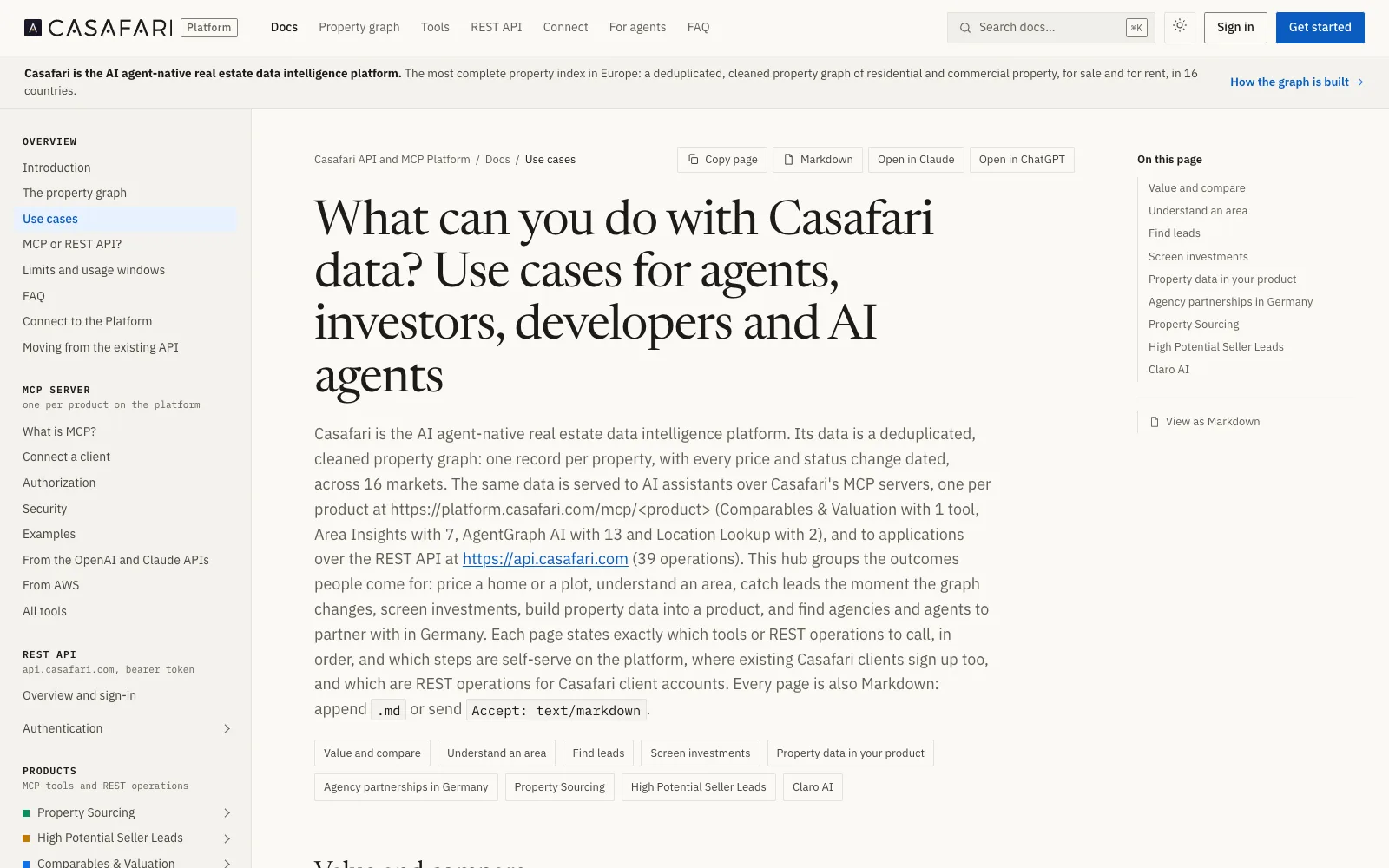
You can build automated place autocompletion using Location Lookup, neighbourhood price trends and rental yield charts using Area Insights, and unified multi-country listing searches using Property Sourcing. Additionally, you can engineer CRM lead feeds with Seller Leads, automated property valuation tools with Comparables, commercial site selection models using Claro, and programmatic usage tracking via Account endpoints. Further technical implementation blueprints are detailed on developers.casafari.com/docs/use-cases.
How is the Casafari REST API different from the Casafari MCP servers?
Both surfaces access the same underlying property graph and draw from the same platform token balance, though Property Sourcing and Seller Leads are REST only and AgentGraph AI is MCP only. The REST API is designed for deterministic, application-driven code, scheduled jobs, and backend microservices that store structured data. The MCP servers are tailored for conversational AI agents and environments like Claude, ChatGPT, and Cursor where model logic determines data queries dynamically at run time.
How much does the Casafari API cost and what are tokens?
Usage across both REST and MCP surfaces is metered using tokens. According to the developer documentation as of October 2026, the Free plan provides 1,000 tokens for 30 days with no credit card required. Paid options include the Agent plan at €49 per month billed annually (or €70 month-to-month, ex VAT) and Custom plans set by contract; extra usage is paid with prepaid credits. Location Lookup requests cost zero tokens.
Which countries does the Casafari property data API cover?
The core property graph covers residential and commercial real estate across 16 countries, encompassing both for-sale and for-rent markets with consolidated historical pricing data. Coverage varies for specialized services: Claro specifically targets commercial premises in Spain and Germany, and commercial plots in Germany.
Can I get a property valuation from the Casafari API?
Yes, automated property valuations are available through the Comparables endpoints. By passing a subject property’s coordinates, address or Spanish cadastral reference, its property type, total surface area and bedroom count, the API returns fair, fast-sell and out-of-market price estimates alongside comparable active listings, past sales and rentals, and official registry records.