CASAFARI Agentic AI
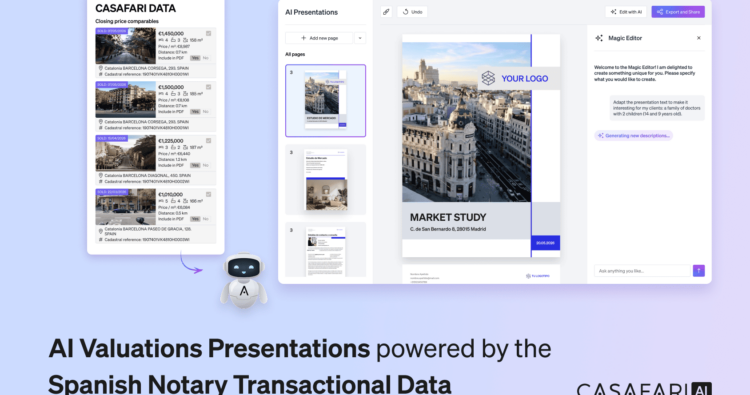
Real estate excellence is often hindered by an ‘execution trap’—where the sheer volume of follow-up and data management prevents agents from acting strategically. CASAFARI Agentic AI rewrites this narrative by serving as an autonomous partner that handles the operational workload of the modern agency.
Our market intelligence layer automates lead flow and predictive analytics, turning a chaotic to-do list into a streamlined, high-growth portfolio. This shift allows consultants to transcend the traditional agent role, evolving into global wealth advisors who use CASAFARI data to build scenarios and advise clients with long-term vision, rather than just managing daily routines.
Intro
In the heart of the Italian luxury real estate market, where a handshake often carries as much weight as a contract, the rise of Artificial Intelligence is frequently met with a mix of intrigue and traditionalist skepticism. However, for Simone D’Elia, founder of Property Finder Italia, the future of the industry doesn’t lie in replacing the “human touch,” but in using high-fidelity data to amplify it.
In this insightful conversation, D’Elia explores how leveraging CASAFARI’s extensive database and AI-driven workflows allows brokers to shed the “administrative ghosts” of manual research and repetitive follow-ups. By transforming complex market insights into seamless automations, Simone D’Elia illustrates how the broker of the future can maintain a constant, personalized presence in a client’s life without ever losing the personal connection that defines the Italian market.
The Italian real estate market is often based on deep personal relationships. In your opinion, how can Agentic AI enhance this “human touch” instead of replacing it?
I believe in Agentic AI a lot. I share this opinion in a positive way, though I don’t think the market’s view is quite as positive.
Anyway, I believe AI support can be useful, perhaps through a very polite follow-up. Let’s put it this way: creating automations that might not be perceived as AI and that are certainly very, very soft and non-invasive.
Using CASAFARI Data to Solve Pain Points and Improving the Workflows with Agentic AI
CASAFARI is known for having the most complete real estate database in more than 20 countries globally. When you think about “feeding” our new AI workflows with this data, which specific data points do you believe offer the greatest “competitive advantage” for an Italian broker?
Definitely the history of the property—meaning from the moment it was put up for sale, seeing the journey it has taken is interesting. Also, knowing if the same property is being sold by multiple agencies without having to figure it out yourself, as well as accessing properties that have been sold or removed. As far as I’m concerned, these are very interesting insights.
If you look at your team’s daily routine, what is that “administrative ghost”—the activity that most hinders their productivity—that you wish to automate with CASAFARI’s new workflows?
I would like something that continuously generates a search for similar properties every time we take on new properties to our portfolio, to create a continuous workflow with the client.
Also, I’d be interested in creating a pipeline for various clients. Because sometimes you have to follow 20–30 clients, but maybe one only follows four or five and loses the others; it becomes a bit complex to register them and then understand where to go. But CASAFARI surely has a CRM that does this.

Can you describe a moment when having immediate, AI-processed data allowed you to win a client’s trust faster than a competitor?
Yes, definitely when we propose for a buyer a property that isn’t ours, knowing that perhaps only one specific agency has that property can make a difference, because the client can say something like “Ah, I’ve already seen this property,” or maybe the opposite.
Another option: knowing the area and the competitor properties existing there without having to analyze all the portals ourselves. So, it is certainly very useful both for proposing one’s own property and for potentially performing a comparative analysis of someone else’s property.
Having a lot of data also helps us to perceive if your property is well-positioned in the market or, for example, if the client is telling you a tall tale, because if the client claims to have seen other similar properties and then you know those properties don’t exist… Obviously, you have to have the patience to analyze the data, but it’s very useful from this point of view.
Market knowledge is a competitive advantage.
Access to market data is very advantageous both because it allows you to provide a different comparative analysis of the market and the property, and certainly in terms of work speed.
When you show a potential buyer a report generated or enhanced with CASAFARI, how does the perception of your competence change?
I send Smartlinks a lot, we don’t waste much time creating brochures for properties that aren’t ours.
Having Smartlink generated by CASAFARI is very useful, both for time management and for how it is actually laid out, because it’s customizable.
Moreover, it’s clickable, so it goes to our protected area; it doesn’t just go to a random link. I used to work with generic links from portals. My colleagues used to make brochures, so they would download photos, create texts, layout everything in PDF, and send everything to the client. These are two very different ways of working. CASAFARI obviously solves all this and unifies things from this perspective.
We have our technical vision of Agentic AI automation, and you have your “on the ground” vision of the Italian luxury real estate market. Where do these two visions meet?
Well, two or three different answers here.
- Definitely a net saving in terms of time regarding lead generation operations.
- If I don’t have access to data, I wouldn’t know where the future will take me.
- Having all the data is certainly important to understand if we should acquire properties in an area, on a street or even understand for what price a certain building was sold – or not sold and then removed.
CASAFARI’s vision aligns with Property Finder when it comes to using technology as a toolstay ahead in Real Estate. By reclaiming time through automated workflows, real estate agents can shift their focus from operational routines to high-value human connections. CASAFARI’s data ecosystem has defined a new reality for the modern real estate market.
A year from now, if these AI workflows are fully implemented, how will Property Finder Italia look different from its competitors?
It would probably be in the attention given to client follow-up management. Certainly, because follow-up covers many things, but it can include branding, property acquisition, sales, mortgage sales…
You can do everything if you use CASAFARI’s workflows.
If you forget the client, they forget you immediately, on average within a month or two. So, automating the follow-up would be a secret weapon. Once the client is entered—entering as much data as possible, which you perhaps collect over time, and always updating the records—that follow-up becomes a very soft weekly, bi-weekly, or monthly chat with the client where you send them a bit of everything: branding via newsletters, congratulations on the purchase of a house… Everything automated. This way, you forget about this work load, but the client doesn’t forget about you.
Conclusions
This insightful conversation with Simone D’Elia, founder of Property Finder Italia, underscores a nuanced yet powerful truth about the future of real estate: technology, particularly Agentic AI, is not a replacement for human expertise but its ultimate amplifier. By automating essential, repetitive tasks like client follow-up and continuous property searches, agents are liberated to focus on what truly drives the Italian luxury market—building and maintaining genuine, personal relationships.
Ultimately, D’Elia sees the “broker of the future” as one who operates seamlessly within a single, unified digital environment. This integration transforms a high-volume, data-intensive job into an automated, high-touch, relationship-driven profession, ensuring that even as the market evolves technologically, the human connection remains firmly at the core of every successful transaction.