
Property valuations and collateral reviews you can defend
Chartered Surveyors, credit risk teams and loan servicers build audit-ready valuation trails and monitor real estate collateral across Europe using CASAFARI's deduplicated property graph. By generating up to 50 ranked comparables, complete asking price histories and postcode market trends in seconds, teams assemble defensible evidence trails to support—never replace—the qualified valuer's professional judgment.
How do you assemble a Red Book-ready comparable trail in minutes?
Valuers and risk analysts gain instant access to structured, transparent market evidence without cross-referencing multiple property portals. Rather than manually saving unverified portal listings with conflicting prices, professionals query CASAFARI to produce clear comparable sets tailored to specific appraisal requirements.
Using the Valuation & Market Study tool, the CASAFARI Property Data APIs, or via AI assistants using the Casafari MCP server, teams define a search radius between 0.05 km and 50 km or draw a custom polygon boundary. Searches can filter by asset category—including apartments, houses, entire residential buildings, commercial investments, or development plots.
In response, the system returns up to 50 ranked comparable properties paired with similarity scores, aggregated area statistics (average asking price, price per square metre, and days on market), official registry records where available, and three automated asking-based estimates: fast-sell, fair-market, and out-of-market prices (CASAFARI Developer Documentation, October 2026). This structured output provides a transparent evidence base for the valuer to inspect, adjust, and sign.
To learn more about integrating these inputs into valuation reports, see our guide on building CMA reports with the Comparables MCP server or review the technical workflow for valuing a property with comparables.
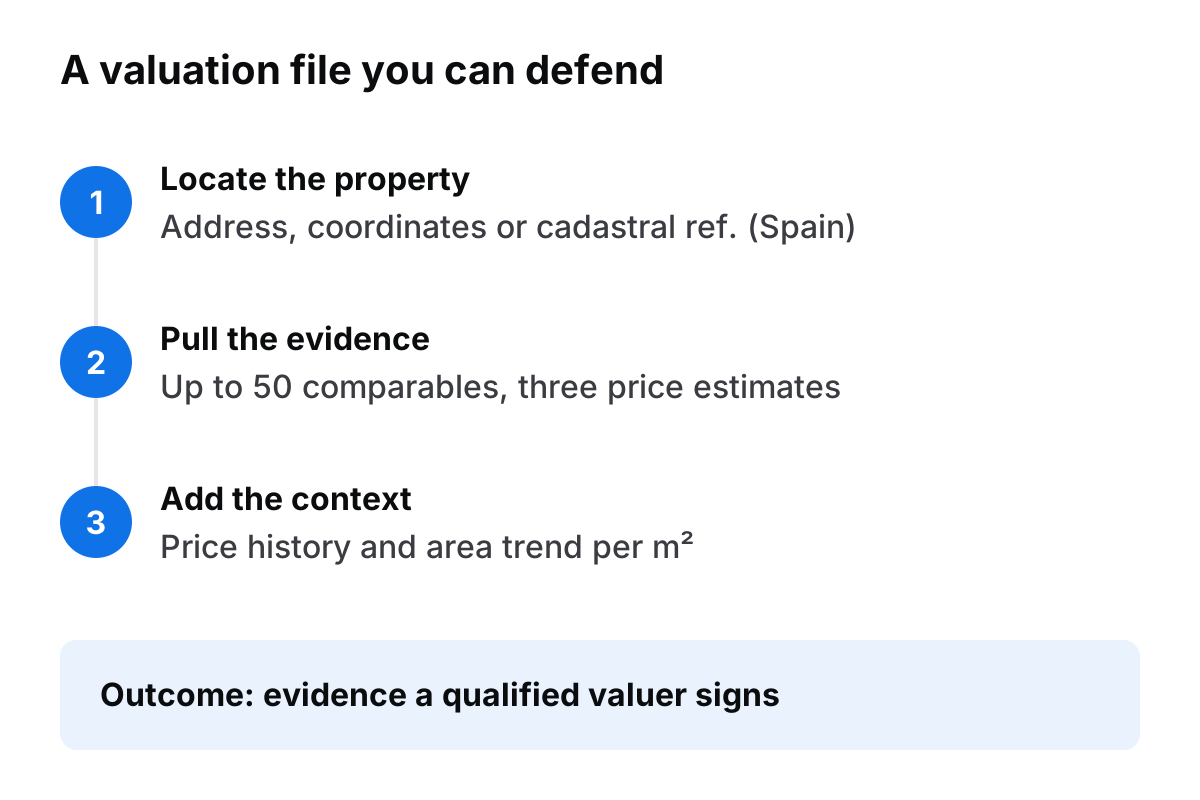
How do you value Spanish collateral straight from a cadastral reference?
Lenders, servicers, and appraisal firms assessing Spanish residential or commercial portfolios can eliminate address errors by querying property records directly through official identifiers. Rural, coastal, and urban parcel addresses in Spain frequently suffer from conflicting naming conventions across real estate portals, causing delays during collateral reviews.
Under Spain's Orden ECO/805/2003 valuation standard (Boletín Oficial del Estado, March 2026), mortgage valuations require verifying the subject asset through its 20-character cadastral reference (referencia catastral).
By passing the 20-character code directly into CASAFARI's Comparables engine, teams instantly resolve the exact coordinates and plot boundary of the parcel (CASAFARI Developer Documentation, October 2026). The query retrieves ranked comparables immediately surrounding the cadastral location, bypassing manual address matching. For step-by-step guidance, read how the Spanish cadastral reference supports property valuations or inspect the workflow for valuation by cadastral reference in Spain.
What has happened to this asset's asking price and status over time?
Credit risk teams and workout specialists gain complete visibility into an asset's market timeline, revealing hidden illiquidity or previous overpricing before sign-off. Assessing high-value commercial loans or non-performing residential books requires knowing whether collateral has spent months on the market undergoing multiple price markdowns across different agencies.
By submitting a listing URL or agency reference via the web application or REST API, teams retrieve a single deduplicated property record. CASAFARI merges every listing of that asset across portals into one consolidated timeline.
The resulting record details every dated asking price adjustment, along with status changes across active, reserved, hold, sold, and rented states (CASAFARI Developer Documentation, October 2026). This historical record allows valuers to verify market sentiment and document liquidity trends. Technical teams can learn more about looking up a property's full price and status history.
How do you monitor portfolio collateral values across postcodes and regions?
Risk departments and loan servicers can continuously monitor collateral values and detect regional market declines before formal regulatory revaluations are triggered. Under the Bank of England PRA Basel 3.1 standards (PS9/24) (January 2026), UK banks must obtain an updated property valuation at least once every five years, or every three years for material loans exceeding GBP 2.6 million or 5% of the firm's own funds.
With Area Insights, risk teams analyze postcode-level asking price per square metre trends, stock volumes, and time-on-market metrics across European regions.
For enterprise-wide risk pipelines, Data Exports delivers the deduplicated property graph directly into a dedicated Google Cloud Storage bucket as standard Avro files (CASAFARI Developer Documentation, October 2026). This clean data stream feeds directly into internal automated monitoring models, notifying credit officers whenever market shifts require a formal valuer review. Further details are available in the Data Export technical documentation.
How to start with CASAFARI
Getting started with CASAFARI's valuation data requires no complex setup. Teams can test the platform through self-serve onboarding, beginning with a Free plan that includes 1,000 tokens valid for 30 days without requiring a payment card.
As workflow requirements grow, users can upgrade directly within the console to the Agent plan at EUR 70 per month (or EUR 49 per month billed annually), or qualify for Enterprise and Custom tiering directly inside the account dashboard.
To begin building defensible valuation evidence trails, sign in to the CASAFARI platform or visit developers.casafari.com to review documentation.
Frequently asked questions
Does CASAFARI replace a qualified valuer under RICS Red Book or EBA rules?
No, CASAFARI does not replace a qualified valuer. Regulatory frameworks and professional standards require a qualified, independent valuer to maintain final professional responsibility for formal valuations and revaluations. CASAFARI supplies deduplicated comparable evidence, property history, and market statistics so the valuer can verify inputs, apply adjustments, and document audit trails efficiently.
Are CASAFARI figures asking prices or completed transaction prices?
CASAFARI primarily tracks asking prices, price adjustments, and market statuses deduplicated across portals and estate agencies, accompanied by official registry records where available. Valuers use live asking price dynamics and time-on-market data to analyze current supply and seller sentiment alongside historical registry records.
Can we value commercial real estate and development plots as well as residential homes?
Yes, CASAFARI supports commercial and land appraisals alongside residential properties. When querying Comparables via the web app, REST API, or Casafari MCP, you can select asset types such as commercial buildings, investment assets, and development plots in addition to apartments and houses.
Which countries does CASAFARI cover for cross-border collateral monitoring?
CASAFARI's property graph covers 16 countries: 14 in Europe (Andorra, Austria, Belgium, Switzerland, Germany, Spain, France, Greece, Italy, Luxembourg, Monaco, Poland, Portugal, and San Marino), the United Arab Emirates, and the United States, where CASAFARI is entering now: selected states, commercial real estate only, via Claro AI.
How does bulk Data Export integrate with a bank's internal risk warehouse?
CASAFARI Data Export delivers the deduplicated property graph in bulk as standard Avro Object Container Files directly into a dedicated Google Cloud Storage bucket per account and country. Credit risk engineering teams can ingest these structured data feeds directly into internal risk warehouses and collateral monitoring engines.
See it on your own market
1,000 free tokens for 30 days, no card. Then the Agent plan or prepaid tokens.