
Portals and proptech: build on the property graph, not a scraper
Product and engineering teams can launch deduplicated property search, link resolution, and grounded AI tools in days on the CASAFARI property graph. By integrating via REST APIs, OpenAPI specs, or remote Model Context Protocol (MCP) servers, teams avoid building complex scraping pipelines, accessing clean property data, asking price histories, and location boundaries directly.
How do you ship property search in your app without building a data pipeline?
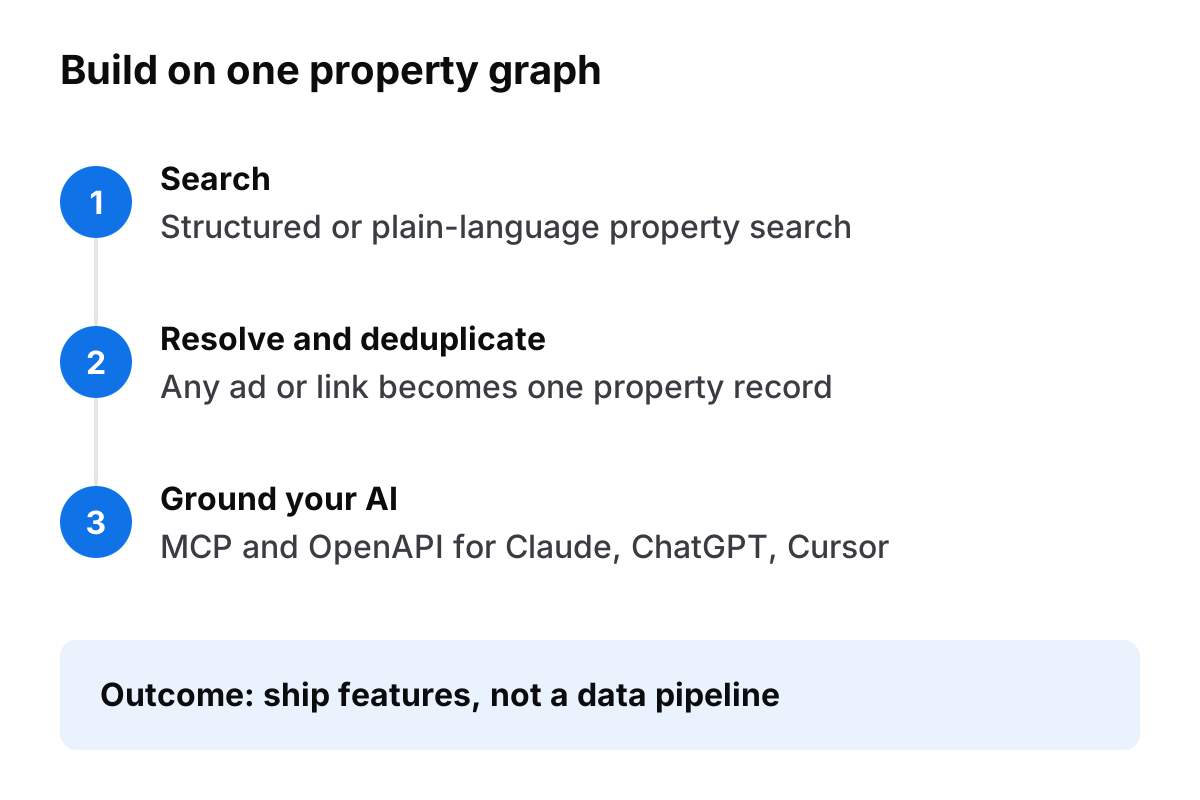
Instead of devoting engineering cycles to building and maintaining brittle web scrapers across national boundaries, engineering teams can deliver a unified property search experience within days. CASAFARI aggregates, normalises, and deduplicates listings into a single property graph so product leaders can focus on user experience rather than data infrastructure.
To build an effective search workflow, applications should begin by resolving places first with Location Lookup over MCP and REST. Calling GET /v1/locations/search or resolving coordinates consumes 0 tokens while returning unique location identifiers. For apps requiring precise spatial filtering, fetching polygon geometries via POST /api/v1/references/zipcode-boundary allows developers to pass custom boundaries directly into property queries, as shown in the property search API use case in the developer documentation (October 2026, CASAFARI Developer Documentation).
With location parameters established, your application queries Property Sourcing through structured filters using POST /v1/property-sourcing/searches or via natural language using POST /v1/property-sourcing/searches/describe. Every query returns clean property objects representing deduplicated physical assets.
How do you resolve a portal link or ad ID to one property and its full history?
Real estate CRM systems and property portals frequently encounter duplicate records. A client forwards a web link from a third-party portal to an agent, or five different brokerage feeds submit listings for the exact same apartment at varying asking prices. Resolving these inputs to a single source of truth usually requires complex heuristic algorithms.
CASAFARI solves this deduplication challenge upstream. Applications can submit a client-forwarded URL or portal reference to POST /v1/property-sourcing/properties/resolve (25 tokens) to obtain a canonical property identifier (prop_...). Alternatively, platforms ingesting advertisement IDs in bulk can map them via POST /api/v1/properties/match-by-listings as described in matching advertisements to one property record.
Once the property identifier is returned, requesting GET /v1/property-sourcing/properties/{property_id}?expand=listings,history (10 tokens) retrieves every active listing, advertising agency, and historical asking price change. Note that this endpoint details asking price history across listings, while CASAFARI also integrates closing prices from open data, notaries, and client reports, providing complete transparency over market positioning over time, as detailed in resolving client-forwarded links to a single property (October 2026, CASAFARI Developer Documentation).
How do you give an AI assistant a grounded property tool that never hallucinates?
Large language models often struggle with real estate intelligence because they lack access to structured, live data. Without deterministic constraints, assistants invent square meterage, fabricate asking prices, or fail ungracefully when hitting rate limits.
Building a reliable real estate AI assistant requires no proprietary SDK installation. Developers can equip LLM frameworks using standard developer surfaces via standard specifications at platform.casafari.com/v1/<product>/openapi.json, tools.json, and llms.txt. Using these specs, agents query endpoints directly via CASAFARI Property Data APIs. The assistant resolves locations first, executes plain-language queries via POST /v1/property-sourcing/searches/describe, and inspects price history using verified property identifiers.
For production resilience, CASAFARI endpoints return structured RFC 9457 problem+json error payloads designed specifically for autonomous agent handling, as documented in building a grounded property tool for an AI assistant (October 2026, CASAFARI Developer Documentation). When an assistant encounters HTTP status 429 (request_limit_reached), it reads the specified wait window and pauses automatically. If it receives HTTP status 402 (payment_required), it extracts the upgrade_url field to present a seamless top-up prompt directly to the human user.
How do you connect Claude, ChatGPT, Cursor or Gemini CLI to Casafari MCP?
Product managers, data analysts, and software engineers can bring live property data into their existing workspaces without writing integration code or handling API keys. CASAFARI operates remote Model Context Protocol (MCP) servers across its product suite, accessible at https://platform.casafari.com/mcp/<product> for locations, area insights, comparables, AgentGraph, and Claro.
Authentication uses standard OAuth 2.1 browser flows, issuing secure OAuth access tokens directly to the client without exposing credentials in environment files. When deciding how to integrate, team leads can review guidelines on choosing between the Claro app, MCP server and REST API.
These remote servers work natively with Casafari MCP for AI agents across environments including Claude (desktop, web, and mobile), Claude Code, ChatGPT developer mode, Cursor (~/.cursor/mcp.json), and Gemini CLI, as explained in connecting Claude, ChatGPT, Cursor and Gemini CLI to Casafari MCP (October 2026, CASAFARI Developer Documentation).
How do you embed the Claro AI search box on your site in minutes?
For portals and proptech applications seeking to offer natural-language commercial or residential property search without engineering a custom frontend interface, the Claro AI search box provides a turn-key option.
By adding the script tag /embed.js to a web application, frontend teams can authenticate search requests via POST /v1/embed/search (or the search_premises MCP tool) using a publishable key prefixed with pub_. This key is restricted to authorised web domain origins and delivers up to 50 deduplicated results per page, as noted in embedding the Claro AI search box with a publishable key (October 2026, CASAFARI Developer Documentation).
In terms of geographical coverage, CASAFARI's property graph covers 16 countries = 14 in Europe (Andorra, Austria, Belgium, Switzerland, Germany, Spain, France, Greece, Italy, Luxembourg, Monaco, Poland, Portugal, San Marino), the United Arab Emirates and the United States, where CASAFARI is entering now: selected states, commercial real estate only, via Claro AI.
How do you start building on CASAFARI today?
Integrating deduplicated property data into your portal, proptech platform, or AI application requires no long procurement cycles. Development teams can self-serve access immediately by choosing to sign in to the CASAFARI platform.
New developer accounts begin on the Free plan, which provides 1,000 tokens valid for 30 days with no credit card required. This allowance enables full testing of Location Lookup, Property Sourcing endpoints, and MCP connectors. As query volume grows, applications can scale seamlessly on the Agent plan at EUR 70 per month (or EUR 49 per month billed annually) or upgrade usage parameters directly within the platform console.
Frequently asked questions
Does CASAFARI provide an npm or Python SDK for its APIs?
No, CASAFARI does not ship npm or PyPI SDKs. Instead, every product exposes a standard OpenAPI specification at platform.casafari.com/v1/
How does CASAFARI deduplicate listings from different property portals?
CASAFARI aggregates listings from portals and agency websites, grouping every advertisement for the same physical asset into a single property record (prop_...). Using POST /v1/property-sourcing/properties/resolve or POST /api/v1/properties/match-by-listings, your application maps any portal link or advertisement ID to that single record. This allows you to retrieve all active listings, agencies, and asking price histories for the property.
What happens when an AI agent hits a rate limit or runs out of tokens?
All self-serve endpoints return structured RFC 9457 problem+json error payloads designed specifically for autonomous agents. When an agent receives HTTP status 429 (request_limit_reached), the payload specifies the exact retry window to wait before retrying the call. When it receives HTTP status 402 (payment_required), the response includes an upgrade_url parameter that the assistant can surface directly to the user.
Which countries does the CASAFARI property graph cover?
CASAFARI's property graph covers 16 countries = 14 in Europe (Andorra, Austria, Belgium, Switzerland, Germany, Spain, France, Greece, Italy, Luxembourg, Monaco, Poland, Portugal, San Marino), the United Arab Emirates and the United States, where CASAFARI is entering now: selected states, commercial real estate only, via Claro AI.
How much does it cost to test the CASAFARI API and MCP servers?
You can sign in at platform.casafari.com/signin and start on the Free plan, which includes 1,000 tokens for 30 days with no credit card required. Location Lookup calls cost 0 tokens, resolving a client link costs 25 tokens, and paid plans start with the Agent plan at EUR 70 a month or EUR 49 a month billed yearly.
See it on your own market
1,000 free tokens for 30 days, no card. Then the Agent plan or prepaid tokens.