
Real estate prospecting: strategies and why you should do it

Real estate prospecting generates a steady flow of leads and commissions by setting clear weekly or monthly goals, allocating dedicated time, focusing on a familiar local area, targeting specific seller profiles, and tracking routes and results with tools such as CASAFARI CRM and CASAFARI GO.
Why is real estate prospecting important in your routine?
Real estate prospecting is essential to keep your business healthy in the long term and increase brand recognition. In the end, an estate agent must be able to have an income after their job with their current clients is done.
Prospecting provides the agent with a constant flow of new clients, keeping your real estate commissions steady (or even making them grow), while still raising the chances of these clients recommending your services to their friends, relatives and acquaintances in the future.
And, if you think about the agency as a whole, real estate prospecting allows the business to have a greater predictability and stability for the company’s revenues, making planning for the long term easier.
Meaning, brokers that encourage their agents to be constantly prospecting are able to plan the expansion of their team, the distribution of bonuses, the launch of new agencies, marketing or any other kind of initiatives.
Real estate leads: 21 ways to source potential clients
Real estate prospecting strategies: what should you have in mind
1. Goals
The only way for you to be sure your initiatives of prospecting for real estate are successful is to set goals. Define how many real estate leads you want to add to your funnel of new clients weekly or monthly and challenge yourself.
This is also a good way to keep the consistency of your prospection.
2. Consistency
Every estate agent knows that selling or buying a house for a client is something that could take months, which gives us one more reason why real estate prospecting should be a constant effort.
The results of your work are not immediate, so you need to keep the business going to make sure your real estate commissions and the agency’s revenue keep coming.
So, don’t deal with this task as something that can be left behind after you collect a certain amount of leads or that is less important than any other.
3. Time allocation
If you are going to be prospecting for real estate on a regular basis, you should allocate time on your schedule for this task so it really gets done. And, since we talked about goals, make sure that the time allocated is enough to reach the number of real estate leads you need monthly and stick to what’s been planned.
Another relevant point for successful real estate prospecting initiatives is regarding the time of the day that you choose to approach potential clients. When you begin to prospect, make sure to explore different moments throughout the day to understand what works best for you and your leads.
4. Choosing an area
Be strategic about where you are going to start your real estate prospecting efforts. Define an area in which you have a lot of experience: the more knowledgeable you are about an area, the more useful you can be to the real estate leads found on your way, so it increases your chances of converting them into actual clients.
5. Potential clients
When prospecting for real estate, you can target:
- People that don’t know you or your agency,
- People that got in touch with you as a recommendation from former clients,
- People trying to sell their properties without much success,
- People who want to sell their property, but don’t know where to start or are afraid of this getting too complicated,
- People that had the intention of selling a property in the past, but were not 100% convinced.
You will find many different types of people, with the most varied needs and multiple levels of knowledge about real estate as well. So, test different approaches with each kind of client and see what works best for you and for them in order to conquer their trust.
6. Results
In order to see if your time prospecting for real estate is being well spent, you have to measure the results of your actions. Looking at the data you will be able to optimise your work, sticking to the strategies and routes of prospection that are providing the best results.
Keep track of the routes you went through, which new leads you got, their interests and every other information that might help you seal a deal.
And here’s where CASAFARI GO, a powerful feature of CASAFARI CRM, comes to your aid.
How CASAFARI GO boosts your prospection efforts
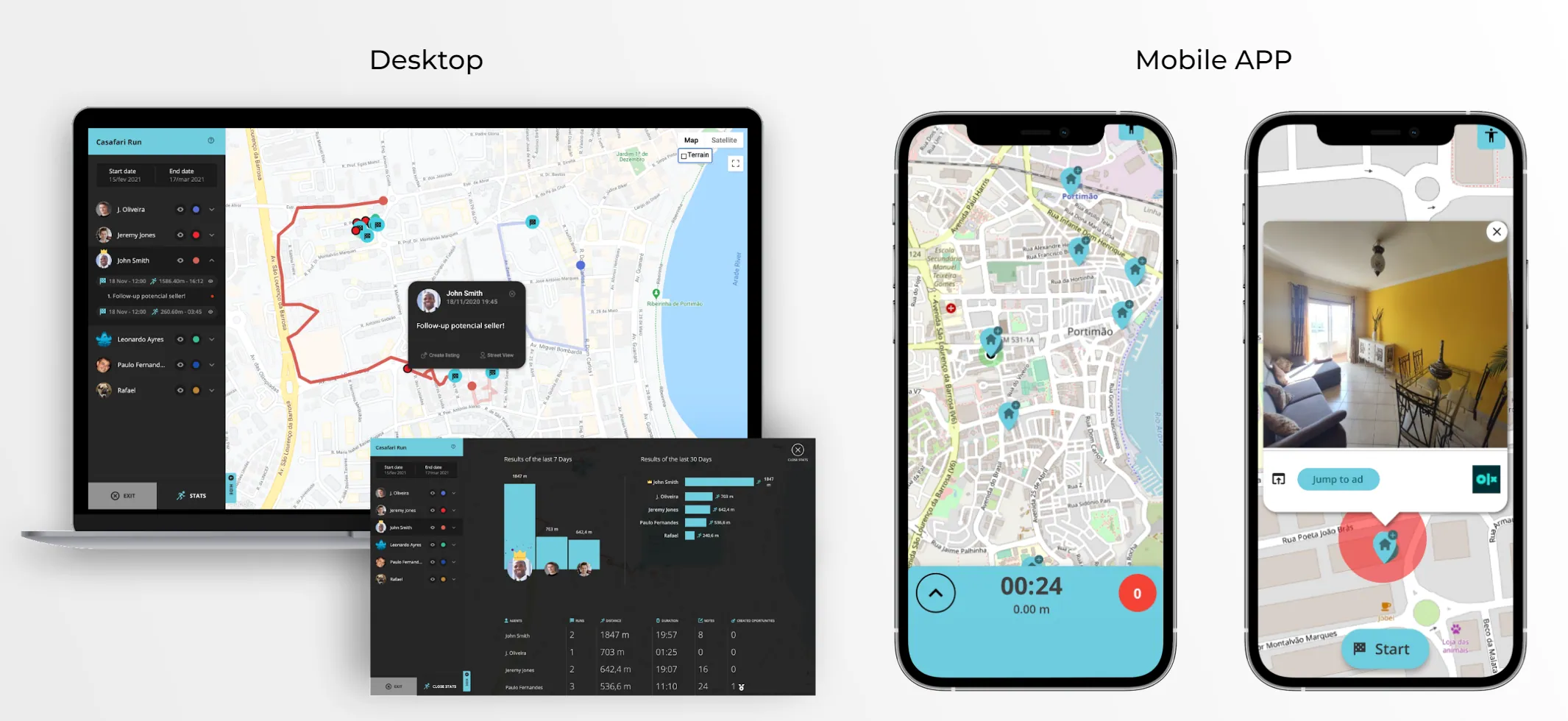
CASAFARI GO is a feature designed to make real estate prospecting an efficient task. It allows you to:
- find the routes with more properties for sale by the owner (FSBO) around you and call the owners instantly,
- see all the routes taken, statistics of the success and opportunities found by all professionals in your agency,
- automate saving the information of a lead to your CRM,
- add notes and photos to your app to approach clients in the future.
And all you have to do is press “GO” on your CASAFARI CRM app.
CASAFARI GO: Real estate prospecting made easier
CASAFARI GO concentrates and organises your real estate prospecting efforts on a platform that the agent is already used to, gamifying the process for professionals of the same agency to increase lead generation.
Interested in testing this feature of CASAFARI CRM? Activate CASAFARI GO with your account manager and start real estate prospecting with all these resources at your disposal.
Photo by LinkedIn Sales Solutions on Unsplash
Frequently asked questions
Why is consistent real estate prospecting important for an estate agency?
Consistent real estate prospecting secures a steady flow of new clients and commissions once active transactions close. It increases word-of-mouth referrals from satisfied clients over time. Furthermore, consistent prospecting gives an agency predictable revenue, making it easier to plan team expansion, bonuses, and marketing initiatives.
How should an estate agent structure a real estate prospecting routine?
To structure an effective prospecting routine, estate agents should set clear weekly or monthly targets for new leads and allocate dedicated time in their schedule to meet them. Exploring different times of day helps identify when potential clients are most responsive. Focusing on a specific geographical area where the agent has strong local expertise further improves lead conversion.
Which potential clients should estate agents target when prospecting?
Estate agents can target several profiles during prospecting, including people unfamiliar with the agency and referrals from past clients. They should also reach out to owners struggling with for-sale-by-owner (FSBO) listings, homeowners hesitant about complex sales processes, and vendors who postponed selling in the past. Testing tailored approaches for each profile helps build trust quickly.
How does CASAFARI GO help estate agents during field prospecting?
CASAFARI GO identifies field routes with high concentrations of for-sale-by-owner properties, enabling agents to contact sellers directly. It logs team routes and success statistics to track agency performance. Additionally, lead notes and photos captured on the go are automatically saved into CASAFARI CRM.
How can agencies automate seller lead generation alongside field prospecting?
Alongside field prospecting with CASAFARI GO and CASAFARI CRM, agencies and technical teams can automate property lead capture using CASAFARI Seller Leads. Detailed integration guides are available in the Seller Leads API documentation on developers.casafari.com (in English). Teams can also sign in to the CASAFARI platform to configure lead workflows and track private listings.