
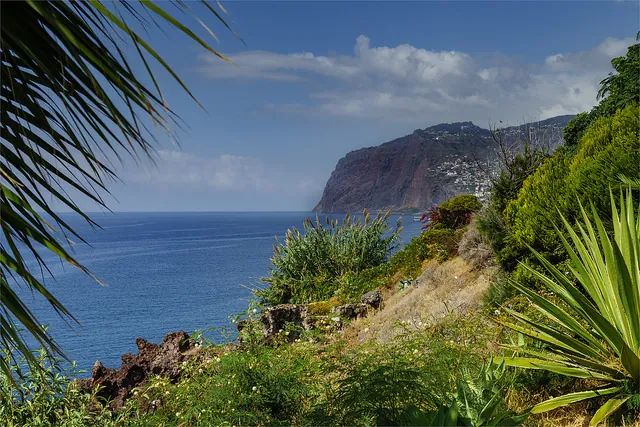
The Autonomous Region of Madeira is one of Portugal’s most resilient property markets, where average asking prices from listings indexed by CASAFARI Area Insights reached €4,102/m² for apartments (+12.5% year on year) and €3,267/m² for houses (+11.6% year on year) in Q3 2026. Official closing data from INE and DREM for Q2 2026 records a median transaction price of €2,816/m² across the archipelago and €3,636/m² in Funchal.
Where is Madeira and how well connected is the archipelago?
Positioned in the North Atlantic Ocean west of Morocco and southwest of mainland Portugal, the Autonomous Region of Madeira forms an integral part of the national property landscape, complementing mainland trends covered in the broader guide to buying property in Portugal. The archipelago consists of two inhabited islands—Madeira and Porto Santo—along with two uninhabited nature reserve sub-archipelagos, the Desertas and the Selvagens.
Connectivity is exceptionally strong for an island region. Madeira Cristiano Ronaldo Airport (FNC) links the capital and surrounding municipalities via 26 scheduled airlines to 65 destinations across 24 countries, offering flights to Lisbon in under two hours, direct links to major European hubs, and long-haul connections such as United Airlines flights to New York/Newark and airBaltic services to Tallinn (ANA Aeroportos de Portugal, 2025/2026). For inter-island travel, passengers can reach Porto Santo in 15 to 25 minutes via daily Binter Canarias flights or take the Porto Santo Line ‘Lobo Marinho’ car ferry, which crosses in two hours and fifteen minutes to two hours and thirty minutes.
What is it like to live in Madeira?
Demographic momentum in the region remains robust. According to data published by the Direção Regional de Estatística da Madeira (DREM) in June 2026, the resident population reached 266,130 as of 31 December 2025, marking the highest figure in fourteen years and continuing seven consecutive years of regional population growth. Within this total, foreign nationals account for 19,371 residents—representing 7.3% of the regional population—more than doubling since 2021. Over half of these foreign residents (10,193 people) reside in Funchal, which supports a total population of approximately 113,300 and a density of 1,488.4 inhabitants per square kilometre (DREM, 2025).
Life in Madeira revolves around its dramatic subtropical microclimates, outdoor pursuits along the historical network of irrigation channels known as levadas, and the ancient Laurissilva subtropical forest. Covering roughly 15,000 hectares (about 20% of the main island), the forest has been protected as a UNESCO World Natural Heritage site since December 1999 (IFCN Madeira, 2026). For residents seeking a different pace, neighbouring Porto Santo offers a nine-kilometre stretch of golden sand and a calmer coastal environment.
Housing stock, key municipalities and who buys in Madeira
Property choices across the archipelago vary considerably by geography. In Funchal—particularly in the sought-after parish of São Martinho, the Lido, Ajuda, and the historic Sé and Santa Maria Maior parishes—buyers find contemporary ocean-view apartments, secure gated developments, and traditional refurbished quintas. Moving along the sunny south-west coast through Câmara de Lobos, Ribeira Brava, Ponta do Sol, and Calheta, international buyers and remote professionals frequently target modern cliffside villas with infinity pools or historic stone houses awaiting renovation. Further afield, Machico, Santa Cruz, the greener northern slopes of São Vicente and Santana, and Porto Santo provide alternative residential settings.
Official transaction records from DREM and INE for the full year 2025 indicate that 90.0% of residential properties in Madeira were acquired by buyers with tax residency in Portugal, encompassing both domestic purchasers and expatriates who have established local tax residency. Buyers with a foreign tax domicile accounted for the remaining 10.0% of transactions, split between 5.7% from EU member states and 4.3% from non-EU jurisdictions. The leading foreign resident communities choosing to settle in Madeira originate from Venezuela (15.5%), Brazil (10.1%), Nepal (7.9%), Germany (7.0%), and the United Kingdom (6.2%), according to DREM statistics.
Madeira property market: asking prices, closing prices and rents in 2026
Analysing property values in Madeira requires a clear distinction between listing asking prices and official transaction data. Figures from CASAFARI Area Insights for the Autonomous Region of Madeira (location id 4115, encompassing both Madeira island and Porto Santo with statistical outliers excluded, queried on 25 October 2026) show that apartments for sale commanded an average asking price of €4,102/m² in Q3 2026, representing a 12.5% increase year on year from €3,646/m² in Q3 2025. Houses for sale recorded an average asking price of €3,267/m² in Q3 2026, up 11.6% year on year from €2,927/m² in Q3 2025. The higher per-square-metre asking price for apartments reflects a strong concentration of luxury, newly built developments equipped with swimming pools and underground parking in prime Funchal locations, compared to larger, detached houses dispersed across rural municipalities.
These listing metrics contrast with official closing prices reported by INE and DREM for Q2 2026. The median closing price (actual transaction price) for family dwellings sold across the Autonomous Region of Madeira reached €2,816/m²—an 18.3% increase year on year—yielding a 12-month median of €2,690/m², which breaks down to €3,265/m² for new builds and €2,571/m² for existing homes (JM Madeira, Q2 2026). Within Funchal, the median closing price hit €3,636/m² in Q2 2026, led by the parish of São Martinho at an average of €4,230/m² over the preceding twelve months. Median bank valuations compiled by INE and DREM stood at €2,625/m² across Madeira and €2,911/m² in Funchal in August 2026.
Rental markets have shown comparable upward pressure. According to official lease registration statistics from INE and DREM for Q2 2026, the median monthly rent on new residential lease agreements in Madeira reached €12.78/m²—a 17.4% increase year on year and the second-highest regional rent level in Portugal after Greater Lisbon. Rents averaged €14.81/m² for T0 and T1 units, €12.72/m² for T2 units, and €11.36/m² for T3 properties. In Funchal, the median rent rose to €14.49/m² per month, representing a 17.0% annual increase across 294 new contracts (INE / DREM, Q2 2026).
Professionals and analysts seeking deeper granularity can explore the Area Insights API and MCP documentation for automated data extraction.
Taxes, residency and short-let rules every buyer in Madeira must know
Property acquisitions in the archipelago are subject to specific regional taxation rules. Under Law 21/90, IMT (Imposto Municipal sobre as Transmissões Onerosas de Imóveis) property transfer tax brackets in Madeira are set 25% higher than those on mainland Portugal. Under the 2026 tax tables (Law 73-A/2025, Table IV published by PwC Portugal), primary residences benefit from a 0% IMT rate up to €132,933, progressing to a single 6% rate between €826,228 and €1,438,566, and 7.5% for values exceeding €1,438,566. First-time buyers aged 35 or under purchasing a primary home under the IMT Jovem framework enjoy complete exemption from both IMT and Stamp Duty up to €413,174. However, international buyers who are not tax residents in Portugal are subject to a flat 7.5% IMT rate from the first euro under Decree-Law 97/2026, alongside a standard 0.8% Stamp Duty (Imposto do Selo) on the purchase price.
Short-term rental investments are governed by strict municipal frameworks. Following national Decree-Law 76/2024, the Municipality of Funchal approved its local Alojamento Local regulation (Regulamento n.º 787/2026) in June 2026. As a general rule, new Alojamento Local registrations for apartments or hostels located within multi-family residential buildings under horizontal property regimes are prohibited in Funchal. Exceptions apply only to buildings over thirty years old or properties situated within designated Urban Rehabilitation Areas (ARU) that undergo certified structural rehabilitation works. Additionally, active licence holders must submit annual proof of civil liability insurance to the RNAL portal, a mandatory requirement enforced since March 2025 (Câmara Municipal do Funchal).
Regarding residency and taxation, purchasing real estate in Madeira no longer qualifies foreign investors for the Portuguese Golden Visa (ARI), which was restructured under Law 56/2023 in October 2023. Qualifying investments now require non-real-estate vehicles such as €500,000 in eligible investment funds or scientific research, or €250,000 in cultural heritage. Similarly, the IFICI tax regime offering a 20% flat IRS rate on qualifying local income and foreign income exemptions for ten years requires establishing Portuguese tax residency and working in a certified high-value profession, scientific research, startup, or regional corporate activity in Madeira, rather than simply acquiring residential property.
How CASAFARI helps buyers, investors and agents in the Madeira market
Navigating Madeira’s diverse real estate landscape—from prime new developments in Funchal to rural estates in the north—requires reliable, clean data that bridges asking prices and transaction realities. Investors and real estate agents utilise CASAFARI Area Insights to monitor supply shifts and price movements across the archipelago.
To conduct comprehensive valuations and comparative market analyses that pair listing data with transactional benchmarks, professionals rely on the property valuation and market study tool. Meanwhile, buyers’ agents deploy CASAFARI Property Sourcing to track deduplicated inventory and historical price adjustments across portals. For insights into how market professionals combine listing figures with closed transaction data, read the guide on combining asking prices with transactional closing data.
Explore these analytical tools directly by visiting and choosing to sign in to the CASAFARI platform.
Frequently asked questions
Can you still get a Portuguese Golden Visa by buying property in Madeira?
No. Since the implementation of Law 56/2023 in October 2023, purchasing residential or commercial real estate anywhere in Portugal, including Madeira and Porto Santo, no longer qualifies for the Golden Visa programme. Investors seeking residency by investment must direct funds into non-real-estate options, such as €500,000 in regulated investment funds or scientific research, or €250,000 in cultural heritage projects.
How does IMT property transfer tax work in Madeira in 2026?
Madeira applies IMT property transfer tax brackets that are 25% higher than mainland Portugal under Law 21/90. Under 2026 regulations (Law 73-A/2025), primary residences benefit from a 0% rate up to €132,933, while eligible buyers aged 35 or under buying their first home enjoy an exemption up to €413,174. Non-tax-resident buyers are subject to a flat 7.5% IMT rate from the first euro under Decree-Law 97/2026, plus a 0.8% Stamp Duty.
Can I get an Alojamento Local short-let licence for an apartment in Funchal?
Generally no. Following national Decree-Law 76/2024, Funchal enacted its Municipal Alojamento Local Regulation (Regulamento n.º 787/2026) in June 2026, prohibiting new short-let registrations for apartments and hostels in multi-family residential buildings. Exceptions are restricted to buildings older than thirty years or properties within Urban Rehabilitation Areas (ARU) undergoing certified rehabilitation works.
Who is buying property in Madeira and which areas are most in demand?
Official 2025 statistics from DREM and INE show that 90.0% of residential properties in Madeira were bought by individuals with Portuguese tax residency, while 10.0% were acquired by buyers with foreign tax domiciles (5.7% EU and 4.3% non-EU). Buyer demand is heavily concentrated in Funchal—especially the parish of São Martinho—as well as the sunny south-west municipalities of Câmara de Lobos, Ribeira Brava, Ponta do Sol, and Calheta.
What should I be aware of regarding the property types and locations when looking for a home in Madeira?
Property options are quite diverse, ranging from contemporary apartments with ocean views and gated developments in Funchal’s popular parishes of São Martinho and the Lido to traditional stone houses and villas in south-western areas like Calheta. If you prefer a quieter, greener setting, you might consider looking towards the northern slopes in municipalities such as São Vicente and Santana, or the distinct coastal environment of Porto Santo.
How do property prices in Madeira compare between new builds and existing homes?
According to closing price data from INE and DREM for the 12-month period leading up to Q2 2026, there is a clear difference in market value depending on the property’s age. The median closing price across the region was €2,690/m², which consists of €3,265/m² for new constructions and €2,571/m² for existing residential properties.