
LA SALUT PROPERTY GUIDE
Combination of a tranquil lifestyle and stunning views of the cityscapes
La Salut is Gràcia’s elevated hillside neighbourhood in Barcelona, offering a quiet, family-oriented residential alternative to Vila de Gràcia. According to CASAFARI Area Insights, the average asking price for apartments for sale stood at €5,265 per square metre in Q3 2026 (down 3.7% year on year from €5,466 in Q3 2025), while asking rents averaged €28.0 per square metre per month, providing international buyers with a tranquil hillside retreat backed by robust municipal data.
Where is La Salut and how is it connected to central Barcelona?
La Salut stretches across the southern slopes of the Carmel and Rovira hillsides, sitting immediately above Vila de Gràcia and Camp d’en Grassot i Gràcia Nova. The neighbourhood shares borders with Vallcarca i els Penitents, El Coll, and the districts of Sarrià-Sant Gervasi and Horta-Guinardó. For a broader perspective on the area, you can explore the Gràcia district guide.
Day-to-day mobility requires navigating the neighbourhood’s topography. There is no metro station strictly inside La Salut’s perimeter, so residents walk to boundary stations such as Lesseps and Vallcarca (Line 3) on the western edge or Alfons X (Line 4) to the east. For the steep gradients, residents rely on TMB bus routes H6, D40, V19, 24 and the neighbourhood minibus 116. Medium-term infrastructure upgrades will improve this connectivity: the central tunnel boring machine for Metro Lines 9 and 10 passed under a kilometre from Lesseps in August–September 2026 (scheduled to open in 2030), while the Sanllehy station shaft on the eastern border is scheduled for service in 2031, as reported by El Periódico.
What is it like to live in La Salut?
Named after the 19th-century Sanctuary of Mare de Déu de la Salut, the neighbourhood evolved from a summer retreat of farmhouses and bourgeoisie villas into a calm, leafy residential quarter. Unlike the dense, bohemian streets of Vila de Gràcia below, La Salut offers quiet sloping streets, resident-only traffic exclusion zones around Park Güell, and recent street-calming projects around Carrer Massens, Sant Cugat del Vallès and Avinguda Pompeu Fabra.
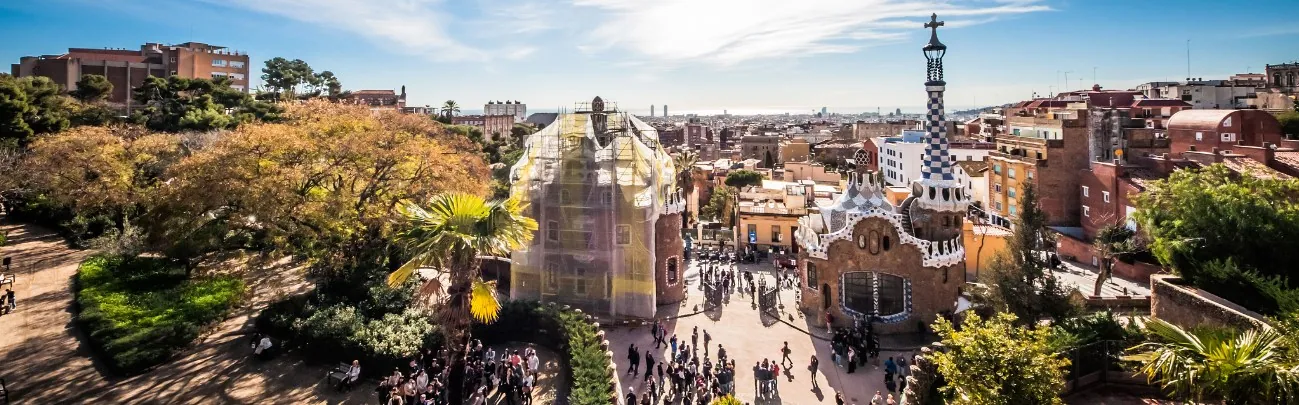
Everyday amenities include shopping along the remodelled Travessera de Dalt, fresh produce markets near Lesseps, and tennis facilities at Club Tennis de la Salut. Architectural landmarks include Antoni Gaudí’s Park Güell (undergoing €3.82m municipal infrastructure upgrades in 2026), Josep Maria Jujol’s Finca Sansalvador, and preserved 18th-century farmhouses like Can Tusquets. According to the Ajuntament de Barcelona municipal population statistics from January 2026, La Salut has approximately 13,900 residents, of whom 20.9% hold foreign nationality and 27.3% are foreign-born.
Housing stock and buyer profiles: what kind of property is in La Salut?
Unlike the uniform grid of the Eixample, La Salut combines mid-20th-century brick apartment blocks along Travessera de Dalt, low-rise modernista and noucentista houses, penthouses with wide views over the Barcelona skyline, and converted historic estates. Hillside plots provide excellent natural light and large terraces, though buyers should verify lift availability in older walk-ups and check heritage protection statuses (BCIN/BCIL) for historic buildings.
The buyer profile is diverse. Catalan families trade up from smaller flats in Vila de Gràcia for extra bedrooms and outdoor space, while European professionals and international relocators choose La Salut for its proximity to international schools in Sarrià-Sant Gervasi and its green surroundings.
La Salut property market: asking prices, closing prices and rents in Q3 2026
Sales activity in La Salut reflects a discerning, low-turnover market. According to CASAFARI Area Insights, the average asking price for apartments for sale in La Salut (location id 10580, queried 25 October 2026) stood at €5,265 per square metre in Q3 2026, marking a 3.7% decrease year on year from €5,466 per square metre in Q3 2025. These figures represent asking prices from indexed listings (outliers excluded) rather than final transaction values.
To understand transaction realities, professionals cross-reference asking prices with official registered closing prices from Land Registry and notary records published by the Ajuntament de Barcelona registered property transaction statistics. Registered second-hand residential closing prices in La Salut range between €3,920 and €5,242 per square metre across roughly 86 annual registered sales, compared with €4,338 to €5,465 per square metre across the wider Gràcia district. This spread shows that unrenovated hillside flats trade at a discount, offering room for negotiation.
On the rental side, CASAFARI Area Insights recorded an average asking rent of €28.0 per square metre per month in Q3 2026, up 2.9% year on year from €27.2 in Q3 2025. Both Q2 and Q3 2026 recorded €27.98 per square metre, reflecting thin new rental listing turnover under strict municipal rent controls. When advising clients, agents often review our guide to the Spanish property purchase contract and escritura alongside how transactional data proves the cost of overpricing.
Taxes, residency and rental regulations every buyer in Barcelona must know in 2026
Property acquisition in Catalonia is subject to specific fiscal and regulatory frameworks. Under Decree-Law 5/2025 enacted by the Agència Tributària de Catalunya, resale residential purchases incur a progressive Property Transfer Tax (ITP) schedule: 10% up to €600,000; 11% from €600,000.01 to €900,000; 12% from €900,000.01 to €1,500,000; and 13% for amounts exceeding €1,500,000. Large landlords (grans tenidors) face a 20% rate, while eligible young buyers and families benefit from a 5% reduced rate. New builds attract a 1.5% Stamp Duty (AJD).
Non-EU buyers should note that Spain’s real estate Golden Visa was abolished on 3 April 2025 under Organic Law 1/2025 in the Boletín Oficial del Estado; purchasing a property no longer grants residency. In the rental market, Barcelona is designated as a stressed residential market zone. According to the Agència de l’Habitatge de Catalunya rent cap regulations, long-term rents and—since January 2026 under Law 11/2025—seasonal lets for work or study are subject to strict rent caps. Furthermore, tourist apartment licences (HUT) are prohibited in Gràcia under the municipal PEUAT plan, and all existing Barcelona tourist licences will expire in November 2028.
How real estate professionals and investors analyse La Salut with CASAFARI
Professionals use CASAFARI Area Insights to monitor micro-market trends between La Salut and Vila de Gràcia. In a low-turnover hillside market where properties are frequently listed by multiple agencies, CASAFARI Property Sourcing deduplicates listings into a single clean record with full pricing history.
Valuers build accurate Comparative Market Analyses using our property valuation and market study tool, matching active asking prices with official registry closing prices. Developers and technical teams can also review the CASAFARI Area Insights API documentation (in English) to integrate automated feeds. To explore live datasets, sign in to the CASAFARI platform.
Frequently asked questions
Is La Salut a good area to buy property in Barcelona?
Yes, La Salut is well suited for owner-occupiers, families, and long-term investors seeking a peaceful hillside residential setting near Park Güell without the nightlife noise of Vila de Gràcia. The neighbourhood features mid-century apartments with terraces and panoramic views, alongside a stable, low-turnover market averaging around 86 registered sales per year. Because municipal rent caps and the 2028 tourist licence phase-out limit short-term rental strategies, it serves residential buyers and value-add renovators best.
How is La Salut connected to the rest of Barcelona by public transport?
While no metro station sits strictly within La Salut, residents are a short walk from Lesseps and Vallcarca stations on Line 3 and Alfons X on Line 4. The sloping streets are served by high-frequency TMB bus routes such as H6, D40, V19, and 24, as well as the neighbourhood 116 minibus. Public transport connectivity will improve further when the central tunnel of Metro Lines 9 and 10 opens at Lesseps in 2030 and Sanllehy in 2031.
What are the property purchase taxes and rental rules in Barcelona in 2026?
Under Catalonia’s Decree-Law 5/2025, buyers of resale homes pay a progressive Property Transfer Tax ranging from 10% on homes up to €600,000 to 13% on properties exceeding €1.5 million, with a 20% rate for large landlords. In the rental market, Barcelona is a declared stressed residential zone where standard and seasonal leases are subject to strict rent caps based on previous contract values or the State Reference Index. Additionally, no new tourist apartment licences are issued in Gràcia, and existing tourist licences expire in November 2028.
Can foreign buyers get a Golden Visa by buying property in Barcelona?
No, Spain abolished its real estate Golden Visa on 3 April 2025 under Organic Law 1/2025, meaning property purchases no longer grant residency permits. Non-EU citizens can still acquire property freely in La Salut using a Foreigner Identity Number (NIE), and those wishing to reside in Spain typically apply through alternative pathways such as the Digital Nomad Visa or the Non-Lucrative Visa.
What should buyers look for when inspecting older residential buildings in La Salut?
Since the neighbourhood contains a mix of mid-century blocks and historic villas, it is essential to verify if the property is subject to heritage protection statuses such as BCIN or BCIL. Additionally, buyers should always confirm the condition and availability of lift access in older walk-up buildings, as the hillside topography can make these older properties particularly challenging to navigate.
Are there specific amenities or leisure facilities that define life in the neighbourhood?
Beyond the world-famous Park Güell, which serves as a major green lung for the area, residents have access to local facilities such as the Club Tennis de la Salut. Everyday needs are well-catered for with shopping along the remodelled Travessera de Dalt and access to fresh produce markets located near the Lesseps boundary.