
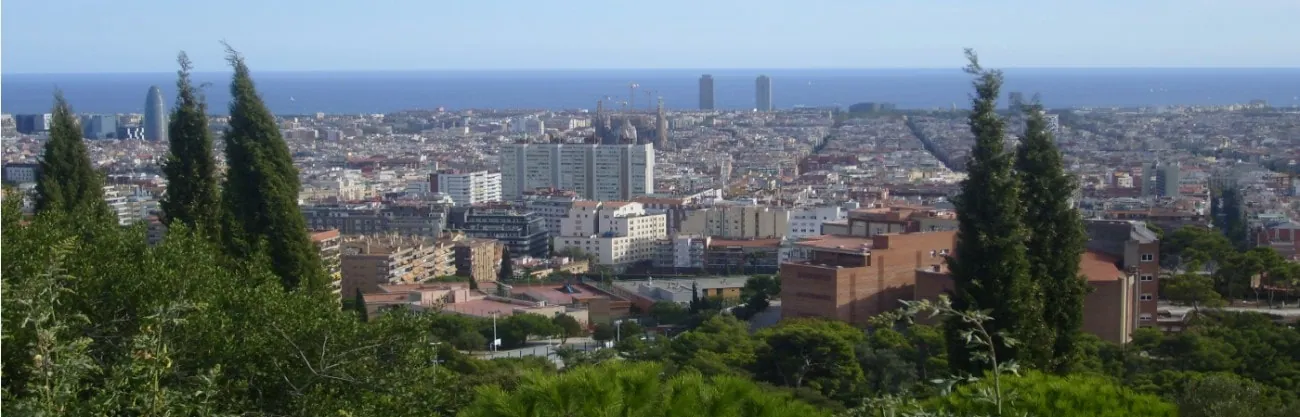
CAMP D’EN GRASSOT PROPERTY GUIDE
The heart of the city centre retaining its own feel
Camp d’en Grassot i Gràcia Nova offers a pragmatic residential bridge between the historic village charm of Vila de Gràcia and the spacious architecture of Eixample. According to CASAFARI Area Insights, the average asking price for apartments for sale in the barrio reached €5,934/m² in Q3 2026, marking a 5.4% increase year on year from €5,629/m² in Q3 2025. With new green corridors, excellent transport links, and a thriving local community, it attracts buyers seeking both quality of life and long-term capital stability in Barcelona.
Where is Camp d’en Grassot i Gràcia Nova and how is it connected?
Nestled at the eastern gateway of the Gràcia district, Camp d’en Grassot i Gràcia Nova is bounded by Vila de Gràcia to the west, Baix Guinardó to the north-east, and the Eixample neighbourhoods to the south. As detailed in the Gràcia district property guide (/area-guide/spain/barcelona/gracia-property/), the area combines the historic industrial settlement of Camp d’en Grassot with the mid-20th-century residential blocks of Gràcia Nova. Together, they form a single administrative barrio spanning 65.1 hectares with 36,422 residents, according to Open Data BCN demographic statistics for El Camp d’en Grassot i Gràcia Nova (2026).
Transport connectivity is a major asset. The neighbourhood is served by L4 at Joanic and Verdaguer, L5 at Verdaguer and Diagonal, and nearby L3 stations at Fontana and Lesseps, alongside key TMB bus corridors including H8, V19, D40, 39, 47, and 114. Furthermore, infrastructure is expanding: on the L9/L10 metro line, the 3.6 km extension connecting to Guinardó | Hospital de Sant Pau is scheduled to open in late 2027, while tunneling toward Lesseps progresses for a projected 2030 opening.
What is everyday life like around La Sedeta and Passeig de Sant Joan?
Everyday life in Camp d’en Grassot balances neighbourhood tranquillity with dynamic urban renewal. The upper section of Passeig de Sant Joan flows directly into Carrer de Pi i Margall, which has been transformed into a green axis allocating 70% of street space to pedestrians and greenery, featuring 5 to 12-metre granite pavements, over 140 new trees, four crossroads plazas, and an uphill segregated cycle lane.
Community life centres around landmarks such as La Sedeta, a former silk textile factory active from 1899 to 1976 that was reclaimed by residents and converted into a vibrant civic centre and schools. Other notable sites include the neo-Byzantine Church of the Immaculat Cor de Maria (1904–1913), the historic CE Europa stadium at Nou Sardenya, and the Mercat de l’Estrella on Carrer de Pi i Margall, for which the City Council tendered a €24.6 million project in September 2026 to demolish and rebuild the market on site with three floors of public housing above.
What kind of housing stock defines Camp d’en Grassot and who buys here?
Unlike the narrow, winding alleys and low-rise townhouses of historic Vila de Gràcia, Camp d’en Grassot developed along an orthogonal grid inspired by the Cerdà plan. This urban layout yields taller, deeper buildings with wider floorplates, lifts, high ceilings, and significantly more natural light.
Closer to Passeig de Sant Joan and Plaça Joanic, buyers find turn-of-the-century and modernist-influenced properties featuring hydraulic mosaic tiles and decorative galleries. Moving north towards Gràcia Nova and Carrer de Pi i Margall, the stock transitions to mid-20th-century brick apartment blocks. This variety attracts local Catalan families upsizing for space and school proximity, as well as international professionals relocating from central Barcelona who desire a quieter residential street without sacrificing walkability.
How are property prices and rents performing in Camp d’en Grassot in 2026?
Property pricing requires a clear distinction between asking prices on active listings and registered closing prices on completed transactions. According to CASAFARI Area Insights (location id 10582, queried October 2025–2026), the average asking price for apartments for sale in Camp d’en Grassot i Gràcia Nova reached €5,934/m² in Q3 2026, up 5.4% from €5,629/m² in Q3 2025.
In contrast, official registered transaction data from HabitatBCN reports an average closing price of €5,415/m² for second-hand flats in the barrio across 284 sales in full-year 2025, resulting in an average closing ticket of €402,398 and outperforming the broader Gràcia district closing average of €4,816/m².
Rental dynamics show a similar distinction. CASAFARI Area Insights records average asking rents on new listings at €27.1/m²/month in Q3 2026 (+1.1% year on year from €26.8/m²/month in Q3 2025). Meanwhile, official contracted rents from INCASÒL deposits—which reflect long-term leases subject to Catalonia’s stressed-zone rent caps—averaged €17.34/m²/month (€1,068/month for an average 64 m² flat) in Q1 2026, following €17.13/m²/month across 2025.
Which tax, residency and rental rules affect buyers in 2026?
Navigating property acquisitions in Catalonia requires close attention to recent legal reforms. Under Decree-Law 5/2025, in force since June 2025, Property Transfer Tax (ITP) for resale homes follows a progressive four-tier scale: 10% up to €600,000; 11% between €600,000 and €900,000; 12% between €900,000 and €1,500,000; and 13% above €1,500,000. Eligible buyers aged 35 or under benefit from a reduced 5% rate on primary residences, while large property holders face a flat 20% rate.
For international buyers, Spain’s real estate Golden Visa scheme was abolished in April 2025 under Organic Law 1/2025, meaning non-EU purchasers must utilize standard routes such as digital nomad or non-lucrative visas. On the rental front, Barcelona’s tourist apartment regulations under Decree-Law 3/2023 dictate that existing licences will expire without renewal by November 2028, and Catalan Law 11/2025 enforces strict documentary proof and rent caps for seasonal and temporary lets.
How real estate professionals analyse Camp d’en Grassot with CASAFARI
For estate agents, investors, and valuers operating in Barcelona, precision is paramount. Professionals use CASAFARI Property Sourcing to track deduplicated listings, price adjustments, and market velocity across every street in Camp d’en Grassot. By pairing these insights with property valuation and market study tools, advisors can benchmark active asking prices against verified closing data to guide client transactions with confidence. Explore current market data directly by visiting the platform sign-in. To deepen your understanding of regional market mechanics, review our guide to buying property in Spain and our technical analysis on comparing asking prices with transactional data.
Frequently asked questions
Is Camp d’en Grassot a good area to buy property in Barcelona?
Yes, Camp d’en Grassot i Gràcia Nova is highly regarded by buyers seeking long-term residential stability and larger floorplates than those found in central Gràcia. Spanning 65.1 hectares with 36,422 residents, the neighbourhood combines Eixample-style apartment layouts with the green boulevards of Passeig de Sant Joan and Carrer de Pi i Margall, maintaining official registered closing prices (€5,415/m² in 2025) above the wider Gràcia district average (€4,816/m²).
What is the difference between Vila de Gràcia and Camp d’en Grassot i Gràcia Nova?
Vila de Gràcia is the historic 19th-century village core characterized by narrow pedestrian streets, lively squares, and smaller low-rise buildings that frequently lack lifts. Camp d’en Grassot i Gràcia Nova lies immediately to the east and north-east on a wider, orthogonal street grid, offering quieter residential streets, taller 20th-century buildings with lifts, and larger family apartments.
What taxes do you pay when buying a resale flat in Camp d’en Grassot in 2026?
Under Catalonia’s Decree-Law 5/2025, second-hand residential purchases incur progressive Property Transfer Tax (ITP) rates: 10% on the portion up to €600,000, 11% between €600,000 and €900,000, 12% between €900,000 and €1,500,000, and 13% above €1,500,000. Buyers aged 35 or under meeting income requirements qualify for a reduced 5% rate on a primary residence, whereas large property holders face a flat 20% rate.
Can you buy an apartment in Camp d’en Grassot for tourist or seasonal rentals?
Tourist rentals are no longer viable for new buyers, as Barcelona issues no new tourist apartment licences and all existing licences across the city will expire in November 2028 under Decree-Law 3/2023. For seasonal rentals, Catalan Law 11/2025 requires landlords to file documentary proof of the tenant’s temporary cause with INCASÒL and subjects temporary contracts signed for work, study, or medical reasons to statutory rent caps.
What future infrastructure or urban projects are planned for this area?
The neighbourhood is set to benefit from significant infrastructure improvements, most notably the expansion of the L9/L10 metro line, which will connect to Guinardó | Hospital de Sant Pau by late 2027 and progress toward Lesseps by 2030. Additionally, the City Council has committed to a €24.6 million project to rebuild the Mercat de l’Estrella, which will provide a modernised facility and three floors of new public housing above the market.
What environmental and lifestyle changes can residents expect on the streets?
The area is undergoing a transition toward greener urban living, particularly with the transformation of Carrer de Pi i Margall into a pedestrian-focused green axis. This initiative includes segregated cycle lanes, four new crossroads plazas, and over 140 new trees, significantly improving local connectivity and walkability while complementing existing community hubs like the La Sedeta civic centre.