
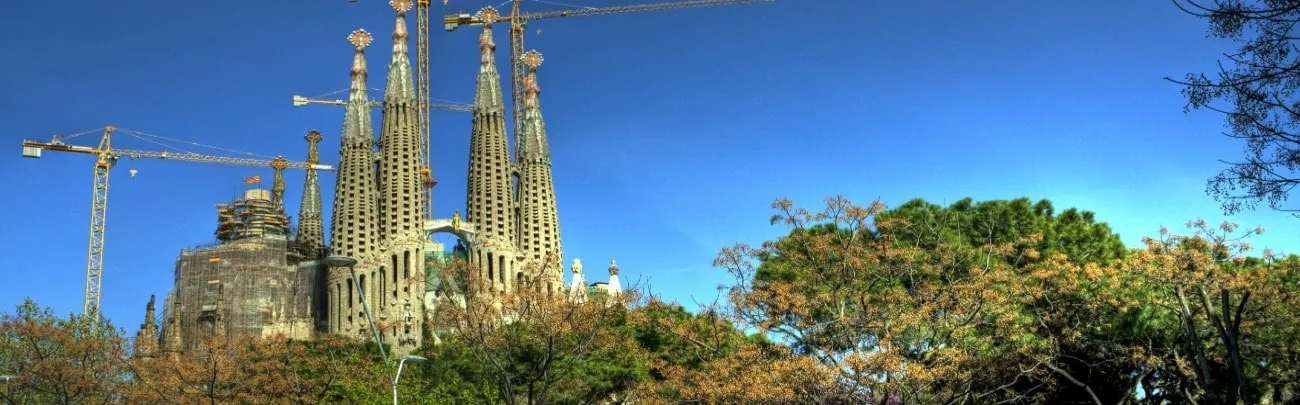
SAGRADA FAMILIA PROPERTY GUIDE
Residential streets surrounding the iconic Gaudí’s masterpiece
Sagrada Família is one of Barcelona’s most residential, well-connected Eixample neighbourhoods, home to 53,201 residents across 104.2 hectares according to the Ajuntament de Barcelona (2026 update). Apartments for sale in the area carry an average asking price of €5,830/m² (+3.9% year-on-year) and an average asking rent of €30.3/m²/month (-5.9% year-on-year) in Q3 2026, as reported by CASAFARI Area Insights, offering an accessible entry point within the wider Eixample district.
Where Sagrada Família sits in the Eixample and how it connects to the rest of Barcelona
Administrative boundaries define the Sagrada Família neighbourhood as extending from Carrer de Nàpols to the south-west—bordering Dreta de l’Eixample—up to Carrer de Sant Antoni Maria Claret to the north-west, Carrer de Dos de Maig to the north-east, and Avinguda Diagonal to the south. This dense, well-structured grid connects seamlessly to the wider Eixample property guide.
Public transport infrastructure is exceptional. Residents rely on the Sagrada Família metro interchange (lines L2 and L5), alongside peripheral stations like Verdaguer, Encants, and Sant Pau | Dos de Maig. Surface mobility is supported by TMB bus corridors such as the H10, D50, and V21. Journeys to Josep Tarradellas Barcelona-El Prat Airport take between 30 and 50 minutes via metro and the L9 Sud connection at Collblanc, or via Rodalies regional trains from Clot and Passeig de Gràcia.
Daily life beyond the basilica: Avinguda de Gaudí, Sant Pau and local amenities
While international attention focuses on the Temple Expiatori—where the 172.5-metre Tower of Jesus Christ was structurally completed and inaugurated in June 2026 for the Gaudí centenary—the surrounding streets maintain an authentic neighbourhood character just two blocks away.
Avinguda de Gaudí serves as a pedestrianized diagonal promenade linking the basilica directly to Lluís Domènech i Montaner’s UNESCO-listed Recinte Modernista de Sant Pau. Daily life revolves around local anchors such as the Mercat de la Sagrada Família on Carrer de Padilla, neighbourhood green spaces like Plaça de Gaudí, and well-regarded culinary spots including Bardeni el Meatbar on Carrer de València, fresh seafood at La Paradeta on Passatge de Simó, and the panoramic rooftop terrace at the Sercotel Rosellón on Carrer del Rosselló.
Housing stock and buyer profiles: from Poblet factory conversions to Modernista flats
Sagrada Família originated as El Poblet, a 19th-century working-class district of textile workshops and low-rise houses before Cerdà’s masterplan filled the blocks with characteristic chamfered intersections (illots). Today, the housing stock offers a compelling mix of late-19th and early-20th-century fincas régias featuring hydraulic mosaic tiles, high ceilings with Catalan vaulting (volta catalana), and sturdy mid-century brick apartment buildings equipped with lifts.
Buyer profiles span local Catalan families trading up within the Eixample district for a more favourable price per square metre, international technology professionals working in the nearby 22@ innovation district at Glòries, and long-term patrimonial investors. Acquisitions require careful attention on blocks facing Carrer de Mallorca, where urban planning discussions regarding the future Glory Façade grand staircase continue through 2026.
Property prices and rental yields in Sagrada Família: Q3 2026 market data
Market metrics for Sagrada Família demonstrate steady appreciation in asking figures alongside favourable discounts compared to neighbouring prime sectors. According to CASAFARI Area Insights, apartments for sale in Sagrada Família recorded an average asking price of €5,830/m² in Q3 2026, marking a 3.9% increase from €5,613/m² in Q3 2025.
When evaluating actual liquidity, official open data from the Land Registry via the Ajuntament de Barcelona (2024–2025 series updated October 2026) indicates that registered closing prices in Sagrada Família averaged €5,130/m² (with an average transaction ticket of €364,300 in 2025). This offers a notable discount against the wider Eixample district’s registered closing average of €5,945/m² (€534,900 average ticket). Rental values reflect broader regulatory changes, with CASAFARI Area Insights registering an average asking rent of €30.3/m²/month in Q3 2026, down 5.9% year-on-year from €32.2/m²/month.
For deeper analysis on valuation methodologies, consult our guide explaining why transactional closing data matters in property valuations.
What buyers and investors must know in 2026: Catalan taxes, rent caps and licences
Navigating property acquisitions in Catalonia requires a clear understanding of current legislation. Under Decree-Law 5/2025, the Property Transfer Tax (ITP) on residential resales follows progressive brackets: 10% up to €600,000; 11% between €600,000.01 and €900,000; 12% up to €1.5 million; and 13% for amounts exceeding €1.5 million. Large landlords and corporate buyers acquiring entire buildings face a 20% rate, while qualifying buyers aged 35 or under benefit from a 5% reduced rate. General Stamp Duty (AJD) on new constructions remains at 1.5%.
Rental regulations have tightened significantly. Barcelona has operated as a stressed residential market zone since March 2024, capping long-term rents. Furthermore, under Catalan Law 11/2025, seasonal lets and room-by-room rentals are subject to identical price caps and require documented proof of temporary professional or academic necessity deposited with INCASÒL. International buyers should also note that Spain abolished the real estate Golden Visa in April 2025 via Organic Law 1/2025, and Barcelona City Council is proceeding with the complete phase-out of all 10,101 tourist apartment licences (HUT) by November 2028 under Decree-Law 3/2023.
How real estate professionals and investors analyse Sagrada Família with CASAFARI
Real estate agents, portfolio managers, and private investors rely on professional data infrastructure to evaluate opportunities across Eixample. Using CASAFARI Area Insights, professionals track micro-market supply fluctuations, historical asking trends, and days on market down to the street level.
Acquisitions teams perform precise comparative market analyses through the property valuation and market study tool, pairing active listings with official registry closing prices. Buyers’ agents also deploy CASAFARI Property Sourcing to filter deduplicated inventory across portals. To examine live market data and analytics, sign in to the CASAFARI platform.
Frequently asked questions
Is Sagrada Família too touristy to live in full-time?
Visitor footfall is heavily concentrated immediately around the four perimeter streets of the basilica and along Avinguda de Gaudí. Moving just two blocks away towards Sant Pau or Dos de Maig reveals an established, peaceful residential environment housing 53,201 permanent residents, complete with schools, healthcare centres, and traditional local commerce.
What property transfer tax (ITP) do buyers pay in Barcelona in 2026?
Under Catalonia’s Decree-Law 5/2025, residential buyers pay a progressive ITP rate ranging from 10% on portions up to €600,000, 11% up to €900,000, 12% up to €1.5 million, and 13% for higher values. Large property holders and whole-building investors face a 20% rate, whereas qualifying buyers aged 35 or under purchasing a primary residence enjoy a reduced 5% rate.
Can I buy an apartment in Sagrada Família for short-term tourist lets or mid-term seasonal rental?
Barcelona issues no new tourist apartment licences, and all 10,101 existing licences across the city expire without renewal in November 2028 under Decree-Law 3/2023. Additionally, Catalan Law 11/2025 subjects mid-term seasonal leases and room rentals to strict stressed-zone price caps and requires official documentary proof of temporary tenant necessity deposited with INCASÒL.
How does the Sagrada Família Glory Façade project affect properties on Carrer de Mallorca?
While the central Tower of Jesus Christ was inaugurated in June 2026, the planned southern grand staircase on Carrer de Mallorca remains subject to ongoing urban planning negotiations between the board, the City Council, and residents. Prospective buyers evaluating flats on affected blocks should perform thorough urbanistic due diligence, as current discussions include potential building relocation proposals.
What is the typical character and architectural style of residential buildings in this neighbourhood?
The housing stock consists of a compelling mix of late-19th and early-20th-century fincas régias that often feature hydraulic mosaic tiles, high ceilings, and Catalan vaulting. Beyond these historic properties, the area also contains sturdy mid-century brick apartment buildings, most of which are conveniently equipped with lifts.
How does the local property market compare to the wider Eixample district in terms of pricing?
While the wider Eixample district recorded an average registered closing price of €5,945/m² in 2025, Sagrada Família offered a more accessible entry point at an average of €5,130/m². This difference is also reflected in the average transaction tickets, which stood at €364,300 in the neighbourhood compared to €534,900 across the rest of the district.