
FORT PIENC PROPERTY GUIDE
Central area where you will enjoy your peace and quiet
Fort Pienc is a compact, 92.9-hectare residential neighbourhood of 37,672 residents at the eastern edge of Barcelona’s Eixample district, linking Passeig de Sant Joan and Parc de la Ciutadella with the newly transformed Parc de les Glòries. According to CASAFARI Area Insights, apartments here recorded an average asking price of €5,572/m²—up 3.4% year-on-year from €5,389/m² in Q3 2025—and an average asking rent of €34.8/m²/month in Q3 2026, offering buyers an authentic Eixample lifestyle with exceptional transport connectivity.
Where is Fort Pienc and how is it connected to the rest of Barcelona?
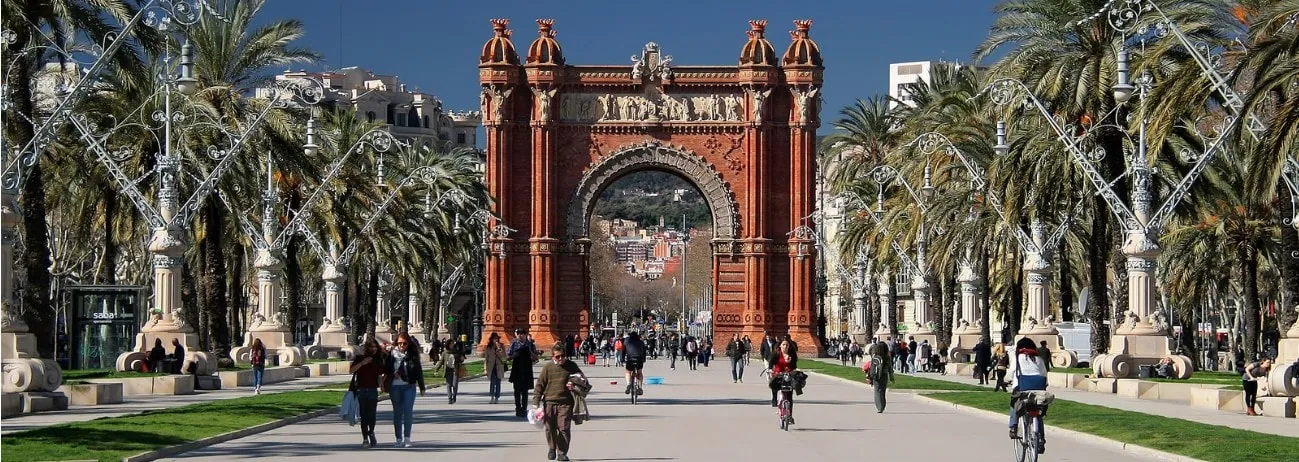
Bounded by Avinguda Diagonal, Avinguda Meridiana, Carrer dels Almogàvers, single blocks of Roger de Flor and Avinguda de Vilanova, Passeig de Sant Joan, Gran Via de les Corts Catalanes, and Carrer de Nàpols, Fort Pienc forms a natural bridge between the historic grid of the Eixample and the modern tech-focused business districts. This precise geographical perimeter connects directly to our broader overview of the Eixample property market.
Transport infrastructure is among the finest in the city. Residents are served by Metro L1 (stations at Marina, Arc de Triomf, and Glòries) and L2 (Tetuan and Monumental), alongside TRAM lines T4, T5, and T6 meeting at Glòries and Marina. For regional and international travel, the neighbourhood features Rodalies commuter rail services at Arc de Triomf and the major coach terminal at Estació del Nord, complemented by frequent TMB bus corridors such as the H12, H14, and V21.
What is everyday life like between Passeig de Sant Joan and the new Parc de les Glòries?
With a residential density of 406 inhabitants per hectare as of January 2026, according to the Ajuntament de Barcelona Padró municipal census data via Ajuntament de Barcelona municipal census figures for Fort Pienc (2026), Fort Pienc remains distinctly residential and largely sheltered from the heavier tourist footfall found further west. The character of the neighbourhood is defined by neighbourhood commerce, local primary schools, and quiet interior courtyards.
At the northern boundary, the urban landscape has been reshaped by the inauguration of the main phase of the Canòpia Urbana project at Parc de les Glòries on 26 April 2025. This milestone delivered 9 hectares of open public space, over 30,000 m² of green areas, and 1,000 newly planted trees, as detailed in the official BIMSA’s Parc de les Glòries redevelopment schedule (2025–2026). Cultural landmarks such as the Teatre Nacional de Catalunya (TNC) and L’Auditori anchor the northern edge, while the shaded terraces of Carrer de Ribes and the lively Mercat del Fort Pienc provide a strong sense of local community.
What types of housing stock and buyers define the Fort Pienc market?
The neighbourhood’s architecture reflects two distinct development eras. Along Passeig de Sant Joan, Gran Via, and Carrer d’Ausiàs March, buyers find classic late-19th and early-20th-century Eixample buildings featuring high ceilings, traditional hydraulic mosaic tiles, and decorative wrought-iron balconies. Closer to Estació del Nord and Carrer de Ribes, the stock shifts toward mid-century brick apartment blocks equipped with modern lifts and underground parking.
Buyers are typically split into three primary groups: local Catalan families trading up within the Eixample for proximity to parks and cultural venues, tech executives and professionals employed in the adjacent 22@ district across Glòries, and international owner-occupiers seeking liquid Eixample assets at a slightly more accessible entry point than Dreta de l’Eixample.
How are asking prices and rents performing in Fort Pienc in Q3 2026?
Market metrics for Fort Pienc demonstrate steady appreciation for residential sales alongside a stabilizing rental market constrained by regulatory ceilings. Based on data from CASAFARI Area Insights, the average asking price for apartments for sale reached €5,572/m² in Q3 2026, compared to €5,389/m² in Q3 2025. These figures reflect asking prices derived from active listings indexed by CASAFARI (with statistical outliers excluded) and do not represent closing prices.
On the rental side, the average asking rent stood at €34.8/m²/month in Q3 2026, virtually unchanged from the €34.9/m²/month recorded in Q3 2025 (-0.3% year-on-year). When conducting professional valuations, property experts cross-reference these active asking prices with official closing prices obtained from the Spanish Notariado and transaction records supplied directly by CASAFARI clients.
What taxes, rental caps and licensing rules apply to buyers in 2026?
Property acquisitions in Catalonia are subject to a progressive Property Transfer Tax (ITP) schedule for resale homes, regulated by Decree-Law 5/2025 and outlined in the Catalonia’s progressive ITP property transfer tax rates under Decree-Law 5/2025. Effective 27 June 2025, the general marginal rates are 10% for the first €600,000, 11% between €600,000 and €900,000, 12% between €900,000 and €1,500,000, and 13% for any valuation exceeding €1,500,000. A flat 20% rate applies to large property holders or entire building purchases, while a reduced 5% rate supports buyers under 35 with qualifying incomes, large or single-family households, and buyers with disabilities.
Rental regulations in Barcelona reflect its designation as a stressed residential market zone. Standard long-term leases are legally bound by the previous contract rent and the State Reference Price Index. Furthermore, under Catalonia’s Law 11/2025 in force since January 2026, seasonal leases for work or study and individual room rentals are bound by the exact same price caps, as detailed by Catalonia Law 11/2025 regulating seasonal and room rentals from January 2026.
Short-term tourist rentals are subject to complete phase-out. Following Decree-Law 3/2023, Barcelona City Council issues zero new tourist licences, and all existing licences will expire permanently in November 2028, as noted in the Consorci de l’Habitatge de Barcelona announcement on the 2028 phase-out of tourist apartment licences. Additionally, foreign investors should note that Spain’s real estate Golden Visa scheme was formally repealed on 3 April 2025 under Organic Law 1/2025, documented in the Organic Law 1/2025 in the Boletín Oficial del Estado repealing Spain’s Golden Visa.
How do property professionals and investors analyse Fort Pienc with CASAFARI?
For real estate agents, investors, and independent valuers, tracking dynamic micro-markets requires precise tools. Professionals rely on CASAFARI Area Insights to monitor active inventory shifts and asking-price trends across Fort Pienc and adjacent Eixample sectors. To establish accurate asset valuations, practitioners utilize property valuation and market study tools, combining deduplicated asking prices with historical closing data.
Finding specific residential opportunities is streamlined through CASAFARI Property Sourcing, which aggregates clean listings from hundreds of distinct sources. To review market intelligence or examine purchase structures in detail, you can sign in to the CASAFARI platform to explore Fort Pienc market data in real time (no invented /signup paths). International buyers can also consult our broader guide to buying property in Spain for foundational legal steps.
Frequently asked questions
Is Fort Pienc a good area to buy property in Barcelona?
Yes, Fort Pienc appeals to both local families and international buyers seeking authentic Eixample architecture without the heavy tourist footfall of Sagrada Família or Dreta de l’Eixample. It combines direct access to Parc de la Ciutadella and the newly inaugurated 9-hectare Parc de les Glòries with proximity to the 22@ tech district and five Metro stations across L1 and L2. Because short-term tourist licences are banned and being phased out by November 2028, the neighbourhood is firmly oriented toward owner-occupiers and regulated long-term rentals.
What are the property transfer taxes (ITP) when buying a resale flat in Fort Pienc in 2026?
Under Catalonia’s Decree-Law 5/2025, resale residential buyers pay a progressive Property Transfer Tax calculated in marginal brackets: 10% on the first €600,000, 11% between €600,000 and €900,000, 12% between €900,000 and €1,500,000, and 13% on any amount above €1,500,000. Large property holders owning five or more homes in stressed zones and buyers of entire residential buildings pay a flat 20% rate. Eligible buyers aged 35 or under with taxable income up to €36,000, single-parent or large families, and buyers with disabilities qualify for a reduced 5% rate on their primary residence.
Do rent controls in Barcelona apply to seasonal lets and room rentals in Fort Pienc?
Yes. Because Barcelona is a declared stressed residential market zone, standard residential leases are capped by the previous contract rent and the State Reference Price Index. Under Catalonia’s Law 11/2025, seasonal leases signed for work, academic, or medical reasons, as well as individual room rentals, are subject to the exact same maximum rent limits as permanent housing, and landlords must attach documentary proof of the tenant’s temporary purpose to the contract.
Can I get a Spanish Golden Visa or a tourist rental licence by buying a property in Fort Pienc?
Neither option is available in 2026. Spain abolished the real estate Golden Visa on 3 April 2025 under Organic Law 1/2025, so purchasing property no longer grants investor residency. Furthermore, under Catalonia’s Decree-Law 3/2023 and Barcelona City Council’s urban plan, no new tourist apartment licences are granted in the city, and all existing licences will expire permanently in November 2028.
What should I look for when inspecting the older housing stock compared to the newer mid-century blocks in Fort Pienc?
When viewing the late-19th and early-20th-century classic Eixample properties, pay close attention to the condition of original hydraulic mosaic tiles and decorative wrought-iron balcony fixtures, which are key to their character. In contrast, when considering the mid-century brick blocks near Estació del Nord and Carrer de Ribes, focus on the maintenance status of modern lifts and the availability of underground parking, which significantly impacts residential utility in this dense urban area.
How does the recent Canòpia Urbana project at Parc de les Glòries impact the residential appeal of northern Fort Pienc?
The inauguration of the 9-hectare Canòpia Urbana park on 26 April 2025 has significantly enhanced the liveability of the neighbourhood by providing over 30,000 square metres of green space and 1,000 newly planted trees. This shift transforms the northern boundary into a major public amenity, offering a calm, park-side environment that complements the existing local community atmosphere of the nearby Mercat del Fort Pienc.