
ESPORLES PROPERTY GUIDE
Quiet and pretty mountain village with accessibility to the best amenities
Esporles town centre—distinct from the wider municipality and the coastal enclave of Port des Canonge—is a lived-in, year-round Serra de Tramuntana mountain village located 15 km northwest of Palma. Governed by strict UNESCO landscape protections and Balearic planning rules, the tight local housing market is dominated by stone townhouses around the Passeig del Rei. According to CASAFARI Area Insights for Esporles Town (location ID 3688785, queried 25 October 2026), houses for sale averaged an asking price of €5,902/m² in Q3 2026, marking a 5.1% increase year on year from €5,616/m² in Q3 2025. These figures reflect asking prices from indexed listings, excluding outliers.
Where is Esporles Town and how well is it connected to Palma?
Nestled in a steep valley straddling the Torrent de Sant Pere at the southern foothills of the UNESCO-listed Serra de Tramuntana, Esporles Town forms the administrative and social heart of the wider municipality, which recorded a population of 5,264 inhabitants (2,567 men and 2,697 women) as of 1 January 2025, according to official figures from the Instituto Nacional de Estadística (INE). Unlike seasonal coastal resorts that shutter for the winter, Esporles functions as a vibrant primary-residence community.
Connectivity is a primary driver for buyers seeking village life within easy reach of the capital. The village sits roughly 15 km—or a 20-minute drive—from central Palma via the Ma-1100 and Ma-1040 roads. Furthermore, it lies less than 10 minutes from the University of the Balearic Islands (UIB), the Parc Bit technology park, and Son Espases University Hospital. Public transport is equally reliable: TIB bus line 202 (Estellencs – Esporles – Palma) connects Esporles directly with Palma’s Estació Intermodal via the UIB and Son Espases approximately every hour between 06:45 and 21:50, offering a journey time of 25 to 35 minutes according to the Consorci de Transports de Mallorca (TIB) timetable in force in October 2026.
For weekend recreation, residents are neighbours to Valldemossa and Banyalbufar along the dramatic Ma-10 mountain road, sit 9 km from the Golf de Son Termens course, and live just 8 km inland from the municipality’s rocky swimming cove at Port des Canonge. Readers looking at the broader municipal area can also explore the wider municipality of Espores through our dedicated wider municipality of Esporles guide.
What is everyday life like in Esporles village?
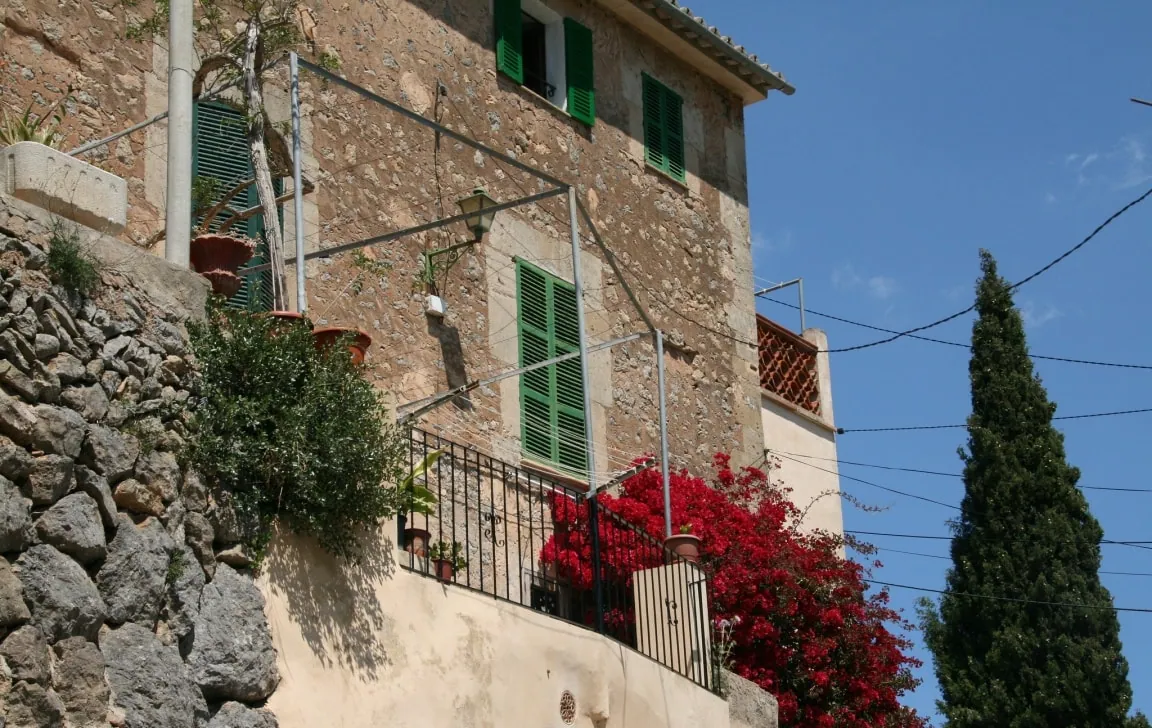
Divided historically into Vilavella (the older upper quarter) and Vilanova, the village presents a remarkably intact traditional streetscape. Two- and three-storey stone-faced townhouses (cases de poble) feature green wooden shutters and tile roofs, interspersed with small stone bridges crossing the torrent. The social focus of the town is the tree-lined Passeig del Rei, shaded by mature plane trees where residents gather at pavement cafés and bakeries.
The village skyline is anchored by the Parròquia de Sant Pere on Plaça de l’Ajuntament. Dedicated to Saint Peter, the town’s patron saint, the church was designed in a striking Neo-Gothic style by celebrated Mallorcan architect Gaspar Bennàzar, with construction beginning in 1904 and blessing taking place in 1923, though its upper main facade and bell tower remain charmingly unfinished. This architectural heritage is complemented by the town’s 19th-century textile-mill past.
Everyday life is anchored by a bustling Saturday morning market offering local organic produce, the annual Sant Pere patron saint festivities in late June, the Fira Dolça pastry fair each October, and endless hiking trails leading up the holm-oak forested slopes to the Ermita de Maristella. Just outside the village sits La Granja de Esporles, a historic Mallorcan possessió originating as a 10th-century Islamic farmstead (Alpich) around natural springs before passing to Cistercian monks and noble families like the Vidas and Fortunys. Following its acquisition in September 2022 for a luxury hotel conversion project, the former ethnographic museum and manor house remain closed to the general public in 2026.
What types of property are for sale in Esporles Town and who buys them?
The property inventory in Esporles Town is heavily weighted toward traditional architecture. Buyers find classic two- and three-storey stone village houses (cases de poble) concentrated around Vilavella, Vilanova, and Es Balladors, many featuring rear courtyards, stone arches, or small plunge pools. Beyond the historic core, detached chalets occupy hillside urbanisations such as Ses Rotgetes and Es Verger, while larger historic manor houses and rustic fincas stand on the immediate agricultural fringe of the town.
Apartments are notably scarce. Strict urban planning in the historic centre protects the low-rise stone streetscape, meaning multi-family apartment blocks are few and far between. This structural scarcity shapes the buyer pool: academics, tech specialists, and medical professionals working at Parc Bit, UIB, and Son Espases; Mallorcan families priced out of central Palma who desire private outdoor space and local schooling; and discerning northern European—British, German, Scandinavian, and Benelux—buyers seeking a genuine, year-round Mediterranean community.
How are property asking prices performing in Esporles Town in 2026?
Analysing local price trends requires careful attention to property typology. According to CASAFARI Area Insights for Esporles Town (location ID 3688785, queried 25 October 2026), houses for sale averaged an asking price of €5,902/m² in Q3 2026, representing a 5.1% increase year on year from €5,616/m² in Q3 2025. These figures reflect asking prices derived from indexed listings on the market (with statistical outliers excluded), rather than final notarised closing prices.
In contrast, apartments in Esporles Town averaged an asking price of €3,750/m² in Q3 2026, down 10.2% from €4,176/m² in Q3 2025. This apartment series carries a crucial statistical caveat: because Esporles is overwhelmingly a village of houses, apartment supply is sparse and volatile. A single high-end flat entering or leaving the market can swing the quarterly average sharply between €2,441/m² and €4,236/m².
To put these asking prices into wider perspective using official closing data, registered closing prices across the Balearic Islands averaged €4,311/m² in Q2 2026 (rising from €3,988/m² at the close of 2025, with Palma standing at €4,086/m²), while Ministry of Housing appraised values averaged €3,980.8/m² in Q2 2026 (+13.1% YoY), according to data from the Colegio de Registradores and the Ministry of Housing reported via EFE. The price premium commanded by houses in Esporles reflects the acute scarcity of renovated stone townhouses and mountain-view fincas within a 20-minute commute of Palma.
What taxes, residency rules and planning laws apply when buying in Esporles in 2026?
Purchasing property in Esporles involves navigating regional Balearic tax brackets and stringent land-use regulations. For resale homes, the Agència Tributària de les Illes Balears (ATIB) levies progressive Property Transfer Tax (ITP) across marginal bands: 8% up to €400,000; 9% from €400,000.01 to €600,000; 10% from €600,000.01 to €1,000,000; 12% from €1,000,000.01 to €2,000,000; and 13% on any amount exceeding €2,000,000. For instance, a €1.2 million village house incurs an effective ITP rate of approximately 9.33%, before notary and land registry fees. Qualifying primary residences benefit from reduced ITP rates of 4%, 2%, or full relief, while new-build properties attract 1.5% Stamp Duty (AJD) plus VAT.
Regarding wealth tax, the Balearic Islands enforce a regional tax-free threshold of €3,000,000 per taxpayer (alongside a €300,000 primary residence exemption) under Law 12/2023, applicable to both local residents and non-residents whose Spanish assets are concentrated in the Balearics and who opt for regional rules, with net wealth above €3 million taxed at progressive rates from 0.28% to 3.45% (Agencia Tributaria, 2025–2026).
Tourist rentals are governed by the Consell de Mallorca’s Territorial Plan (PIAT) and Decree-Law 4/2025. While Esporles town centre is classified as a non-vulnerable inland zone—making it eligible in principle for tourist rental (ETV) licences—Decree-Law 4/2025 strictly bans new ETV licences in multi-family apartment buildings (pisos) and caps overall tourism places. In 2026, buyers of single-family village houses cannot create new places ex novo; they must acquire a property with an active, transferable ETV licence or bid for de-registered places through the Consell’s 1:1 temporary pool. Properties situated on ANEI (Área Natural de Especial Interés) rustic land cannot obtain tourist rental licences.
Planning rules in surrounding rural areas are exceptionally strict. As part of the Cultural Landscape of the Serra de Tramuntana—designated a UNESCO World Heritage site in 2011—rustic ANEI land prohibits new residential construction. Only conservation, maintenance, and legal rehabilitation of existing buildings are permitted, requiring strict preservation of dry-stone terraces (pedra en sec), traditional roofs, and facades. Within the village core, buyers must always verify the cédula de habitabilidad and check for any historic urbanistic infractions (fuera de ordenación). Finally, non-EU buyers should note that Organic Law 1/2025 repealed Articles 63 to 67 of Law 14/2013, abolishing Spain’s real estate Golden Visa for investments of €500,000 or more from 3 April 2025. UK and other non-EU purchasers now rely on the Schengen 90/180-day rule, the non-lucrative visa, or the international telework (digital nomad) visa.
How do buyers, investors and agents analyse Esporles with CASAFARI?
Operating in a micro-market like Esporles Town presents distinct logistical hurdles. The same historic stone townhouse or hillside chalet is frequently listed simultaneously across multiple local and international agencies at varying asking prices, while sparse apartment data can skew raw portal averages. Professionals cut through this fragmentation using CASAFARI Property Sourcing to view every deduplicated property in Esporles alongside its complete listing history, including price reductions and days on market.
To benchmark a prospective purchase against both competing asking prices and verified historical sales, valuers and investors rely on our property valuation and market study tool. Meanwhile, analysts tracking hyper-local supply dynamics across Mallorca utilise CASAFARI Area Insights to monitor supply shifts and valuation trends. Explore live market intelligence directly by choosing to sign in to the CASAFARI platform.
Related Resources
For a broader procedural understanding of the Spanish property market, consult our complete guide to buying property in Spain.
Frequently asked questions
Is Esporles a good place to live all year round in Mallorca?
Yes, unlike coastal resorts that quieten down during the winter months, Esporles is a thriving, working Mallorcan town with an official registered population of 5,264 inhabitants (INE, 1 January 2025). It offers local schools, pharmacies, Saturday produce markets, and cafés along the Passeig del Rei. Furthermore, it sits just 20 minutes by car or 25 to 35 minutes on the hourly TIB 202 bus from central Palma, passing the UIB university campus, Parc Bit, and Son Espases Hospital.
Can you get a tourist rental licence (ETV) for a house in Esporles town?
While the Consell de Mallorca’s PIAT zoning classifies Esporles town centre as an eligible non-vulnerable inland area, Decree-Law 4/2025 strictly prohibits new ETV licences in multi-family apartment buildings (pisos) and maintains a freeze on new tourist beds. For detached or terraced village houses, no new places are created ex novo in 2026; owners can only secure a licence by acquiring a property with an active, transferable ETV permit or by bidding for de-registered places through the Consell de Mallorca’s 1:1 temporary pool.
What are the property transfer taxes (ITP) when buying a home in Mallorca in 2026?
Resale homes in the Balearic Islands are subject to progressive Property Transfer Tax (ITP) set by the ATIB across marginal bands: 8% up to €400,000; 9% from €400,000.01 to €600,000; 10% from €600,000.01 to €1,000,000; 12% from €1,000,000.01 to €2,000,000; and 13% for any amount exceeding €2,000,000. Buyers acquiring a qualifying primary residence may benefit from reduced rates of 4%, 2%, or full relief, while new builds attract 1.5% Stamp Duty (AJD) plus VAT.
What are the building and renovation rules for rustic property in Esporles?
Rustic properties located within ANEI protected land in Esporles—which forms part of the UNESCO World Heritage Serra de Tramuntana landscape—are strictly prohibited from undertaking new residential construction. Only conservation, maintenance, and legal rehabilitation of existing structures are permitted, requiring meticulous preservation of traditional dry-stone walls (pedra en sec), hydraulic systems, roofs, and facades. Buyers must also verify that any rural property holds a valid habitability certificate and lacks outstanding urbanistic infractions.
What residency options do non-EU citizens have for living in Esporles?
Since the repeal of the real estate Golden Visa on 3 April 2025, non-EU buyers must rely on alternative pathways to reside in Spain. These options include applying for the non-lucrative visa or the international telework (digital nomad) visa, or adhering to the standard Schengen 90/180-day rule for non-resident stays. Prospective buyers should research these specific visa requirements as they are now the primary means for non-EU nationals to live in the area.
Is it easy to find an apartment for sale in the village centre?
Multi-family apartment blocks are notably scarce in Esporles, as strict urban planning protections preserve the traditional low-rise stone streetscape of the historic centre. Because of this structural scarcity, the village property inventory is heavily weighted toward two- and three-storey stone townhouses (cases de poble). Consequently, the market for apartments is volatile, with limited supply that can significantly influence average price fluctuations in the local area.