
PALMA PROPERTY GUIDE
Vibrant city and a real pearl of the Mediterranean
Palma City is the capital of Mallorca and the Balearic Islands, home to 443,196 residents according to the Instituto Nacional de Estadística (INE, January 2025) — nearly half the archipelago’s population. In Q3 2026, apartment asking prices from listings indexed by CASAFARI Area Insights averaged €5,697/m² (+5.5% year on year), while asking rents reached €21.1/m²/month (+7.1%), supported by year-round European connectivity and record 32.27% foreign buyer participation across the Balearics (Colegio de Registradores, Q2 2026).
Where Palma City sits on Mallorca and how it connects to Europe
Palma occupies a privileged geographic setting on the south-west coast of Mallorca around the wide crescent of the Bay of Palma, anchoring the wider Palma de Mallorca municipality property guide and the wider Mallorca property market. The city enjoys a dependable Mediterranean climate, characterised by an official normal annual average temperature of 18.2 °C at the Palma Port weather station, featuring a 21.8 °C daily maximum and a 14.6 °C daily minimum based on the Agencia Estatal de Meteorología (AEMET) 1981–2010 normal series.
Accessibility remains one of Palma’s primary economic pillars. Palma de Mallorca Airport (PMI) lies roughly ten minutes by car east of the centre, offering regular two-hour flight connections to London, Frankfurt, Zurich, Paris and Madrid. Meanwhile, the Port of Palma accommodates major commercial ferries, cruise liners and exclusive private vessels within its historic marinas and the Real Club Náutico de Palma.
Year-round living, culture and the newly transformed Paseo Marítimo
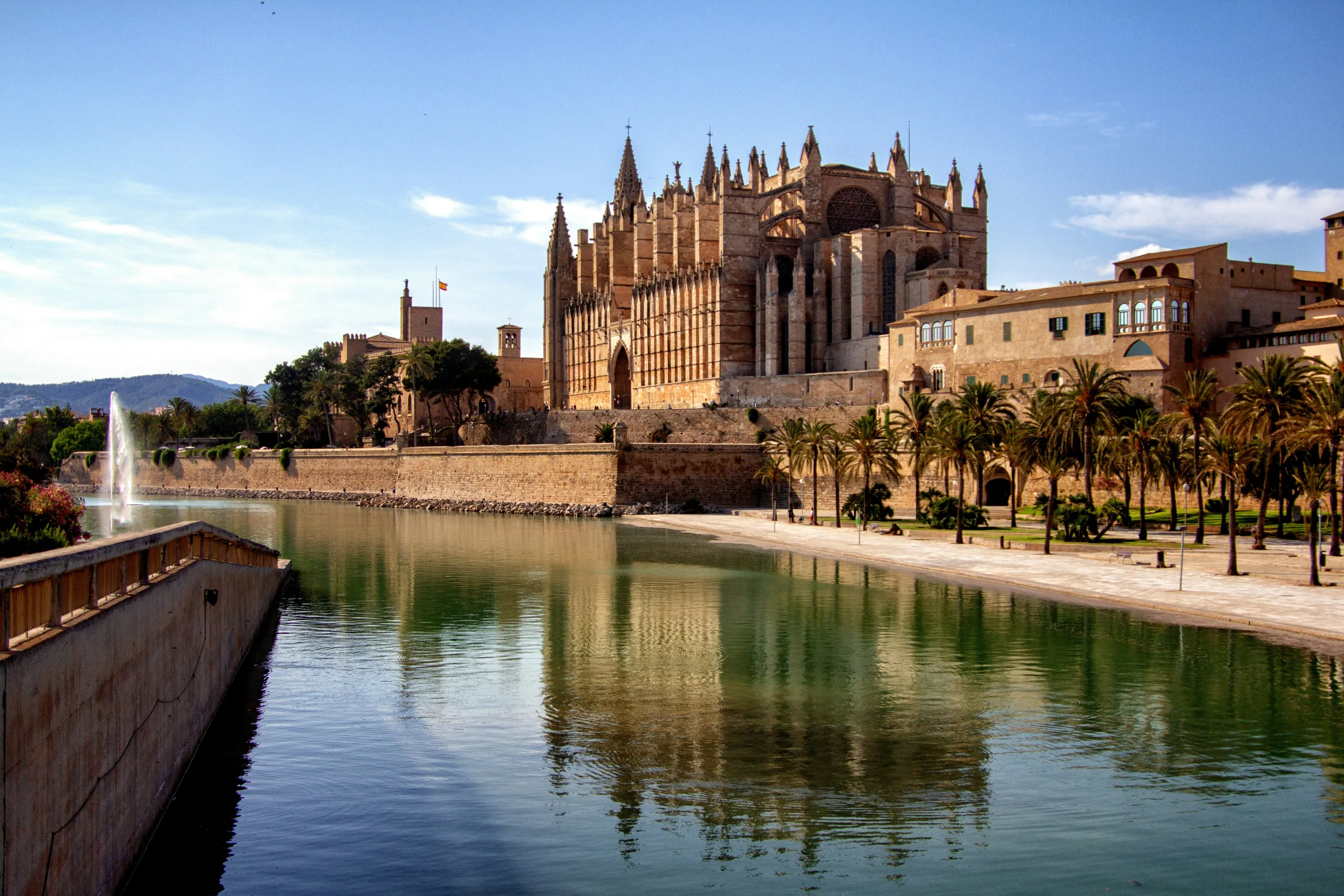
Unlike seasonal resort towns across the Mediterranean, Palma functions as a vibrant twelve-month European city. Its historic core merges Gothic and Renaissance architecture — including the Cathedral of Santa Maria (La Seu), the Almudaina Palace, La Lonja and the Banys Àrabs — with high-end international commerce along Passeig del Born and Avinguda de Jaume III.
Cultural institutions such as the Es Baluard Museum of Contemporary Art and the Fundació Miró Mallorca anchor an active arts calendar, highlighted each September by La Nit de l’Art. Culinary distinction is equally prominent, anchored by establishments like British chef Marc Fosh’s Michelin-starred restaurant at Hotel Convent de la Missió, which holds 1 Michelin Star in the 2026 Michelin Guide.
Urban infrastructure reached a major milestone with the completion of the 3.5-kilometre Paseo Marítimo urban remodelling by the Balearic Port Authority (APB) in November 2025. Honoured with design accolades in July and October 2026, the project introduced widened pedestrian promenades, reduced traffic lanes, landscaped green spaces, and the transformation of the historic Tito’s building into Lío Mallorca.
For leisure, residents and buyers have immediate access to urban waterfront areas, the sandy stretches of Platja de Palma to the east, and the three 18-hole golf courses nestled around Son Vida just fifteen minutes west of the cathedral.
Housing stock and key neighbourhoods: from the Old Town to Son Vida
Palma City comprises distinct micro-markets, each offering entirely different architectural typologies and investment profiles.
- Palma Old Town (Casco Antiguo): Centred around La Seu, Calatrava, Cort and La Lonja, Palma Old Town features historic courtyard palaces, Gothic stone arches, exposed Mares sandstone, and meticulously renovated penthouses.
- Santa Catalina: Located immediately west of the ancient torrent, Santa Catalina is a former fishermen’s quarter prized by international buyers and yacht crews for its low-rise townhouses, private roof terraces, Es Jonquet windmills, and bustling indoor food market.
- Paseo Marítimo and Portixol: Waterfront apartments along the Paseo Marítimo and eastward toward Portixol and Molinar offer direct sea views and immediate access to the newly pedestrianised coastal promenades.
- Son Vida: Positioned on the pine-clad hills above the city, Son Vida represents Palma’s premier gated community, featuring luxury contemporary villas and panoramic views across the bay.
Foreign demand underpins much of this activity. According to the Colegio de Registradores (Q2 2026), international purchasers accounted for a record 32.27% of all residential transactions in the Balearic Islands, led by German buyers alongside robust British, Swedish, French and Dutch participation.
Palma property market data: asking prices, rents and closing benchmarks in 2026
Navigating Palma’s real estate market requires a clear distinction between listing asking prices and official registered closing values. According to CASAFARI Area Insights, the average asking price for apartments for sale in Palma de Mallorca reached €5,697/m² in Q3 2026 (outliers excluded), representing a 5.5% increase year on year from €5,398/m² in Q3 2025 (queried 23 October 2026).
In the rental sector, CASAFARI Area Insights recorded an average asking rent for apartments in Palma of €21.1/m²/month in Q3 2026, marking a 7.1% rise year on year from €19.7/m²/month in Q3 2025.
When evaluating property values, buyers must compare these listing figures against official closing data. The average registered closing price (precio medio de compraventa registrada) published by the Colegio de Registradores and Notariado stood at €4,291/m² in Palma in Q2 2026. Meanwhile, official appraised values (valor tasado de la vivienda libre) reported by the Ministerio de Vivienda y Agenda Urbana (MIVAU) averaged €3,814.5/m² in Q2 2026. The spread between €5,697/m² asking prices and €4,291/m² registered deeds reflects market composition: active listings heavily skew towards high-spec refurbishments in prime districts like the Old Town and Santa Catalina, whereas registered deeds encompass the entire municipal housing stock, including unrenovated apartments across outer residential quarters.
Taxes, tourist licences and residency rules for Palma buyers in 2026
Property acquisitions in Palma are subject to specific fiscal and legal frameworks:
-
Purchase Taxes: Resale properties in the Balearic Islands incur progressive Property Transfer Tax (Impuesto sobre Transmisiones Patrimoniales, ITP) levied across five brackets by the Agencia Tributaria de las Illes Balears (ATIB): 8% up to €400,000; 9% from €400,000.01 to €600,000; 10% from €600,000.01 to €1,000,000; 12% from €1,000,000.01 to €2,000,000; and 13% for amounts exceeding €2,000,000 (with reduced rates or relief available for qualifying primary residences). New-build homes attract 10% IVA plus Stamp Duty (AJD) at the 1.5% general rate, or 0.5% under Law 4/2026. Further details are outlined in our guide to the Spanish property contract and escritura deed.
-
Wealth Tax: Following Law 12/2023, the Balearic Islands apply a €3,000,000 tax-free allowance per individual for Wealth Tax (Impuesto sobre el Patrimonio), aligned with Spain’s solidarity tax, with progressive regional rates ranging from 0.28% to 3.45% above that threshold.
-
Tourist Rental Regulations: Holiday rentals in multi-family apartment buildings (ETVPL) have been banned in Palma since 2018 and barred across the Balearics under Decree-Law 4/2025. Furthermore, in early 2026, Palma City Council declared the entire municipality a single unsuitable zone in its urban planning rules, prohibiting new tourist rental licences (ETV) across all residential typologies.
-
Residency and Visas: Spain’s Golden Visa route for real estate investments of €500,000 or more was abolished by Organic Law 1/2025, taking effect on 3 April 2025. Non-EU buyers now navigate property purchases under standard Schengen rules or alternative pathways such as non-lucrative or digital nomad visas.
How real estate professionals and investors analyse Palma with CASAFARI
Fragmented listing portals across Mallorca frequently generate duplicate adverts and pricing anomalies for the same Old Town residence or Santa Catalina townhouse. Estate agents, buyer’s agents, property developers and institutional investors rely on CASAFARI Property Sourcing to deduplicate listings and track complete historical pricing data across portals.
For accurate valuations and comparative market analyses, professionals use the property valuation and market study tool to cross-reference listing asking prices against official transactional data, as discussed in our using transactional closing prices in property valuations guide. Micro-area trends can be monitored via CASAFARI Area Insights or integrated programmatically using the Area Insights API and MCP documentation (page in English).
To explore live market data and configure your workspace, sign in to the CASAFARI platform.
Frequently asked questions
Can you get a holiday rental licence for an apartment in Palma de Mallorca?
No. Tourist rentals in multi-family apartment buildings have been banned in Palma since 2018 and barred across the Balearic Islands under Decree-Law 4/2025. Furthermore, in early 2026, Palma City Council declared the entire municipality an unsuitable zone under its urban planning regulations, prohibiting new tourist rental licences (ETV) across all residential property types.
What are the property purchase taxes in Mallorca in 2026?
Resale residential properties in the Balearic Islands incur progressive Property Transfer Tax (ITP) set by the ATIB across five brackets: 8% up to €400,000, 9% up to €600,000, 10% up to €1,000,000, 12% up to €2,000,000, and 13% for values exceeding €2,000,000. New-build properties are subject to 10% VAT (IVA) and Stamp Duty (AJD) at a general rate of 1.5%.
Is the Spanish Golden Visa still available when buying property in Palma?
No. Spain officially abolished the Golden Visa residency route for real estate investments of €500,000 or more via Organic Law 1/2025, effective 3 April 2025. Non-EU buyers can still acquire property freely, but residency rights must be sought through alternative immigration channels such as digital nomad or non-lucrative visas.
Which neighbourhoods in Palma City are best for buying property?
The ideal location depends on buyer lifestyle and investment goals. Palma Old Town appeals to those seeking historic courtyard palaces and architectural character, Santa Catalina attracts buyers wanting a bohemian village feel near the harbour, the Paseo Marítimo offers frontline sea views alongside recent waterfront regeneration, and Son Vida provides luxury hillside villas adjacent to golf courses.
Why do asking prices and registered sale prices differ in Palma de Mallorca?
In Q3 2026, CASAFARI Area Insights recorded an average apartment asking price from active listings of €5,697/m² in Palma, whereas official registered closing prices averaged €4,291/m² in Q2 2026 according to the Colegio de Registradores and Notariado. Active listings heavily weight premium, fully refurbished properties in prime international enclaves, whereas registered deeds reflect the entire municipal housing stock, including unrenovated local apartments.
Who is buying property in Palma de Mallorca and the Balearic Islands?
International buyers represent a significant portion of the market, accounting for a record 32.27% of all residential property transactions in the Balearic Islands in Q2 2026 according to the Colegio de Registradores. German nationals form the largest foreign buyer group in the archipelago, complemented by strong demand from British, Swedish, French, Dutch and Swiss purchasers.