Ibiza
Gateway to beautiful beaches, boisterous nightlife and colourful scenery
Ibiza is one of the Mediterranean’s most supply-constrained luxury property markets, where CASAFARI Area Insights records average asking prices from listings in Q3 2026 of €10,319/m² for houses (+1.4% year on year) and €7,503/m² for apartments (+5.3% year on year). Spanning five distinct municipalities across the Pitiusic archipelago, the island combines high-end lifestyle appeal with strict Balearic planning regulations, progressive transfer taxes, and rigorous enforcement of short-term rental limits. Read more in our broader overview of the property market in Spain.
How Connected Is Ibiza to Mainland Spain and Europe Year-Round?
Ibiza forms part of the Pitiusic Islands (Pine Islands) alongside its smaller neighbour Formentera, positioned in the western Balearic archipelago. Unlike purely seasonal destinations, the island maintains robust year-round infrastructure. According to Aena passenger statistics for Ibiza Airport, Ibiza Airport (IBZ) handled 9,138,224 passengers and 85,086 flights in 2025, led internationally by the UK (1,870,796 passengers), Italy, Germany and the Netherlands. While the summer schedule operates 75 direct routes across 14 countries, the winter season preserves vital domestic air links to Madrid, Barcelona, Palma, Valencia, Alicante, Málaga, Seville and Bilbao, alongside direct European connections to major financial hubs.
At sea, year-round ferry services operated by Baleària, Trasmed and GNV link Ibiza Town and Sant Antoni directly to Barcelona, Valencia, Dénia and Palma de Mallorca. Furthermore, frequent maritime links provide around 79 daily crossings connecting Ibiza to Formentera, with fast ferries completing the journey in 30 minutes.
What Is It Like to Live in Ibiza Across Its Five Municipalities?
Ibiza’s registered resident population has grown to 167,988 inhabitants as of July 2026 (according to Continuous Population Statistics via the Instituto Nacional de Estadística (INE) municipal population data), sustaining a genuine year-round community of international families, remote executives and local professionals alongside seasonal visitors. The island is divided into five distinct administrative municipalities, each offering a unique architectural and lifestyle character:
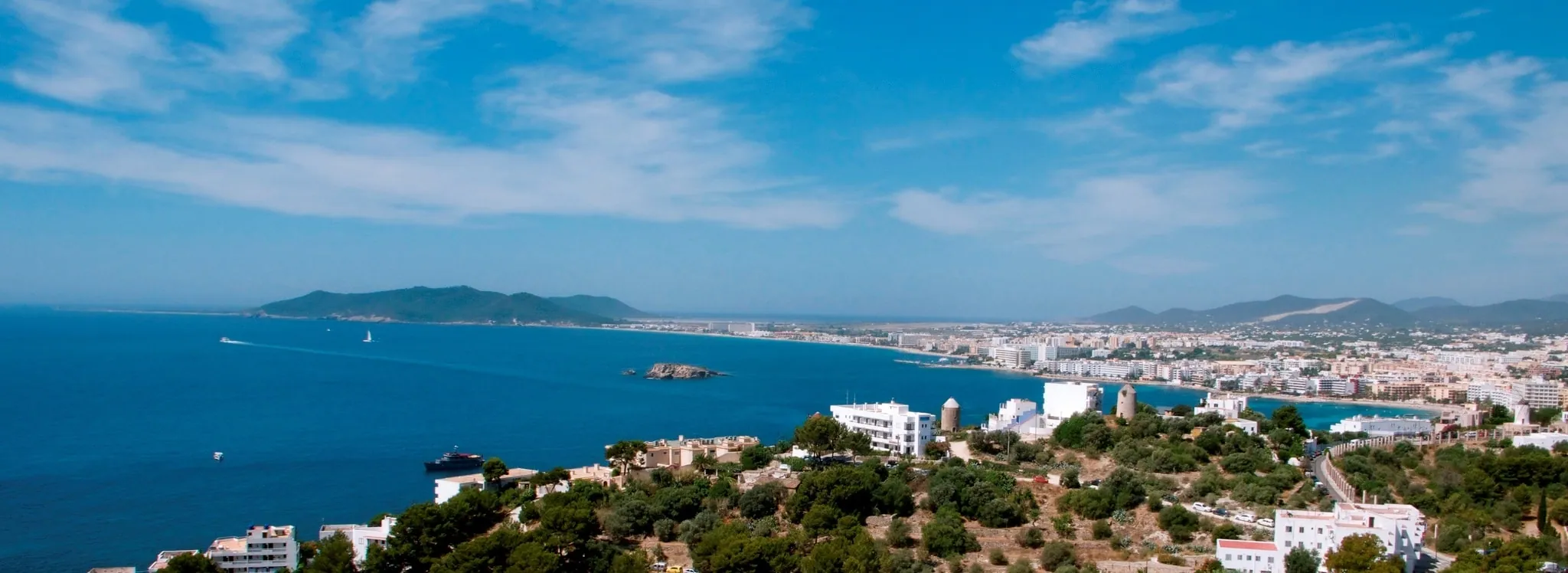
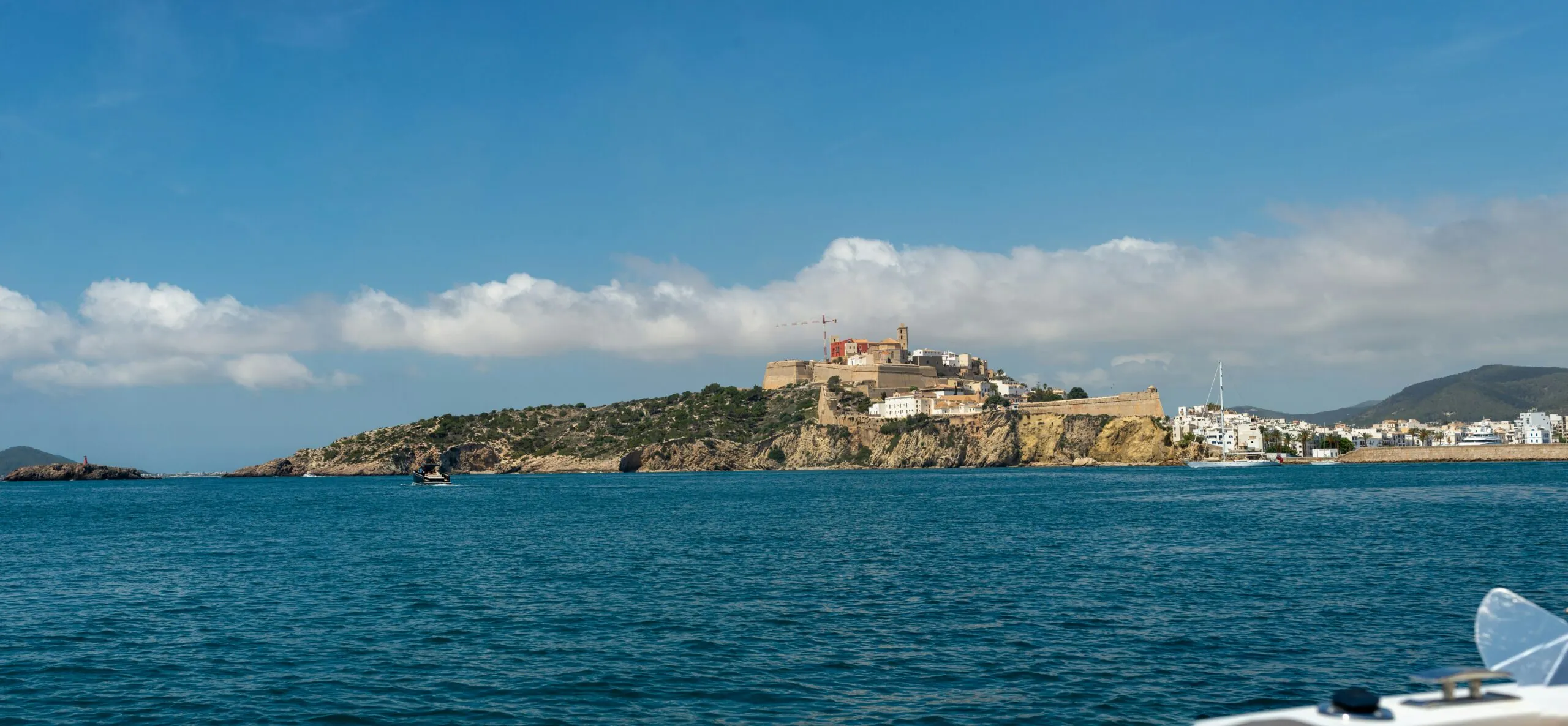
- Ibiza Town (Eivissa) (55,337 residents as of the 2025 Padrón): The administrative and cultural capital, combining the UNESCO-listed fortified citadel of Dalt Vila, the superyacht marinas of Marina Botafoch and Marina Ibiza, and the vibrant seafront districts of Talamanca and Figueretas.
- Santa Eulària des Riu (42,479 residents): The eastern municipality favoured by year-round families, home to a palm-lined promenade, a modern marina, international school access, and sought-after rural villages such as Santa Gertrudis and Jesús.
- Sant Josep de sa Talaia (29,761 residents): Encompassing the southwest and south coast, this municipality holds the airport, golden coves like Cala Comte and Cala Jondal, and the island’s highest concentration of ultra-prime cliffside villas within gated enclaves such as Vista Alegre and Es Cubells.
- Sant Antoni de Portmany (29,132 residents): The western bay celebrated for sunset views, a regenerating waterfront promenade, and tranquil rural inland parishes like Buscastell and Santa Agnès.
- Sant Joan de Labritja (7,046 residents): The low-density, pine-clad north where traditional whitewashed fincas, terraced agricultural valleys and secluded coves such as Benirràs and Cala Xarraca attract buyers seeking absolute privacy.
What Housing Stock Defines Ibiza and Who Is Buying?
Ibiza’s property market features a striking architectural dichotomy. Traditional cubic country houses—known as fincas payesas—feature thick dry-stone walls coated in traditional whitewash (cal), timber beam ceilings, and expansive rustic plots. Alongside these historic farmhouses stand contemporary glass-and-stone architectural villas in hillside urbanisations, modern lock-up-and-leave apartments overlooking the marinas, and historic townhouses nestled within Dalt Vila.
Who is acquiring these properties? According to data from the Colegio de Registradores, foreign buyers accounted for 29.8% of all residential property sales across the Balearic Islands in 2025, peaking at 31.47% in the final quarter of that year—the highest proportion in Spain. British, German, Dutch, Italian, French and mainland Spanish buyers drive this demand, predominantly purchasing with cash or conservative financial leverage. For a deeper look at regional demand patterns, explore our analysis of lifestyle and second homes in Mallorca and Ibiza.
How Is the Ibiza Property Market Performing in Q3 2026?
Market metrics in Ibiza reflect acute scarcity and sustained demand for premium assets. According to CASAFARI Area Insights (queried on 23 October 2026 for island location id 313381), average asking prices from active listings indexed by CASAFARI (outliers excluded) stood as follows:
- Apartments for sale in Ibiza: Reached an average asking price of €7,503/m² in Q3 2026, marking a 5.3% increase year on year from €7,128/m² in Q3 2025.
- Houses and villas for sale in Ibiza: Reached an average asking price of €10,319/m² in Q3 2026, representing a 1.4% year-on-year rise from €10,178/m² in Q3 2025.
To contextualise these figures against official closing prices, notary and land registry data (CIEN / Colegio de Registradores) show that actual closing prices across the Balearic Islands averaged €3,988/m² in 2025, with foreign buyers paying an average closing price of €4,896/m² in 2025 and €5,344/m² in H1 2026. Ibiza’s asking prices sit notably above the archipelago-wide average due to strict geographic boundaries, rigorous municipal planning restrictions on new construction, and the concentration of luxury turnkey stock. Notably, apartment asking prices are growing faster (+5.3% YoY) than houses (+1.4% YoY) as buyers compete for manageable, high-spec lock-up-and-leave residences in prime urban and marina locations.
What Taxes, Tourist Licence Rules and Planning Laws Matter to Buyers in 2026?
Navigating Ibiza’s regulatory framework requires careful attention to regional fiscal and planning codes:
- Purchase taxes (ATIB): Resale properties incur the progressive Balearic Property Transfer Tax (Impuesto sobre Transmisiones Patrimoniales, ITP) managed by the Agència Tributària de les Illes Balears (ATIB) transfer tax scales. Rates range from 8% on the first €400,000; 9% for the band between €400,000.01 and €600,000; 10% between €600,000.01 and €1,000,000; 12% between €1,000,000.01 and €2,000,000; and 13% on any excess over €2,000,000 (with reduced concessions for eligible young or disabled primary-residence buyers). New-build acquisitions carry 10% IVA (VAT) plus Balearic Stamp Duty (AJD) of 1.5%, rising to 2% for properties valued at €1,000,000 or more.
- Wealth Tax: The Balearic autonomous wealth tax threshold stands at €3,000,000 in net assets (Law 12/2023), allowing non-residents whose primary Spanish assets are located in the Balearics to apply this regional allowance rather than the lower state limit.
- Tourist rental licences (ETV): Under the moratorium in force since February 2022 and reinforced by Decree-Law 4/2025, no new ETV short-term rental licences are issued in Ibiza, and holiday letting is strictly banned in multi-family apartment buildings. Only detached houses holding an active, verified DRIAT licence (which lapses automatically if unused for three consecutive years) may legally host paying holiday guests. The Consell d’Eivissa maintains rigorous enforcement, having opened 262 sanction files and collected over €1.06 million in fines, with tourism penalties reaching up to €400,000 and urban-use penalties under Article 167.4 of the Balearic Urban Law (LUIB) set at 50% to 100% of the property’s value.
- Rustic land rules and Law 7/2024: Constructing a new home on common rustic land (suelo rústico común) requires a minimum plot of 15,000 m² under the Insular Territorial Plan (PTI) and LUIB, with strict volume limits and an absolute prohibition in protected areas (ANEI and ARIP). For older country houses with historic, statute-barred alterations, Balearic Law 7/2024 offers an extraordinary three-year legalisation window (running through 2025–2027) subject to energy and water efficiency upgrades and a municipal regularisation fee ranging from 10% to 15% of execution costs.
- Residency routes: Spain abolished the €500,000 real estate Golden Visa on 3 April 2025 under Organic Law 1/2025. Non-EU and UK buyers relocating to the island now utilise alternative pathways including the Non-Lucrative Visa, the Digital Nomad / International Telework Visa, or the Entrepreneur Visa.
For comprehensive guidance on drafting binding agreements and navigating public deeds, consult our guide on contracts and the public deed (escritura) when buying in Spain.
How Do Real Estate Professionals Analyse and Source Property in Ibiza with CASAFARI?
Because Ibiza lacks a single central multiple listing service and high-end properties are frequently marketed across multiple agencies at varying asking prices, professional investors and advisors rely on aggregated data infrastructure. Industry professionals use CASAFARI Area Insights to monitor macro pricing trends, supply shifts and liquidity across municipalities.
To eliminate duplicate listings and uncover off-market opportunities, professionals deploy CASAFARI Property Sourcing, which aggregates hundreds of portals into a single verified feed with historical pricing data. Furthermore, advisors combine active asking comparables with verified closing data using property valuations and comparative market studies. To explore these analytical tools directly, sign in to the CASAFARI platform or consult the technical Area Insights API and MCP documentation.
Frequently asked questions
Can you still get a tourist rental licence (ETV) in Ibiza?
No new tourist rental licences (Estancia Turística en Vivienda, or ETV) are currently being issued in Ibiza due to the indefinite regional moratorium reinforced by Decree-Law 4/2025. Short-term holiday lets are also strictly prohibited in multi-family apartment buildings across the island. To operate legally, a property must be a detached house holding an active, pre-existing DRIAT tourist licence that has not lapsed through three consecutive years of inactivity.
What are the property purchase taxes in Ibiza and the Balearic Islands?
Resale property purchases in Ibiza are subject to the Balearic Islands’ progressive Property Transfer Tax (ITP) administered by the ATIB, with marginal brackets ranging from 8% on the first €400,000 up to 13% on any amount exceeding €2,000,000. For brand-new properties bought directly from developers, buyers instead pay 10% Value Added Tax (IVA) alongside Balearic Stamp Duty (AJD) of 1.5%, which increases to 2% for properties valued at €1,000,000 or more.
How can UK and non-EU citizens move to Ibiza after the end of Spain’s Golden Visa?
Spain officially abolished the real estate Golden Visa pathway on 3 April 2025 under Organic Law 1/2025. British and other non-EU nationals wishing to reside in Ibiza for more than 90 days within any 180-day period now secure residency through alternative programmes. The primary options include the Non-Lucrative Visa for financially independent retirees, the International Telework or Digital Nomad Visa for remote professionals, and the Entrepreneur Visa.
What should buyers check when purchasing a rustic finca in Ibiza?
Country houses on rustic land (suelo rústico) are governed by strict municipal and island planning rules, requiring a minimum plot size of 15,000 m² for new builds on common rustic land and imposing total building bans in protected environmental zones. Buyers must verify the certificate of occupancy (cédula de habitabilidad) and ensure all pools, annexes and extensions match municipal archives and land registry records. Properties with historic, unpermitted extensions can potentially utilise the extraordinary legalisation window under Balearic Law 7/2024 through May 2027 by paying regularisation penalties and upgrading energy and water systems, though such regularised homes remain barred from obtaining tourist rental licences.
How accessible is Ibiza for year-round residents and international owners?
Despite its reputation as a summer hotspot, Ibiza maintains year-round connectivity, with the airport handling over 9.1 million passengers in 2025. Beyond the seasonal summer routes, the island preserves essential domestic air links to cities like Madrid and Barcelona and maintains daily ferry connections to mainland ports such as Dénia and Valencia throughout the winter.
Who typically buys property in Ibiza and how do they fund their acquisitions?
The Ibiza property market is driven by a significant international presence, with foreign buyers accounting for 29.8% of residential sales across the Balearic Islands in 2025. These investors, primarily from the UK, Germany, Italy, the Netherlands and France, overwhelmingly opt for cash purchases or conservative financial leverage when acquiring their properties.