
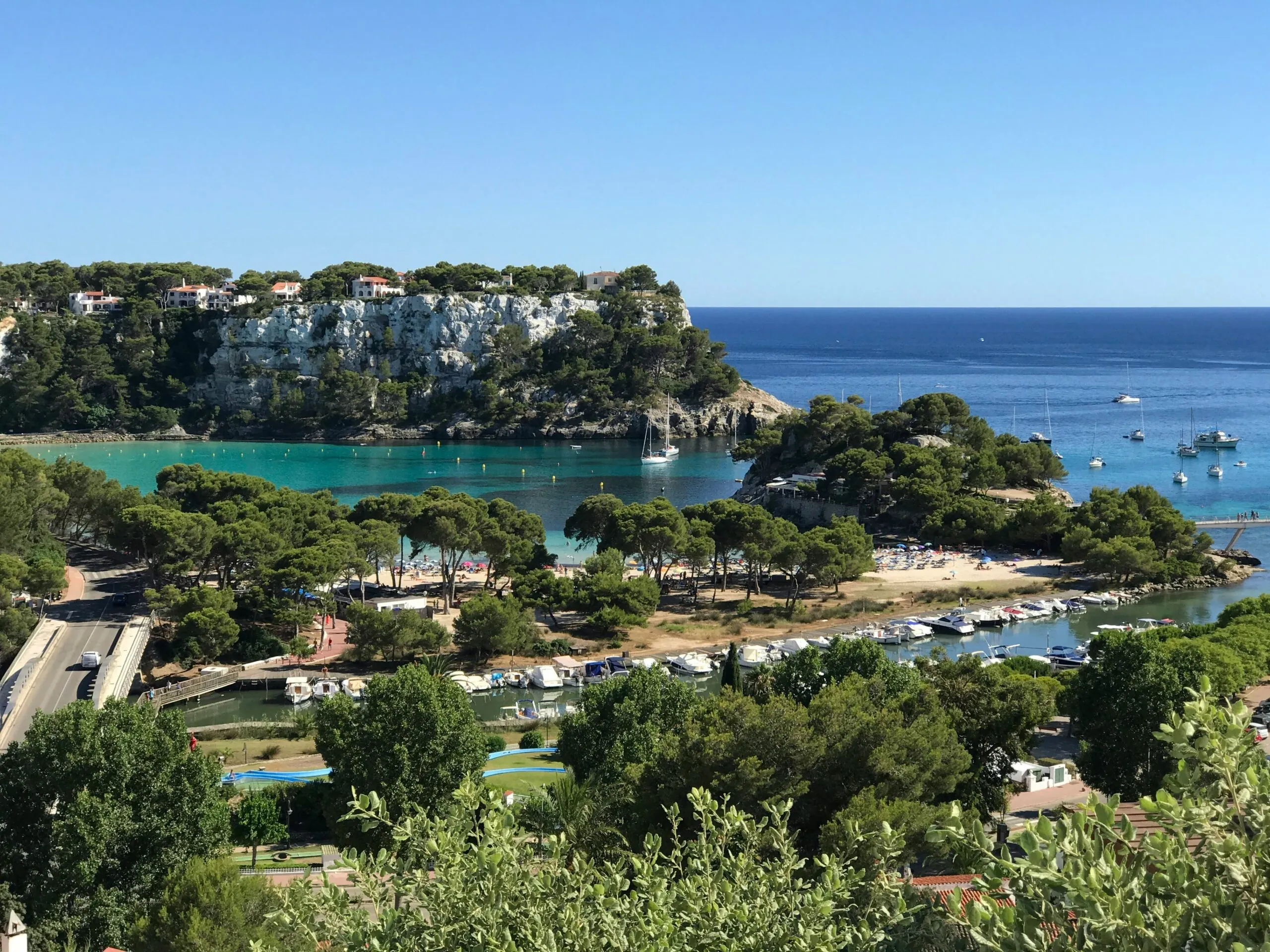
Menorca is the easternmost and most protected of Spain’s Balearic Islands, a UNESCO Biosphere Reserve since 1993 where strict planning limits supply. According to CASAFARI Area Insights in Q3 2026, average asking prices from listings stand at €4,302/m² for apartments (+9.2% YoY) and €4,546/m² for houses (+4.1% YoY). For context on the wider property market in Spain, Menorca provides a resilient, low-density counterpoint.
Where Menorca sits in the Balearics and how it is connected
Covering 701.8 km² of land with 216 km of coastline and 75 officially catalogued beaches, Menorca is surrounded by a 514,485-hectare terrestrial and marine Biosphere Reserve, expanded in June 2019 (Ministry for the Ecological Transition MITECO / UNESCO). Permanent population stood at 102,821 inhabitants across eight municipalities as of January 2025 (Instituto Nacional de Estadística INE / IBESTAT), anchored by the two historic urban poles along the Me-1 road: Ciutadella de Menorca in the west (32,431 residents) and the capital Maó in the east (30,666 residents), followed by Alaior (10,217), Es Castell (7,774), Sant Lluís (7,312), Es Mercadal (6,459), Ferreries (5,170) and Es Migjorn Gran (1,765).
Air and sea links remain robust. Menorca Airport (MAH) operates year-round direct flights to Madrid, Barcelona, Valencia, Bilbao, Palma de Mallorca and London-Gatwick, expanding between March and November to eight additional UK airports (Luton, Stansted, Manchester, Liverpool, Bristol, Birmingham, East Midlands and Leeds). Regular ferries operated by Baleària, Trasmed and GNV connect Maó and Ciutadella daily with Barcelona, Valencia and Alcúdia and Palma in Mallorca.
Housing stock and neighbourhoods: from Maó’s Georgian townhouses to Ciutadella’s palaces
Menorca’s architectural landscape divides distinctly between its two main towns. Maó and neighbouring Es Castell reflect eighteenth-century British rule, featuring townhouses with traditional sliding sash windows and shuttered balconies overlooking one of the Mediterranean’s largest natural harbours. Buyers here gravitate toward historic centre properties, waterfront apartments, and coastal villas in Cala Llonga and Sant Lluís (including Binibèquer and Binisafúller). In contrast, Ciutadella preserves honey-coloured mares-stone aristocratic palaces, vaulted ground floors and medieval lanes around its cathedral, alongside coastal residential zones such as Cala Morell, Son Xoriguer and Cala en Blanes.
Interior market towns like Alaior, Es Mercadal and Ferreries offer authentic village townhouses, while the countryside features traditional stone farmsteads (llocs) and prehistoric Talayotic monuments. Roughly two-thirds of the island’s territory is strictly protected under the Plan Territorial Insular (PTI, revised May 2023 by the Consell Insular de Menorca) as Special Interest Natural Areas (ANEI) or High-Level Protection Areas (AANP), rendering authentic rural fincas exceedingly scarce.
Menorca property prices and market trends in Q3 2026
According to CASAFARI Area Insights for the Island of Menorca (location id 3688856, queried 25 October 2026, outliers excluded), asking prices from active listings showed steady growth. Apartments for sale recorded an average asking price of €4,302/m² in Q3 2026, up 9.2% year-on-year from €3,939/m² in Q3 2025. Houses and villas for sale reached an average asking price of €4,546/m² in Q3 2026, representing a 4.1% year-on-year increase from €4,367/m² in Q3 2025. These figures reflect asking prices from indexed listings rather than closing prices.
For broader archipelago context, official closing figures from the Colegio de Registradores Anuario 2025 show that foreign buyers accounted for 29.8% of all home purchases in the Balearic Islands in 2025, paying an average closing price of €548,662 compared to €304,120 for domestic buyers. Balearic registered closing prices averaged €4,173/m² in Q1 2026 (+10.3% YoY). Analysts and investors utilize property valuation and market study tools to benchmark asking prices against comparable market evidence.
Taxes, tourist licences and legal rules for buyers in 2026
Property acquisitions in Menorca are subject to specific regional taxes and administrative controls managed by the Agència Tributària de les Illes Balears (ATIB). Resale homes incur a progressive Property Transfer Tax (ITP) ranging from 8% on the first €400,000 up to 13% for portions exceeding €2,000,000, with reduced rates subject to a €331,859.70 property value cap. New-build properties attract 10% IVA and 1.5% to 2% Stamp Duty (AJD).
Short-term holiday lettings are tightly governed. Decree-Law 4/2025 maintains a regional moratorium on new tourist beds and bans new tourist licences (ETV) in multi-family apartment buildings. In Menorca, Consell Insular Resolution 2025/284 permits deregistered tourist beds at €2,500 per bed, restricted exclusively to detached single-family houses inside designated permitted zones.
Non-EU and British buyers must navigate two additional regulatory frameworks: the abolition of the Spanish Golden Visa via Organic Law 1/2025 (Boletín Oficial del Estado BOE), which ended residency permits for €500,000+ real estate purchases in April 2025, and mandatory military authorisation from the Ministry of Defence required for non-EU citizens purchasing rural land (suelo rústico) in National Defence Interest Zones. Professional buyers can review our guide to the Spanish purchase contract and escritura for transaction procedures.
How real estate professionals and investors analyse Menorca with CASAFARI
Because Menorca’s property market spans local agencies, national portals and international brokerages, duplicate listings and valuation discrepancies frequently occur. Real estate agents, developers and institutional investors rely on CASAFARI Property Sourcing to aggregate and deduplicate every active listing across the island’s eight municipalities, tracking historical price adjustments and status changes.
By pairing granular portal data with verified market analytics, professionals can evaluate asking prices across Maó, Ciutadella and coastal urbanisations with absolute confidence. Explore the data directly by visiting the sign in to the CASAFARI platform.
Frequently asked questions
Do British buyers need military permission to buy rural property in Menorca?
Yes. Under Spain’s Law 8/1975 and Royal Decree 689/1978, the entire Balearic archipelago is classified as a National Defence Interest Zone. Since Brexit, UK citizens and other non-EU nationals must obtain prior military authorisation from the Spanish Ministry of Defence before signing the public deed and registering any property located on rural land. Urban residential properties within towns and designated coastal developments are exempt from this requirement.
Can you get a tourist rental licence (ETV) for a property in Menorca?
Under Balearic Decree-Law 4/2025, new tourist rental licences are prohibited in multi-family apartment buildings. In Menorca, Consell Insular Resolution 2025/284 established a temporary pool of deregistered tourist beds priced at €2,500 per bed, available exclusively for detached single-family houses located within officially permitted tourist zones. Investors seeking holiday rental income typically purchase a detached villa in an eligible zone or acquire a property holding an active pre-existing licence.
What are the property purchase taxes (ITP) in Menorca and the Balearic Islands?
Resale property purchases in Menorca incur the Balearic progressive Property Transfer Tax (ITP), managed by the ATIB. Rates begin at 8% on the first €400,000, rising to 9% up to €600,000, 10% up to €1,000,000, 12% up to €2,000,000, and 13% on amounts above €2,000,000. Reduced rates of 4% or lower apply only to primary residences and younger buyers when the property value does not exceed the regional cap of €331,859.70.
Does buying a property in Menorca still grant a Spanish Golden Visa?
No. Under Organic Law 1/2025, which took effect on 3 April 2025, Spain officially abolished the investor residency visa for real estate purchases of €500,000 or more. Non-EU buyers, including British nationals, can purchase property in Menorca freely, but those intending to reside in Spain for more than 90 days in a 180-day period must apply through alternative legal residency routes such as the Non-Lucrative Visa or the Digital Nomad Visa.
How do the property markets differ between Maó and Ciutadella?
Maó and neighbouring Es Castell offer a distinctly British-influenced architectural heritage, featuring historic townhouses with sash windows and shuttered balconies set around one of the Mediterranean’s largest harbours. Conversely, Ciutadella is renowned for its aristocratic palaces built from local honey-coloured mares-stone, medieval lanes and grand vaulted ground floors. Buyers looking for coastal villas typically explore areas like Cala Llonga and Sant Lluís for the former, while Ciutadella offers unique residential options such as Cala Morell and Son Xoriguer.
Is it easy to find a rural finca to buy on the island?
Finding an authentic rural finca is quite difficult as roughly two-thirds of Menorca’s territory is strictly protected under the Plan Territorial Insular (PTI), as revised in May 2023. These areas are designated as Special Interest Natural Areas (ANEI) or High-Level Protection Areas (AANP), which severely limit development. Because of these protections, the supply of true rural farmsteads, known locally as llocs, remains exceptionally scarce for prospective buyers.