
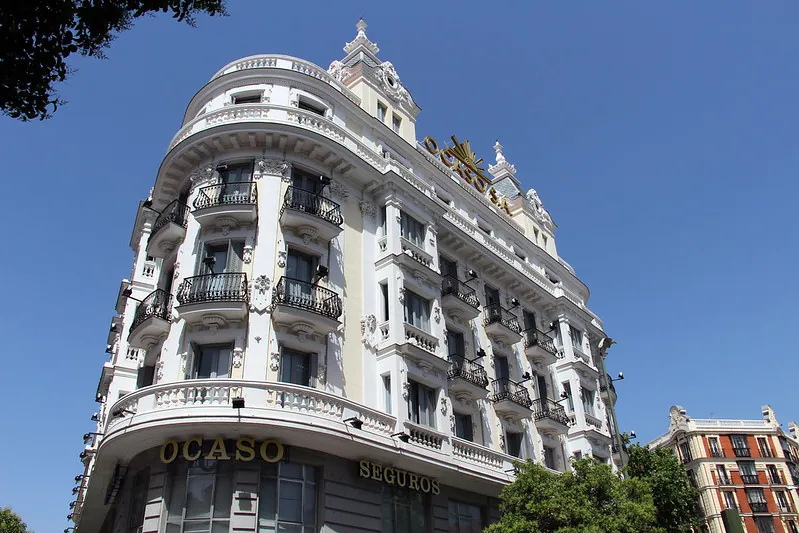
Chamberí (District 7) is Madrid’s quintessential prime residential district immediately north of Centro and west of Salamanca, spanning 4.68 square kilometres and 138,667 residents across six distinct barrios. According to CASAFARI Area Insights, apartments for sale in the district reached an average asking price of €9,484 per square metre in Q3 2026, contrasting with official registered closing prices of €7,559 per square metre reported by the Colegio de Registradores for the end of 2025.
Where Chamberí sits in Madrid and how its six barrios connect
Chamberí occupies a strategic position immediately north of Madrid Centro and west of the Salamanca district, separated from Salamanca and the AZCA financial hub by the wide axis of Paseo de la Castellana. To the west lies Moncloa-Aravaca, and to the north sits Tetuán. Within its 467.92 hectares (Ayuntamiento de Madrid, January 2025), the district is divided into six administrative barrios: Almagro, Trafalgar, Arapiles, Gaztambide, Ríos Rosas and Vallehermoso. Each neighbourhood possesses a distinct architectural character and buyer profile, making an understanding of micro-locations essential for international investors.
Transport connectivity is exceptional. The district is served by 13 Metro stations across Lines 1, 2, 3, 4, 5, 6, 7, 8 and 10—including Alonso Martínez, Gregorio Marañón, Bilbao, Quevedo and Canal—anchored by the Moncloa interchange to the west and Nuevos Ministerios to the north-east, which offers direct Metro Line 8 trains to Madrid-Barajas Airport and six Cercanías Renfe commuter lines (Metro de Madrid, October 2026).
Everyday life, architecture and housing stock across Chamberí
Chamberí successfully balances a castizo, neighbourhood atmosphere with sophisticated cosmopolitan living. Leafy public spaces like Plaza de Olavide and Plaza de Chamberí anchor vibrant communities where traditional vermouth taverns sit alongside contemporary dining, including the two-Michelin-starred Restaurante Coque on Calle Marqués del Riscal (Michelin Guide Spain 2026). Cultural landmarks include the Teatros del Canal, Andén 0 (the preserved 1919 ghost metro station), the sports facilities of Parque de Santander, and the Sorolla Museum, which partially reopened on 15 October 2026 via a new 2,000+ square metre extension accessed via Calle Zurbano 68 while its historic house-museum completes restoration (Ministerio de Cultura, October 2026).
The housing stock varies considerably across the six sub-markets. Almagro is characterised by grand late-19th and early-20th-century classical architecture, embassies and palacetes featuring high ceilings, ornate stone façades and concierge services. Trafalgar and Ríos Rosas—including the lively gastronomic hub of Calle Ponzano—offer sought-after period buildings and turn-of-the-century bourgeois apartments popular with international executives and families. Further west towards the university corridor, Gaztambide, Arapiles and Vallehermoso feature mid-century residential blocks providing strong long-term rental liquidity.
Chamberí property prices and rental trends: asking versus closing figures
Analysing prime Madrid real estate requires separating advertised asking prices from official transaction deeds. According to CASAFARI Area Insights, apartments for sale in Chamberí reached an average asking price of €9,484 per square metre in Q3 2026 (queried 25 October 2026, location ID 11781, outliers excluded), representing a 2.5% year-on-year increase from €9,255 per square metre in Q3 2025. In the rental sector, asking rents averaged €31.7 per square metre per month in Q3 2026, down 3.9% year on year from €33.0 per square metre in Q3 2025 as asking rates consolidate following post-2022 peaks.
By contrast, official data from the Colegio de Registradores and the Ayuntamiento de Madrid (end of 2025) show that completed sales in Chamberí closed at an average registered price of €7,559 per square metre. This sits well above the Community of Madrid regional closing average of €4,091 per square metre and Spain’s national closing average of €2,284 per square metre for 2025. Combining live listing data with historical registry deeds is vital for accurate underwriting, a workflow supported by the property valuation and market study tool.
Taxes, tourist licences and residency rules for buyers in 2026
Property acquisition in Chamberí is shaped by a distinct regional tax and regulatory framework. Resale residential properties in the Community of Madrid are subject to a 6% general Property Transfer Tax (Impuesto de Transmisiones Patrimoniales – ITP), calculated on the higher of the deed price or the Cadastral Reference Value, with a 10% rebate (an effective rate of 5.4%) for primary residences under €250,000 (Comunidad de Madrid, April 2026). International buyers should also consult a thorough guide to buying property in Spain and understand Spanish property contracts and the public deed.
Regulatory changes have also transformed short-term rentals and investment residency. Under the Ayuntamiento de Madrid’s Plan Reside (in force since 22 September 2025), new licences for scattered short-term tourist flats (Viviendas de Uso Turístico, VUT) are strictly banned inside residential buildings throughout the central ring—including all of Chamberí—even on ground floors with independent street access. Furthermore, Spain officially repealed the €500,000 real estate Golden Visa on 3 April 2025 under Organic Law 1/2025. While Madrid’s regional ‘Ley Mbappé’ (Law 4/2024) provides a 20% personal income tax deduction for new tax residents, it expressly applies to financial assets and excludes direct real estate investments.
How investors and estate agents analyse Chamberí with CASAFARI
Navigating a high-barrier district like Chamberí requires granular market intelligence. Real estate professionals use CASAFARI Property Sourcing to deduplicate listings aggregated from across portals, uncover private or for-sale-by-owner opportunities, and track historical price reductions across Almagro, Trafalgar and beyond. For developers, investment funds and tech-enabled agencies seeking to automate market analysis, the Casafari MCP for real estate AI agents and the Area Insights API documentation allow direct integration into proprietary software. To begin exploring institutional datasets and professional tools, sign in to the CASAFARI platform.
Frequently asked questions
Which is the best neighbourhood to buy property in Chamberí, Madrid?
The ideal neighbourhood depends entirely on your investment strategy and lifestyle preferences. Almagro is the premier address for diplomatic and trophy residential buyers seeking stately 19th-century architecture along Paseo de la Castellana. Trafalgar and Ríos Rosas attract lifestyle buyers and professionals seeking period flats close to bustling plazas like Plaza de Olavide, whereas Gaztambide, Arapiles and Vallehermoso offer strong long-term rental liquidity geared towards students and university faculty.
Are short-term tourist rentals allowed in Chamberí under Madrid’s Plan Reside?
No, new short-term tourist flat licences (VUT) are prohibited inside residential buildings throughout Chamberí. Following the implementation of Madrid’s Plan Reside on 22 September 2025, scattered tourist apartments are banned across the entire central ring, even on ground-floor units with independent street access. Investors must focus on long-term residential leasing or compliant medium-term corporate lets.
What taxes and residency rules apply when buying a flat in Chamberí?
Resale property buyers in the Community of Madrid pay a 6% Property Transfer Tax (ITP) on the higher of the purchase price or the Cadastral Reference Value (or 5.4% for primary homes under €250,000). Non-EU buyers should note that Spain repealed the €500,000 real estate Golden Visa in April 2025. Additionally, Madrid’s 20% regional income tax deduction for incoming residents (‘Ley Mbappé’) applies solely to financial investments and excludes direct real estate purchases.
How does CASAFARI help investors and estate agents value and source property in Chamberí?
CASAFARI aggregates, cleans and deduplicates listings from hundreds of portals across the Spanish market, allowing professionals to benchmark live asking prices—such as Chamberí’s Q3 2026 average of €9,484 per square metre—against historical listing changes and official registry deeds. Agents and buyers use Property Sourcing, Comparables tools, and the Casafari MCP to spot mispriced assets, track time on market, and generate evidence-backed valuations in minutes.
What kind of housing stock should I expect when exploring different parts of the district?
The district offers a diverse range of architecture depending on the barrio. Almagro is home to grand 19th and early 20th-century classical palacetes, while Trafalgar and Ríos Rosas provide sought-after period apartments. Moving towards Gaztambide, Arapiles and Vallehermoso, the landscape shifts to mid-century residential blocks that are particularly popular for long-term rental investments.
How well-connected is the area for those who need to travel for business or travel frequently?
Connectivity is excellent, with 13 Metro stations serving the area across nine different lines. The Nuevos Ministerios transport hub to the north-east provides direct rail links to Madrid-Barajas Airport, while the Moncloa interchange facilitates easy travel to the west. This extensive infrastructure makes it a highly practical location for both local professionals and international residents.