
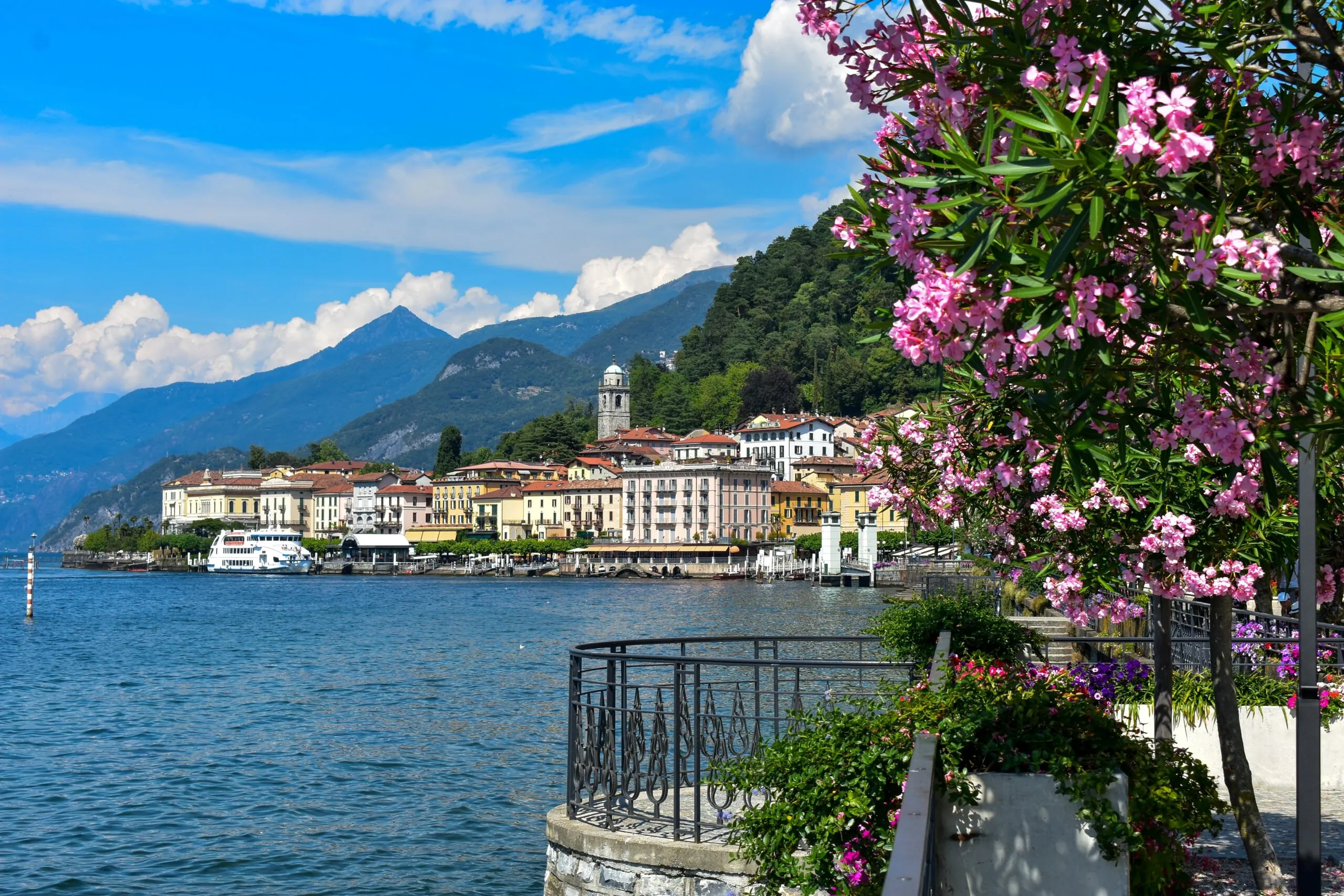
Nestled at the southern tip of Lake Como’s western branch on the Swiss border, Como functions as a vital Lombardy provincial capital and international gateway. According to CASAFARI Area Insights (location id 211097, queried October 2026), asking prices in the Comune of Como reached €3,510/m² for apartments (+12.7% year on year) and €4,049/m² for houses (+11.9% year on year), reflecting robust demand across this dynamic dual-engine market. Explore the broader context in our Italy property market guide.
Where is Como and how connected is it to Milan and Switzerland?
Como sits at the heart of an active regional economy, combining a historic urban centre with seamless cross-border mobility. According to the ISTAT demographic statistics for Como (2026), the Comune of Como recorded 83,035 residents at the start of 2026, while the broader Province of Como reached 605,405 inhabitants. For commuters and travellers, rail connectivity is exceptionally efficient: direct EuroCity and RegioExpress services run from Como San Giovanni to Milano Centrale in approximately 40 minutes, while Trenord trains connect Como Lago to Milano Cadorna in 55 to 60 minutes. Furthermore, cross-border journeys to Lugano take between 30 and 39 minutes, and Milan Malpensa Airport is accessible in roughly 1 hour 15 to 30 minutes via Saronno.
What is daily life like in Como, Brunate and the lakeside villages?
Daily life in Como blends medieval heritage with lively lakeside culture. The walled historic centre, known as the Città Murata, is framed by 12th-century stone walls and the imposing Porta Torre, flanked by Torre Vitali and Torre Gattoni, alongside the Gothic-Renaissance Duomo di Como (Cathedral of Santa Maria Assunta). Rising steeply above the city is the historic 1894 Como–Brunate funicular railway, which climbs 495.5 metres of vertical rise over a 55.2% gradient in about seven minutes to Brunate station, where the town hall sits at 715 metres above sea level and the 29-metre Faro Voltiano (1927) at San Maurizio reaches roughly 909 metres. Beyond the urban core, the lake basin extends into scenic coastal borghi: the western shore features Borgo di Soldino in Laglio and the medieval municipality of Brienno, while the eastern shore encompasses Pognana Lario and the historic Lezzeno hamlets of Cavagnola and Sormazzana along the ancient Strada Regia.
What does the housing stock look like and who buys in Como?
The Como property market offers a remarkably diverse architectural stock that appeals to several distinct buyer profiles. Within the Città Murata, buyers find period apartments inside historic palazzi, whereas Borgo Vico and the station districts offer rationalist and post-war condominiums. The panoramic hillsides of Monte Olimpino, Cardano and Brunate feature early-20th-century Liberty villas, and the coastal borghi showcase traditional stone townhouses (case di corte). Four primary groups compete for this inventory: cross-border workers (frontalieri) and Swiss buyers capitalising on the 30-minute link to Lugano; Milanese professionals trading urban flats for lakeside views; international high-net-worth individuals targeting trophy villas or Italy’s flat-tax regime; and yield-driven investors acquiring apartments near the lakefront.
How are property prices and transactions performing in Como in 2026?
Driven by tight geographical constraints and sustained international demand, asking prices across the municipal territory have experienced steady upward momentum. Based on CASAFARI Area Insights for the Comune of Como (location id 211097, queried 25 October 2026, outliers excluded), asking prices for apartments for sale reached €3,510/m² in Q3 2026, representing a 12.7% increase year on year from €3,115/m² in Q3 2025. Simultaneously, asking prices for houses for sale reached €4,049/m² in Q3 2026, up 11.9% from €3,617/m² in Q3 2025. Every price figure represents an ASKING price derived from indexed listings rather than a closing price.
To contextualise these asking prices with official transaction volume, figures published by the Agenzia delle Entrate OMI regional residential transaction statistics show that the Comune of Como recorded 1,391 normalised residential sales (NTN) in 2025, contributing to a provincial total of 9,483 transactions (+5.8% compared with 8,964 in 2024). This limited municipal liquidity underpins steady price growth, which professionals analyse using CASAFARI Area Insights, CASAFARI Property Sourcing, and Valuation & Market Study. Readers seeking broader regional context can also review our Northern Italy rental market overview and our analysis on how Italian agencies access the whole market with CASAFARI.
Which taxes, short-let rules and planning constraints matter to buyers in 2026?
Navigating property acquisition in Italy requires careful attention to purchase taxes, holding levies, and compliance frameworks. According to the Agenzia delle Entrate, purchasing a residential property from a private seller incurs a 2% registration tax on the revalued cadastral value (prezzo-valore) for a primary residence (prima casa) or 9% for a second home, plus €50 each in mortgage and cadastral taxes. Purchases from developers subject to VAT incur 4% VAT for a primary residence, 10% for a second home, or 22% for luxury properties (categories A/1, A/8 and A/9), plus €200 fixed taxes. Owners of second homes within the municipality also pay municipal property tax (IMU) at an ordinary rate of 0.96% following Comune di Como IMU property tax rates.
Short-term tourist rentals are strictly regulated under national and regional frameworks. Under Law 199/2025, non-entrepreneurial short lets are capped at a maximum of two apartments per owner, taxed at 21% cedolare secca for the first unit and 26% for the second, while holding three or more units mandates a VAT number (Partita IVA). Hosts must complete a strict administrative process outlined by the Comune di Como tourist rental registration rules: filing a CIA or SCIA with the municipal SUAP, obtaining a regional CIR code via ROSS1000 from the Province of Como, and registering for the national CIN on the Ministry of Tourism BDSR platform, alongside mandatory safety equipment and guest reporting on Alloggiati Web.
Furthermore, properties situated within 300 metres of the shoreline or across designated panoramic zones are subject to landscape protection (vincolo paesaggistico under D.Lgs. 42/2004). As detailed in the Comune di Como landscape authorisation procedures, internal alterations require no permit, minor exterior changes follow a 60-day simplified procedure under D.P.R. 31/2017, and major structural changes or pools require an ordinary landscape permit with a binding Soprintendenza opinion taking 105 to 120 days. Finally, international buyers relocating their tax residency can leverage Italy’s flat tax regime (Art. 24-bis TUIR), set at an annual substitute tax of €300,000 on foreign income (plus €50,000 per family member) for transfers from 1 January 2026, or apply for the Investor Visa for Italy.
How can buyers, investors and agents analyse the Como market with CASAFARI?
Real estate professionals, buyer’s agents, and institutional investors rely on CASAFARI’s comprehensive data infrastructure to evaluate opportunities across Lake Como. By combining active asking prices from indexed listings with official closing data, users gain a complete picture of market liquidity. Technical teams can also consult the Area Insights API and MCP documentation for automated integration, or sign in to the CASAFARI platform to begin exploring live inventory and analytics today.
Frequently asked questions
What are the property purchase taxes for a buyer in Como in 2026?
When buying from a private seller in Italy in 2026, registration tax is calculated on the revalued cadastral value at 2% for a primary residence (prima casa, excluding luxury categories A/1, A/8 and A/9) or 9% for a second home, plus €50 mortgage and €50 cadastral tax. When buying from a developer subject to VAT, buyers pay 4% VAT for a primary residence, 10% for a second home, or 22% for luxury properties, plus fixed taxes of €200 each. Second-home owners in the Comune of Como also pay municipal IMU property tax at an ordinary rate of 0.96%.
What licences and rules apply to short-term tourist rentals in Como?
Under Law 199/2025, private landlords can let a maximum of two apartments under the non-entrepreneurial short-let regime, paying flat-rate cedolare secca tax of 21% on the first unit and 26% on the second; managing three or more units requires a VAT number and business registration. Before listing a property, hosts must submit a CIA or SCIA to the Comune of Como’s SUAP, obtain a regional CIR code from the Province of Como via ROSS1000, and generate a national CIN code on the Ministry of Tourism BDSR platform. Both codes must be displayed on all advertisements alongside compliant safety devices and guest registration on Alloggiati Web.
How does the landscape protection constraint (vincolo paesaggistico) affect renovations on Lake Como?
Under D.Lgs. 42/2004, all properties within 300 metres of the Lake Como shoreline and across designated historic or panoramic zones are subject to landscape protection. Internal refurbishments that do not alter external appearances are exempt from permits, while minor exterior modifications qualify for a simplified 60-day authorisation. Structural exterior alterations, swimming pools, or volume extensions require an ordinary landscape permit with a binding opinion from the Soprintendenza taking between 105 and 120 days, and unauthorised new volumes cannot be regularised retrospectively.
How do Italy’s flat tax and Investor Visa work for international buyers moving to Como?
Under Article 24-bis of the Italian Tax Code, individuals who have not been tax resident in Italy for nine of the past ten years can elect a substitute flat tax on all foreign-source income for up to 15 years, set at €300,000 per year plus €50,000 per family member for relocations from 1 January 2026. Non-EU citizens needing residency rights can apply for the Investor Visa for Italy, which grants a two-year renewable permit in exchange for investments such as €500,000 in an operating Italian company, €250,000 in an innovative start-up, or €2 million in government bonds.
How can I travel between Como, Milan and the surrounding lakeside towns?
Como offers excellent transit, with direct EuroCity and RegioExpress trains reaching Milano Centrale in approximately 40 minutes, and Trenord services connecting Como Lago to Milano Cadorna in 55 to 60 minutes. Within the local area, the historic 1894 funicular railway efficiently links the city centre to Brunate in seven minutes, while scenic coastal routes provide access to the borghi along both the eastern and western shores of the lake.
What kind of property can I expect to find in the Como area?
The market is remarkably diverse, ranging from period apartments within the historic Città Murata’s medieval walls to rationalist and post-war condominiums near the station districts. Buyers can also find early-20th-century Liberty villas on the panoramic hillsides of Brunate and Monte Olimpino, or traditional stone townhouses, known as case di corte, dotted throughout the scenic coastal borghi.