
Real estate CRM for estate agencies in 2026: how to choose
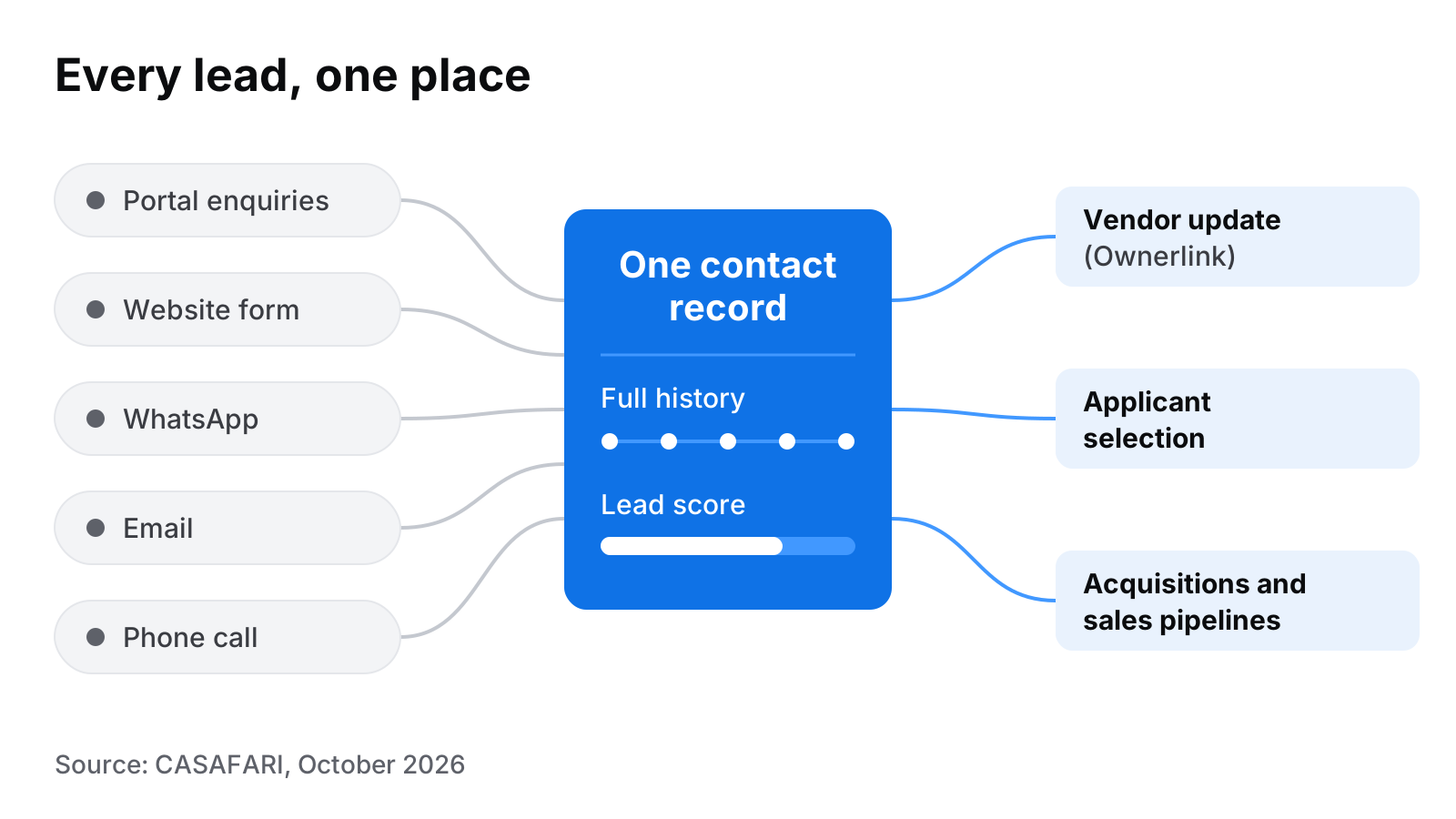
A real estate CRM for an estate agency must capture every lead from property portals, website forms, WhatsApp and email into a single record, maintain one master property listing that feeds distribution channels, update vendors and landlords automatically, and provide clear pipeline visibility for owners. In a UK residential market with roughly 95,000 completions a month according to HMRC statistics for August 2026 and annual price growth under 1% based on the UK House Price Index summary, agencies gain an edge by preventing operational leaks between enquiry and exchange. Dedicated tools such as CASAFARI CRM offer structured workflows and a Free plan to test before committing.
Why 2026 is the year to stop running an agency from an inbox
Consider a typical Tuesday evening in a two-branch estate agency. A portal enquiry for a three-bedroom semi-detached home arrives at 18:20, but negotiators have already logged off for the day. By the time the email is answered at 09:40 the following morning, the applicant has already booked two viewings through a rival business. Meanwhile, a vendor sends a WhatsApp message asking why no feedback has been shared following a second viewing on Saturday.
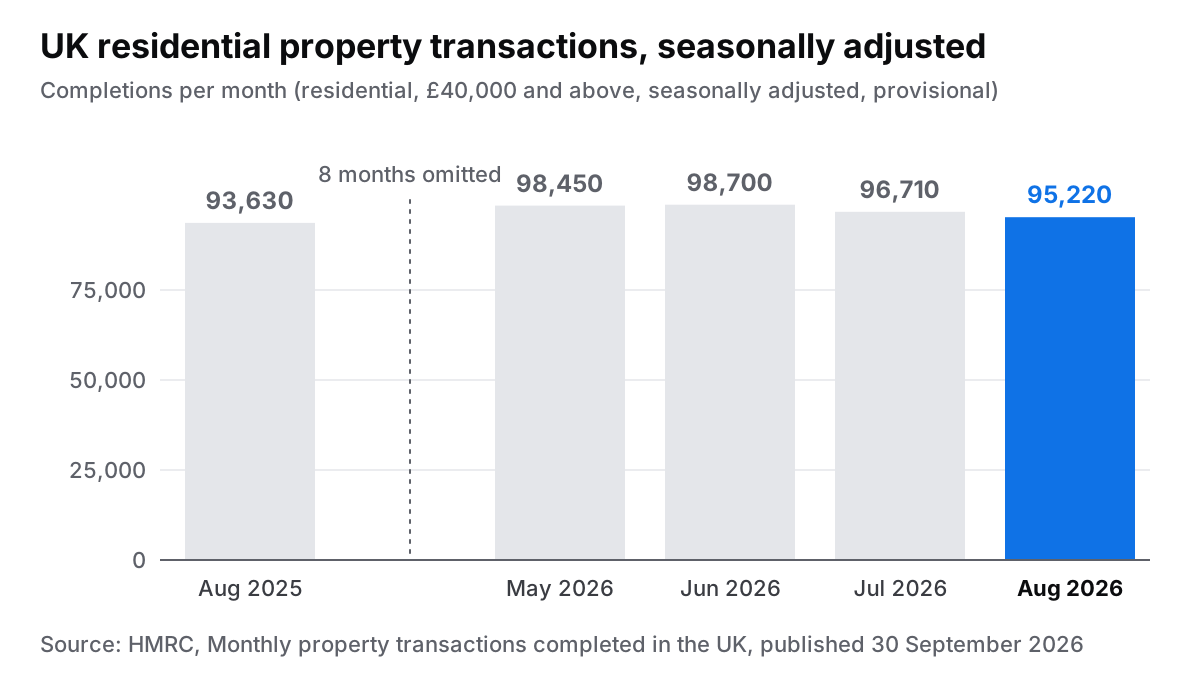
Operational slip-ups of this nature carry a higher cost when market conditions remain tightly constrained. Figures published by HMRC show provisional seasonally adjusted UK residential transactions reached 95,220 in August 2026—down 1% from 96,710 in July 2026 and 2% lower than the 93,630 recorded in August 2025. While earlier months saw slightly higher activity, with May 2026 at 98,450 and June 2026 reaching 98,700, total transaction volume has remained largely range-bound.
At the same time, house price appreciation has moderated across most of the UK. According to the UK House Price Index summary, the average UK house price stood at £273,000 in August 2026, representing an annual growth rate of 0.9% (down from 1.2% in the 12 months to July 2026). Regional variations show England at £294,000 (+0.4%), Wales at £216,000 (+3.1%), and Scotland at £198,000 (+2.9%). The Zoopla House Price Index for September 2026 similarly recorded an average UK house price of £273,000, noting that price growth continued to slow month on month.
Despite flatter price trajectories, consumer engagement remains substantial. Rightmove’s half-year results reported that home hunters spent about 8.4 billion minutes on its site and app during the first half of 2026. Demand exists, but applicants expect rapid responses across multiple communication channels. When market growth is modest, winning new instructions and converting existing leads depends on operational execution.
The four leaks every agency recognises
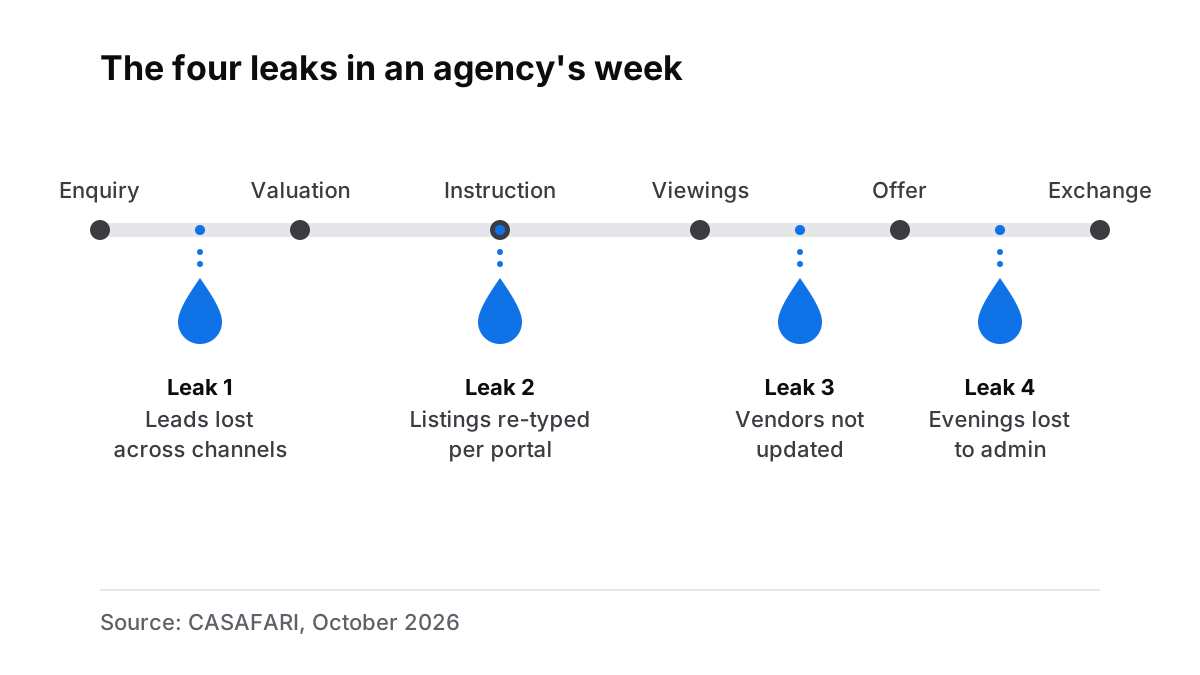
Agency growth is often impeded not by a lack of marketing, but by friction within daily workflows. Four primary operational bottlenecks recur across independent and multi-branch agencies:
- Leads lost across fragmented channels: Enquiries arrive through portals, website contact forms, direct email, incoming phone calls and social messaging. Without a centralised ingestion engine, enquiries lack designated ownership, timestamps and consistent follow-up protocols.
- Listings re-typed per portal: Re-entering property details across portal back-offices, website content management systems, window cards and PDF brochures leads to inconsistencies. Discrepancies in pricing, floor plans or key property features weaken brand credibility and increase administrative overhead.
- Vendors and landlords left uninformed: A primary source of client dissatisfaction involves inadequate communication after viewing appointments. Negotiators frequently conduct viewings and gather feedback without systematically updating property owners, leading to lost instructions.
- Evening hours spent on administration: Negotiators often spend late afternoons manually entering notes, filing consent forms and compiling valuation packs rather than building relationships or prospecting. When choosing appropriate tools, reviewing a broader guide to choosing software for an estate agency provides useful context on how administrative overhead can be minimized.
What a real estate CRM must do (and what a generic CRM cannot)
Generic CRM tools designed for general B2B sales often fail to address property-specific requirements, such as managing paired buyer-property matching or automated portal feed schedules. A specialized real estate CRM fulfills several key functions:
- Lead capture and scoring: Automatically ingests portal leads, website enquiries and messaging into a single contact record. Built-in lead scoring prioritises buyers based on position, funding status and urgency.
- Automated matching and nurture: Matches applicant requirements against available stock. Tools like Smartlink and Smartmail for automated follow-up allow agencies to send curated property selections via email or messaging platforms while maintaining a personal register.
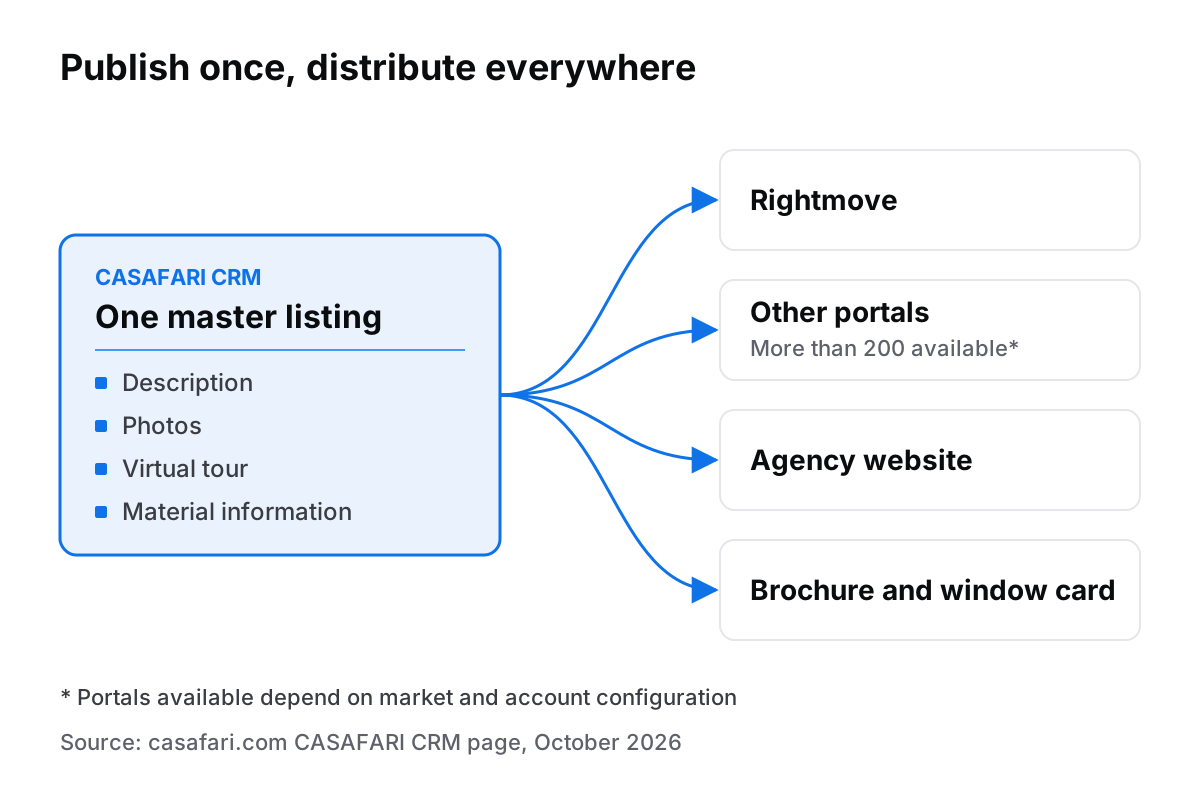
- Single-entry listing distribution: Allows agents to create a listing once and publish it across multiple channels. Systems like CASAFARI CRM offer access to distribute listings to more than 200 property portals (including Rightmove in the UK), though exact portal availability depends on the market and account configuration.
- Owner and landlord updates: Dedicated portals, such as learning how Ownerlink keeps vendors and landlords updated, automatically share viewing statistics, market interest and applicant feedback directly with property owners.
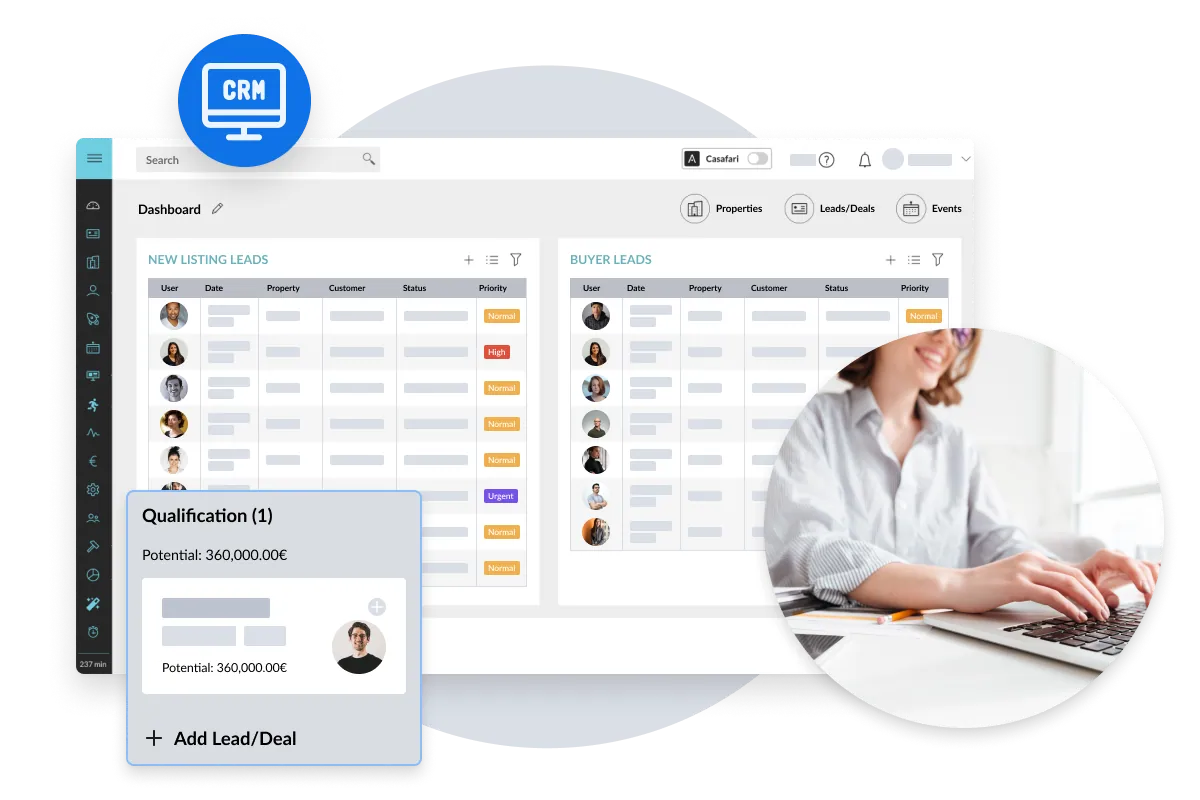
- Dual-pipeline management: Separates acquisitions (from initial market appraisal to signed instruction) and sales or lettings (from applicant registration to exchange and completion) using visual Kanban boards with explicit task assignments.
- Evidence-based pricing tools: Integrates Comparative Market Analysis (CMA) functionality, providing estimated values, local price distribution and historical time-on-market metrics to support listing presentations.
- Mobile access and digital execution: Features a fully integrated app—such as the CASAFARI CRM mobile app—enabling negotiators to record voice notes, review applicant profiles at viewings, and obtain digital signatures for terms of business.
- Governance and access controls: Configures user permissions by role or group, ensuring client data remains secure and providing auditable logs to assist with UK GDPR requirements overseen by the Information Commissioner’s Office (ICO).
A checklist for choosing an estate agency CRM in 2026
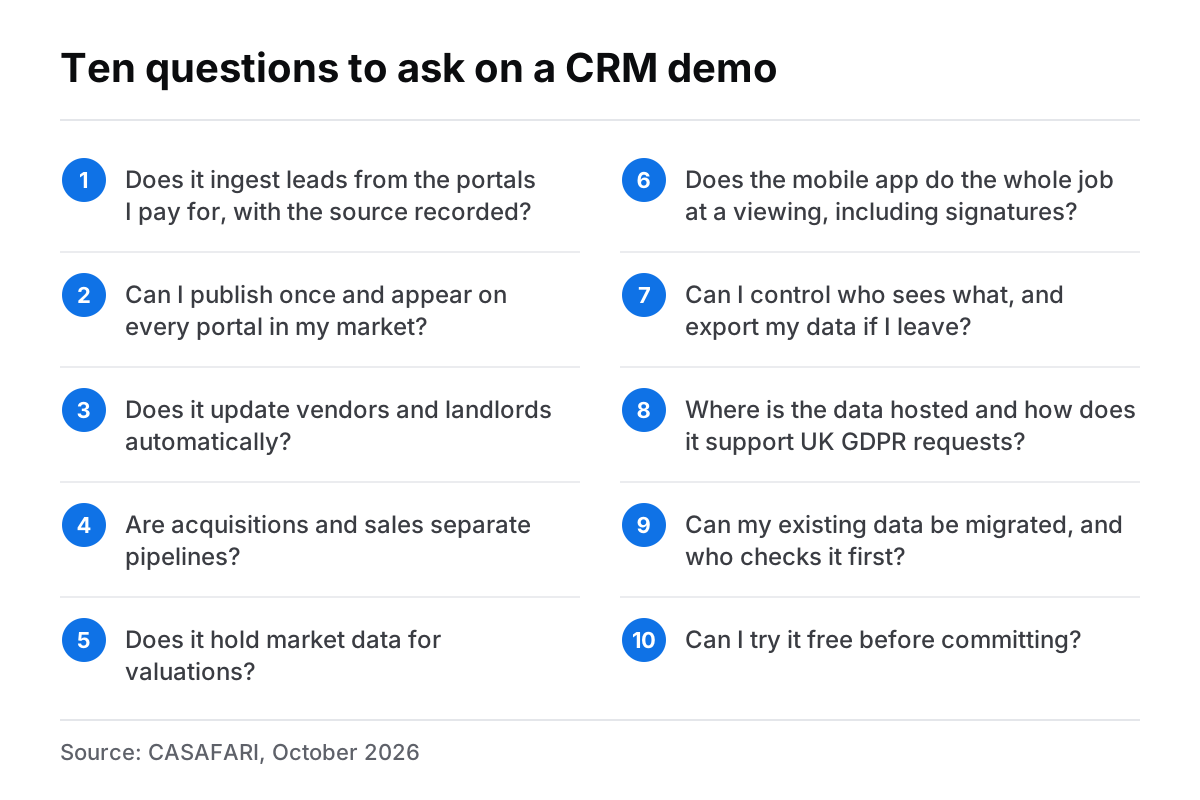
When evaluating real estate CRM software, agency leaders can assess platform capabilities by using the following ten-point checklist during product demonstrations:
- Does the CRM ingest leads automatically from all connected portals, recording the original channel source?
- Can a listing be created once and published across your required portal suite and agency website?
- Does the system provide automated reporting channels to keep vendors and landlords updated on viewing activity?
- Are acquisition and sales/lettings workflows managed through distinct pipeline boards?
- Does the software include built-in market data and CMA generation tools for valuation appointments?
- Does the mobile app allow negotiators to update records, log voice notes and obtain digital signatures on-site?
- Can administrator permissions restrict database exports and control record visibility by branch or role?
- Does the software provider support compliance with data protection laws, including data subject access and deletion requests?
- Is there a structured data migration process supervised by technical support teams?
- Does the vendor offer a clear path to test core functionality via a free tier before committing to paid plans?
When conducting a software trial, select a single branch or team, migrate a recent sample of leads, and measure key performance indicators—such as initial response times and vendor contact frequency—over a two-week testing window.
While optional AI features (such as automated property descriptions, image enhancement, and virtual staging) can provide additional speed, core pipeline management and data integrity should remain the primary decision factors.
How CASAFARI CRM answers the checklist
CASAFARI CRM is engineered around these core operational operational requirements. Serving over 12,000 real estate professionals across more than 10 countries, the platform provides scalable infrastructure tailored for both independent agencies and larger multi-branch networks.
| Agency Requirement | CASAFARI CRM Capability |
|---|---|
| Lead Capture | Centralised ingestion with lead scoring, complete interaction history, and automated Smartreply/Smartmail options. |
| Distribution | Single-entry publishing with potential distribution to over 200 portals (varies by market and account setup). |
| Client Reporting | Ownerlink functionality delivering automated viewing feedback and marketing summaries to vendors. |
| Valuation Tools | Integrated CMA engine providing price distribution, valuation estimates, and time-on-market statistics. |
| On-site Tools | Mobile application featuring voice memo logging and one-tap digital signature collection. |
| Data Governance | Granular user roles, group permissions, and auditable history logs supporting UK GDPR frameworks. |
| Entry Option | Free plan available with no initial cost or long-term commitment. |
For agencies that rely on local canvassing and door-to-door prospecting, CASAFARI GO for prospecting routes and territories helps plan field activities and highlights private-seller opportunities directly on a map.
Additionally, for new or growing independent practices without an established web presence, CASAFARI CRM includes a built-in website builder featuring 10 responsive templates, allowing an agency website to be deployed rapidly.
Agency principals can explore detailed subscription tiers—including Plus, Premium, and Enterprise plans—or book a demo of CASAFARI CRM to evaluate the platform directly.
Moving from your current CRM or spreadsheet without losing a lead
Transitioning to a new real estate CRM requires systematic preparation to protect active deals and maintain client goodwill:
- Consolidate data records: Export current contact databases, ensuring consent markers and lead sources are clearly identified. Group records into active applicants, active vendors/landlords, and past client archives.
- Review stock and collateral: Verify that active property listings carry complete media assets, floor plans, EPC certificates, and required material information before migration.
- Technical evaluation: The CASAFARI team evaluates source data structures prior to import to ensure smooth field mapping and minimize missing values.
- Maintain data compliance: Audit legacy data prior to transfer, purging records that lack a valid legal basis under the ICO’s UK GDPR guidance for organisations. Establish internal user access groups before team onboarding.
By establishing an organized cut-over timeline, agencies can address operational inefficiencies smoothly. Returning to our opening scenario: an enquiry received on a Tuesday evening is logged instantly, assigned an initial lead score, and addressed through an automated response. The following Monday, the agency principal reviews updated pipeline metrics directly from their mobile device, with vendors fully appraised of recent activity.
Frequently asked questions
What is the best CRM for estate agents in the UK?
There is no single CRM that suits every agency, but the most effective system is one that ingests portal leads automatically, offers multi-portal distribution, updates vendors systematically, and maintains clear acquisition and sales pipelines. Agencies should assess prospective platforms against their specific operational workflows using a structured checklist. CASAFARI CRM addresses these functional areas and offers a Free plan to test without commitment.
Do independent estate agents really need a CRM?
Yes, independent agents benefit from a CRM as soon as enquiries arrive across multiple channels such as portals, website forms, direct calls, and WhatsApp. Managing leads manually often results in missed follow-ups and delayed vendor reporting. CASAFARI CRM provides an accessible entry point for smaller teams, including a Free plan and an integrated website builder with 10 responsive templates.
Can a CRM publish my listings to Rightmove, Zoopla and other portals at once?
A real estate CRM with multi-portal distribution allows agents to enter property data once and feed connected marketing channels automatically. CASAFARI CRM supports listing distribution to more than 200 portals worldwide, including major UK channels like Rightmove. Specific portal availability depends on the agency’s geographical market and individual account configuration.
How does UK GDPR affect the way an estate agency uses a CRM?
Under UK GDPR and the Data Protection Act 2018, estate agencies act as data controllers for applicant, vendor, and landlord information. Agencies must establish a lawful basis for processing personal data, define retention schedules, implement role-based access controls, and fulfill subject access requests. A compliant CRM assists this process by logging consent sources, restricting export permissions, and maintaining complete interaction histories.
Can I move my data from my current CRM to CASAFARI CRM?
Yes, data migration is available in many cases. The CASAFARI technical team evaluates the structure of the existing CRM or database prior to migration to ensure correct field mapping. Agencies should prepare by auditing contact consent, organizing active property media, and removing legacy records that no longer serve a valid business purpose.