
EIXAMPLE DRETA PROPERTY GUIDE
Barcelona´s most exclusive neighborhood
La Dreta de l’Eixample forms the eastern half of Barcelona’s iconic 19th-century grid, combining trophy Modernist architecture with prime urban living. According to CASAFARI Area Insights, apartment asking prices reached €8,347 per square metre in Q3 2026—marking a 4.2% year-on-year increase from €8,010 per square metre in Q3 2025—while average monthly asking rents climbed 4.9% to €36.5 per square metre. These figures represent asking prices from indexed listings, excluding outliers, rather than closing prices. For a broader overview of the district, explore our parent Eixample guide and our wider Barcelona guide.
Where is Eixample Dreta and how is it connected?
La Dreta de l’Eixample spans 212 hectares (2.12 square kilometres) and accommodates a registered population of 45,464 inhabitants as of January 2026, according to the Ajuntament de Barcelona municipal demographic data for La Dreta de l’Eixample. Its official administrative boundaries are defined by Carrer de Balmes to the west, Avinguda Diagonal and the upper stretch of Carrer de Nàpols to the north, Passeig de Sant Joan to the east, and Plaça de Catalunya alongside the Rondes de la Universitat and de Sant Pere to the south.
It is essential to distinguish the administrative neighbourhood from the Quadrat d’Or, or ‘Golden Square’ of Catalan Modernisme. As outlined by the Turisme de Barcelona guide to the Quadrat d’Or, this heritage zone centres heavily on Passeig de Gràcia but extends slightly further west across Carrer de Balmes into L’Antiga Esquerra de l’Eixample as far as Carrer d’Aribau.
Transport connectivity is exceptional. Six metro hubs serve the neighbourhood directly or sit on its immediate perimeter: Catalunya (L1, L3), Urquinaona (L1, L4), Passeig de Gràcia (L2, L3, L4), Girona (L4), Verdaguer (L4, L5), and Diagonal (L3, L5). Commuter links include FGC services at Catalunya and Provença, Rodalies regional rail, and the extended TRAM T4 line running along Avinguda Diagonal. According to TMB public transport connections to Barcelona-El Prat Airport, the direct R2 Nord train from Passeig de Gràcia reaches Josep Tarradellas Barcelona-El Prat Airport in 25 to 27 minutes.
What is daily life like from Passeig de Gràcia to Passeig de Sant Joan?
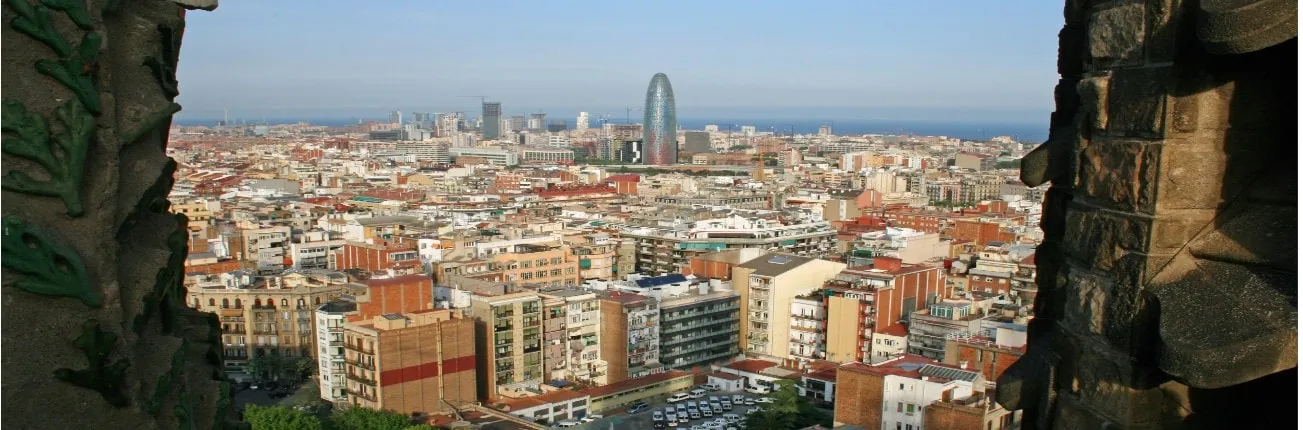
Life in Eixample Dreta varies perceptibly from west to east. Along the grand avenue of Passeig de Gràcia and Rambla de Catalunya, international luxury boutiques, family offices, and architectural masterpieces such as Casa Batlló, La Pedrera (Casa Milà), and Fundació Antoni Tàpies set an upscale, cosmopolitan tone. Moving eastwards past Carrer de Girona towards Plaça de Tetuan and Passeig de Sant Joan, the atmosphere transitions into a tranquil, residential neighbourhood favoured by local families, featuring leafy terraces, artisanal bakeries, and neighbourhood cafés.
Urban mobility has been significantly enhanced by the Ajuntament de Barcelona Superilla green axes programme. Single-level, pedestrian-priority corridors on Carrer del Consell de Cent and Carrer de Girona restrict through traffic exclusively to residents, deliveries, and emergency services. Their intersection creates a vibrant pedestrian square exceeding 2,000 square metres.
Culinary and social life retains enduring anchors. Landmarks such as El Nacional on Passeig de Gràcia and Boca Grande on Passatge de la Concepció remain vibrant social destinations, complemented by neighbourhood celebrations during the annual Festa Major.
What kind of housing stock defines La Dreta de l’Eixample?
Ildefons Cerdà’s masterplan engineered octagonal city blocks (illes) with chamfered corners (xamfrans) and internal courtyards (patis d’illa), designed to maximise natural light and cross-ventilation. Within these blocks stand the classic regal estates (finques règies), characterised by ornate lobbies, wrought-iron lifts, and dual-aspect through-apartments (pisos passants).
Typical interior features of a finques règies include hydraulic mosaic floor tiles (pantalà / mosaic hidràulic), coffered ceilings exceeding 3.5 metres in height, tall French doors opening onto wrought-iron street balconies, and glazed rear galleries (galeries) overlooking the quiet internal courtyard.
Two specific typologies command premium valuations: the ‘Principal’ (the first residential floor above the mezzanine, often featuring grand ceiling heights and a spacious rear terrace) and penthouses (àtics and sobreàtics). These sit alongside modern turnkey refurbishments and mixed-use commercial buildings positioned near Avinguda Diagonal.
How is the Eixample Dreta property market performing in 2026?
Property performance in Eixample Dreta is shaped by micro-location and asset quality. Based on CASAFARI Area Insights, the average asking price for apartments in La Dreta de l’Eixample reached €8,347 per square metre in Q3 2026 (location id 10553, queried 25 October 2026), representing a 4.2% year-on-year increase from €8,010 per square metre in Q3 2025. In the rental sector, average asking rents stood at €36.5 per square metre per month in Q3 2026, up 4.9% from €34.8 per square metre per month in Q3 2025.
These figures reflect asking prices derived from indexed listings (outliers excluded) rather than closing prices. Beneath the neighbourhood average lies a wide dispersion: unrenovated lower-floor units facing busy thoroughfares trade at a discount, whereas meticulously restored fincas règies on Passeig de Gràcia or the pedestrianised green axes achieve significant premiums. Buyers today are predominantly Catalan families upgrading locally, alongside European and North American professionals seeking capital preservation and walkability.
What taxes, rental caps and licence rules affect buyers in 2026?
Regulatory frameworks have evolved considerably. Under Catalonia’s progressive ITP and AJD tax brackets in Catalonia under Decree-Law 5/2025, residential property transfer tax (ITP) for resale housing applies on a progressive scale: 10% up to €600,000; 11% between €600,000 and €900,000; 12% between €900,000 and €1,500,000; and 13% for the portion exceeding €1,500,000. Large property holders (grans tenidors) and corporate buyers acquiring entire residential buildings face a flat 20% rate, while buyers aged 35 or under purchasing a primary residence benefit from a reduced 5% rate. Stamp duty (AJD) for new developments stands at a flat 1.5%.
Non-EU investors should note that Spain’s real estate Golden Visa scheme was formally abolished on 3 April 2025 following the enactment of Organic Law 1/2025 in the Boletín Oficial del Estado (BOE).
Regarding short-term accommodation, Eixample Dreta lies within PEUAT Zone 1, where new tourist licences are strictly prohibited. Furthermore, as confirmed by the Consorci de l’Habitatge de Barcelona on the 2028 HUT tourist licence phase-out, Barcelona will extinguish all existing tourist apartment licences without renewal when the transitional period concludes in November 2028.
For long-term and medium-term leasing, Barcelona operates as a stressed residential market. As outlined by the Generalitat de Catalunya announcement on Law 11/2025 regulating seasonal rentals, statutory rent caps now apply equally to seasonal leases (for work, study or medical stays) and room rentals, requiring landlords to register justified temporary causes with INCASÒL. For further context on national legislation, consult our Spain’s Housing Act and stressed rental market rules and our complete guide to buying property in Spain.
How real estate professionals analyse Eixample Dreta with CASAFARI
Navigating a hyper-local market where property values vary significantly between floors and street orientations requires robust, verified data. Real estate agents, investors, and valuers rely on specialised professional infrastructure to underwrite opportunities with confidence.
- Market Trends: Utilise CASAFARI Area Insights to monitor quarterly asking prices, rental yields, supply volumes, and days-on-market across Eixample sub-neighbourhoods.
- Asset Discovery: Deploy CASAFARI Property Sourcing to access deduplicated active and historical listings from across portals and agencies, complete with full price-change tracking.
- Valuation & Comparables: Generate bank-grade comparative market analyses through our property valuation and comparative market study tools, which combine asking prices with verified closing prices sourced from land registries, open data, and viewing comparables with real closing prices.
To access these analytical tools, sign in to the CASAFARI platform.
Frequently asked questions
What is the difference between Eixample Dreta and the Quadrat d’Or in Barcelona?
La Dreta de l’Eixample is an official administrative neighbourhood spanning 212 hectares, enclosed by Carrer de Balmes, Avinguda Diagonal, Passeig de Sant Joan, and Plaça de Catalunya. In contrast, the Quadrat d’Or, or ‘Golden Square’, is a historic architectural precinct centred on Passeig de Gràcia that contains roughly 150 protected Modernista buildings. While it overlaps most of Eixample Dreta, the Quadrat d’Or extends three blocks further west across Carrer de Balmes into L’Antiga Esquerra de l’Eixample up to Carrer d’Aribau.
How much is property transfer tax (ITP) when buying a flat in Eixample Dreta in 2026?
Under Catalonia’s Decree-Law 5/2025, residential property transfer tax (ITP) for resale homes is calculated across progressive brackets: 10% on the first €600,000, 11% for the portion between €600,000 and €900,000, 12% between €900,000 and €1,500,000, and 13% on amounts exceeding €1,500,000. Large property holders and corporate buyers purchasing entire buildings are subject to a flat 20% rate, whereas eligible buyers aged 35 or under purchasing a primary residence pay a reduced 5% rate.
Can you buy an apartment in Eixample Dreta for short-term tourist or seasonal rentals?
New tourist apartment licences are entirely prohibited in Eixample Dreta under Barcelona’s PEUAT Zone 1 regulations, and all existing municipal tourist licences will be permanently extinguished without renewal in November 2028 under Decree-Law 3/2023. Additionally, under Catalonia Law 11/2025, medium-term seasonal rentals for work, study or medical purposes are bound by the same statutory rent caps as permanent leases and require documented justification filed with INCASÒL.
Does buying a €500,000 property in Barcelona still qualify for Spain’s Golden Visa?
No, Spain formally terminated its real estate Golden Visa programme on 3 April 2025 following the enactment of Organic Law 1/2025. Non-EU citizens purchasing residential property in Eixample Dreta can no longer obtain residency through real estate investment alone and must pursue alternative immigration routes such as the Digital Nomad Visa or non-lucrative residency permits.
What should I look for when inspecting a classic finca regia in this neighbourhood?
When viewing these 19th-century estates, focus your inspection on the condition of original features like the hydraulic mosaic tiles and the integrity of the rear galeries overlooking the internal courtyard. It is also wise to check the building’s lobby and lift, as these communal areas in a finca regia often signal the standard of overall maintenance and the strength of the community of owners.
How do the recently introduced green axes affect accessibility and daily life?
The pedestrian-priority corridors on Carrer del Consell de Cent and Carrer de Girona, established under the Superilla programme, have significantly reduced through traffic in these specific zones. While this creates quieter residential streets and a vibrant pedestrian square exceeding 2,000 square metres, you should confirm if your specific building falls within these restrictions if you rely on private vehicle access for daily commuting.