
ALCUDIA TOWN PROPERTY GUIDE
The antique treasure of the Alcudia Municipality
Alcúdia is a historic walled municipality in northern Mallorca, situated between Pollença and the Bay of Alcúdia. Buyers target the location for restored 14th-century townhouses within the medieval walls, coastal villas in Alcanada, and rural fincas across the surrounding plain. Current market values vary across these distinct sub-markets, and the live ticker on this page reflects real-time asking prices per square metre across active portal listings.
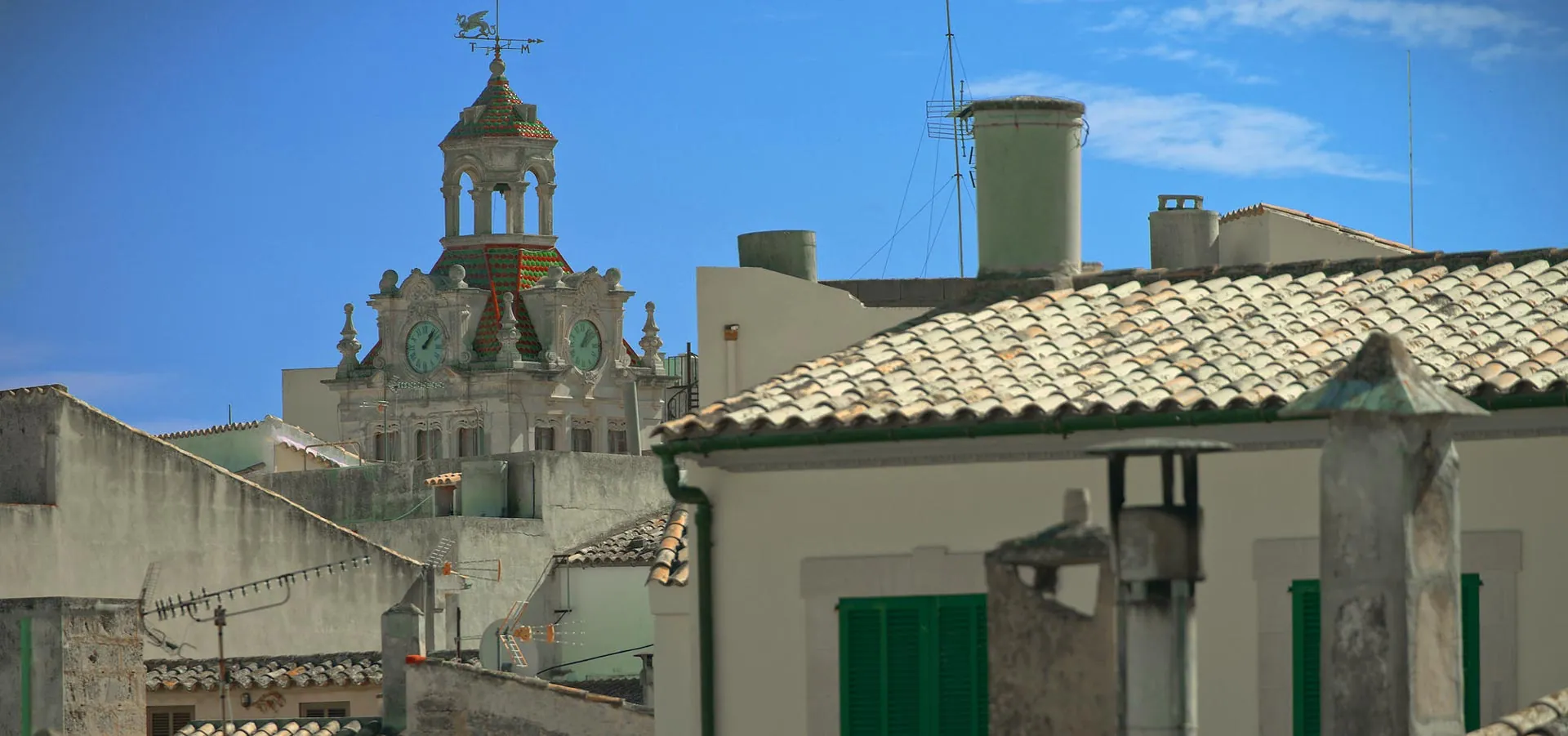
On a Tuesday morning inside the Porta de Mallorca, local trade unfolds beside green window shutters on traditional stone townhouses. A restored casa de poble here might offer a hidden central courtyard and a roof terrace overlooking medieval ramparts. For buyers and estate agents evaluating northern Mallorca real estate, understanding how the historic enclosure interacts with local planning law, tax structures, and holiday-let rules is essential.
Alcúdia town property: what you are buying into
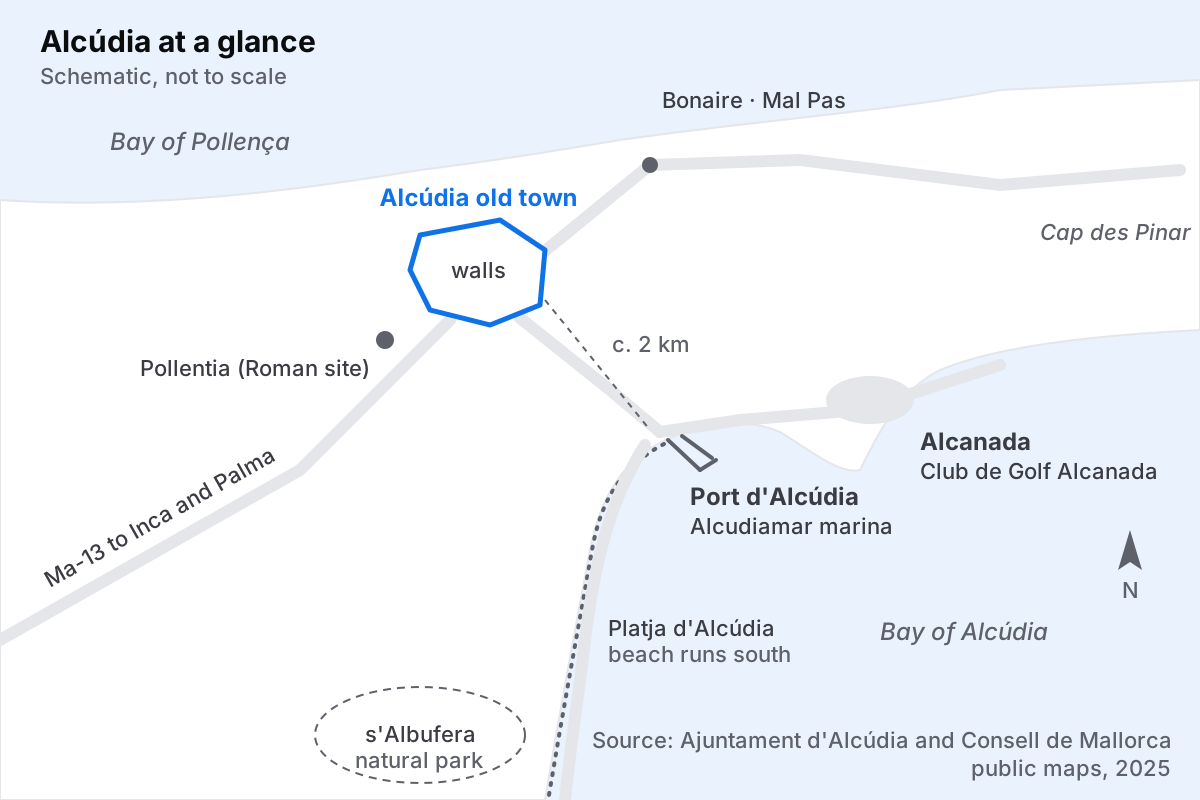
When evaluating Alcúdia property, buyers must distinguish between three distinct residential zones that share the municipal name: the historic old town, the coastal resort of Port d’Alcúdia, and the surrounding residential headlands.
Alcúdia old town operates intramuros, defined by its preserved medieval walls. This is a working Spanish town with year-round activity, municipal offices, primary schools, and weekly street markets on Tuesdays and Sundays. Properties inside the walls are predominantly stone townhouses without direct beach frontage or swimming pools, though many feature private patio gardens.
Port d’Alcúdia, located roughly two kilometres south-east, centers around the commercial marina, the Alcudiamar port, and a long sandy beach extending towards the s’Albufera natural park. This area contains the majority of multi-family apartment blocks and tourist accommodation. To the east and north-east lie the low-density coastal residential districts of Alcanada, Mal Pas, and Bonaire, where detached single-family villas dominate.
Old town, port or headland: where in Alcúdia should you buy?
The medieval wall enclosure of Alcúdia is declared a Bien de Interés Cultural (BIC). Owning property inside the walls requires adherence to heritage conservation standards. Exterior alterations, roof repairs, and façade repainting require municipal permits from the Ajuntament d’Alcúdia to preserve traditional architecture. In return, homeowners reside in an established neighborhood that maintains commercial activity throughout the winter months.
Port d’Alcúdia caters primarily to coastal living. Apartments along the beachfront and marina yield high summer footfall, making them popular for short-term lets where licences exist.
Along the eastern peninsula, Alcanada offers single-family homes positioned along elevated coastal plots. The area is anchored by Club de Golf Alcanada, an 18-hole course designed by Robert Trent Jones Jr. that opened in 2003 adjacent to the Alcanada lighthouse islet. To the north, Mal Pas and Bonaire feature small coves, small-craft harbours, and quiet residential streets, where a car is required for daily errands.
Rural plots on the plain stretching towards sa Pobla contain rustic fincas. Purchasers of suelo rústico must verify legal build limits, agricultural restrictions, and utility connectivity (mains water and grid electricity) prior to signing purchase contracts.
Can you let an Alcúdia property to holidaymakers?
Short-term holiday letting in the Balearic Islands is strictly regulated under Balearic tourism law (Ley 8/2012, amended by Ley 6/2017). A residential property cannot be advertised or rented on a daily or weekly basis to tourists without an official ETV licence (Estancia Turística en Vivienda) issued by the Consell de Mallorca.
The Consell de Mallorca enforces a cap on total tourist bed places across the island. Purchasing a property that already holds an active, legally registered ETV licence is the primary method to secure short-term rental capability. Buyers must confirm via an independent lawyer that the licence number is valid, up to date with municipal tax payments, and legally transferable with the deed.
Since 1 July 2025, Spanish law (Real Decreto 1312/2024) requires all short-term and holiday properties advertised on digital listing platforms to display a valid national registration number from the Registro Único de Arrendamientos. Unregistered marketing exposes property owners to statutory fines from the Consell de Mallorca’s tourist rental registration division and national tax authorities. For broader investor considerations on residential leasing, read our briefing on owning a rental property in Mallorca.
Long-term residential leases operating under the Ley de Arrendamientos Urbanos (LAU) do not require an ETV tourist licence, but are subject to national tenancy terms established under Spain’s 2023 Housing Act.
What does buying in Alcúdia cost in taxes and fees?
When purchasing a resale residential home in Alcúdia, the buyer pays the Balearic Transfer Tax (Impuesto sobre Transmisiones Patrimoniales or ITP). The tax is calculated on a progressive scale based on the property price:
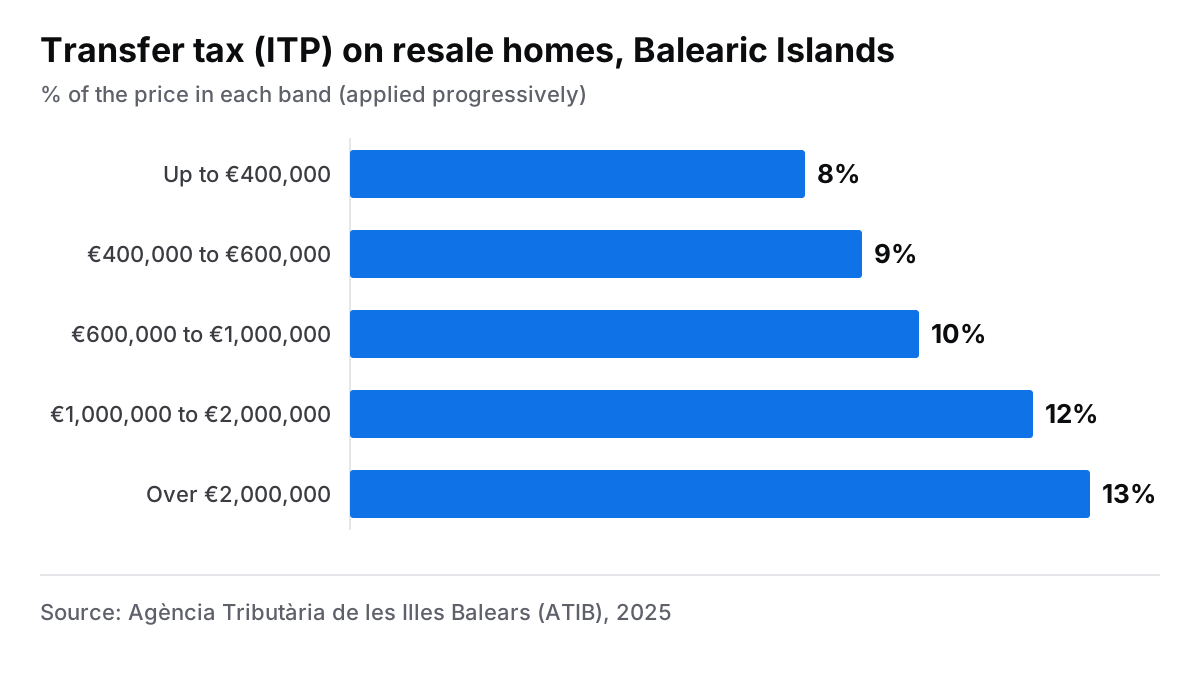
- Up to €400,000: 8%
- From €400,000 to €600,000: 9%
- From €600,000 to €1,000,000: 10%
- From €1,000,000 to €2,000,000: 12%
- Over €2,000,000: 13%
Official rates and guidance can be verified on the Balearic tax agency’s ITP scale. For brand-new residential completions acquired directly from a commercial developer, ITP is replaced by 10% Value Added Tax (IVA) plus 1.5% Balearic Stamp Duty (AJD).
Additional closing transaction costs average between 11% and 14% of the purchase price. These cover notary fees, Land Registry registration fees, and legal costs. Non-resident buyers must obtain a Spanish NIE tax identification number (Número de Identificación de Extranjero) and open a local bank account prior to transaction completion. Review our step-by-step guide to buying property in Spain for procedural details.
Ongoing ownership overheads include local municipal property tax (IBI), garbage collection fees, and community service charges for multi-family buildings. Non-resident owners who do not lease their home pay annual Non-Resident Income Tax (Modelo 210) based on an imputed property rental value calculated by the Spanish tax office. Non-EU residents (including UK citizens) pay a flat 24% rate on this imputed base, compared to 19% for EU/EEA tax residents, as detailed by the non-resident income tax (Modelo 210) portal. Owners preparing to re-sell existing holdings can review procedures for selling a property in Mallorca.
Living in Alcúdia year-round: transport, schools and healthcare
Alcúdia connects to Palma and Son Sant Joan Airport via the Ma-13 dual carriageway. Driving time across the central plain takes under an hour under standard traffic conditions.
Healthcare provision in town is anchored by the Centre de Salut d’Alcúdia for primary care, with regional hospital care provided in Inca and emergency facilities at Hospital Universitari Son Espases in Palma.
Regarding immigration status, non-EU buyers (including UK nationals post-Brexit) must adhere to standard Schengen entry conditions allowing stays up to 90 days in any 180-day period without a visa, as stated under UK government entry rules for Spain.
Spain’s real estate investor residency pathway (commonly termed the ‘golden visa’) was formally repealed under Ley Orgánica 1/2025 with effect from 3 April 2025. Owning real estate no longer qualifies a non-EU buyer for Spanish residency. Foreign nationals seeking long-term residency in Mallorca rely on alternative non-working pathways, such as the Non-Lucrative Visa or the Digital Nomad Visa.
What there is to do in and around Alcúdia
Alcúdia’s historical core dates back centuries before its medieval construction. The modern municipality encompasses the ruins of the Roman city of Pollentia, established following the Roman conquest of 123 BC. Visitors can tour the exposed forum, residential quarters, and Roman theatre adjacent to the medieval town.
King Jaume II initiated construction of the town’s perimeter medieval walls in the early 14th century, followed by a secondary Renaissance wall ring added in the 17th century. Culture within the walls includes the Biblioteca Can Torró, established in 1990 inside a restored 14th-century townhouse.
Outdoor sports anchor northern Mallorca’s regional economy. Alcúdia hosts the annual IRONMAN 70.3 Alcúdia-Mallorca triathlon event every May, drawing international athletes to Platja d’Alcúdia. To the south lies the Parc Natural de s’Albufera de Mallorca, a protected wetland reserve established as a natural park in 1988.
How CASAFARI tracks the Alcúdia market
CASAFARI aggregates, standardises, and deduplicates real estate market listings across major property portals and independent agency websites across Mallorca. By matching duplicate entries for single properties listed across multiple brokerages, CASAFARI provides clean asking price datasets, accurate listing histories, and clear supply metrics.
Real estate professionals, investors, and estate agents can compare Alcúdia with neighbouring areas in Area Insights to evaluate inventory levels, price-per-square-metre distributions, and yield metrics across northern Mallorca. For custom platform integration, explore the Area Insights documentation for developers, or learn how to run a market analysis in CASAFARI within our help desk. You can also try CASAFARI on the platform directly.
Frequently asked questions
Can UK citizens still buy property in Alcúdia after Brexit?
Yes, UK citizens can purchase real estate in Alcúdia without nationality restrictions. Buyers require a Spanish NIE tax number, a Spanish bank account, and independent legal representation. Following Brexit, UK residents are subject to Schengen stay limits of 90 days per 180-day period unless holding a residence visa, and non-resident income tax (Modelo 210) on imputed property income is applied at 24%. Note that purchasing property no longer confers residence rights following the end of the investor visa programme on 3 April 2025.
Can I rent out a property in Alcúdia to holidaymakers?
Short-term holiday renting requires an official ETV tourist licence issued by the Consell de Mallorca. Because total tourist places in the Balearics are capped, investors typically purchase properties that hold an existing, transferable ETV licence. Additionally, as of 1 July 2025, online rental listings in Spain must publish a national registration number from the Registro Único de Arrendamientos under Real Decreto 1312/2024.
What taxes do you pay when buying a house in Alcúdia, Mallorca?
Purchasing a resale property incurs the Balearic Transfer Tax (ITP), calculated progressively from 8% on the first €400,000 up to 13% for amounts over €2,000,000. New-build homes purchased directly from developers are subject to 10% VAT (IVA) plus 1.5% Stamp Duty (AJD) instead of ITP. Buyers should budget an additional 11% to 14% over the purchase price to cover taxes, notary, registry, and legal fees.
How far is Alcúdia from Palma and the airport?
Alcúdia is located in northern Mallorca, approximately 55 kilometres from Palma and Palma de Mallorca Airport (Son Sant Joan). The drive takes under an hour via the Ma-13 dual carriageway under standard road conditions. Public transport connections include regional TIB bus services to Palma’s central intermodal station.