
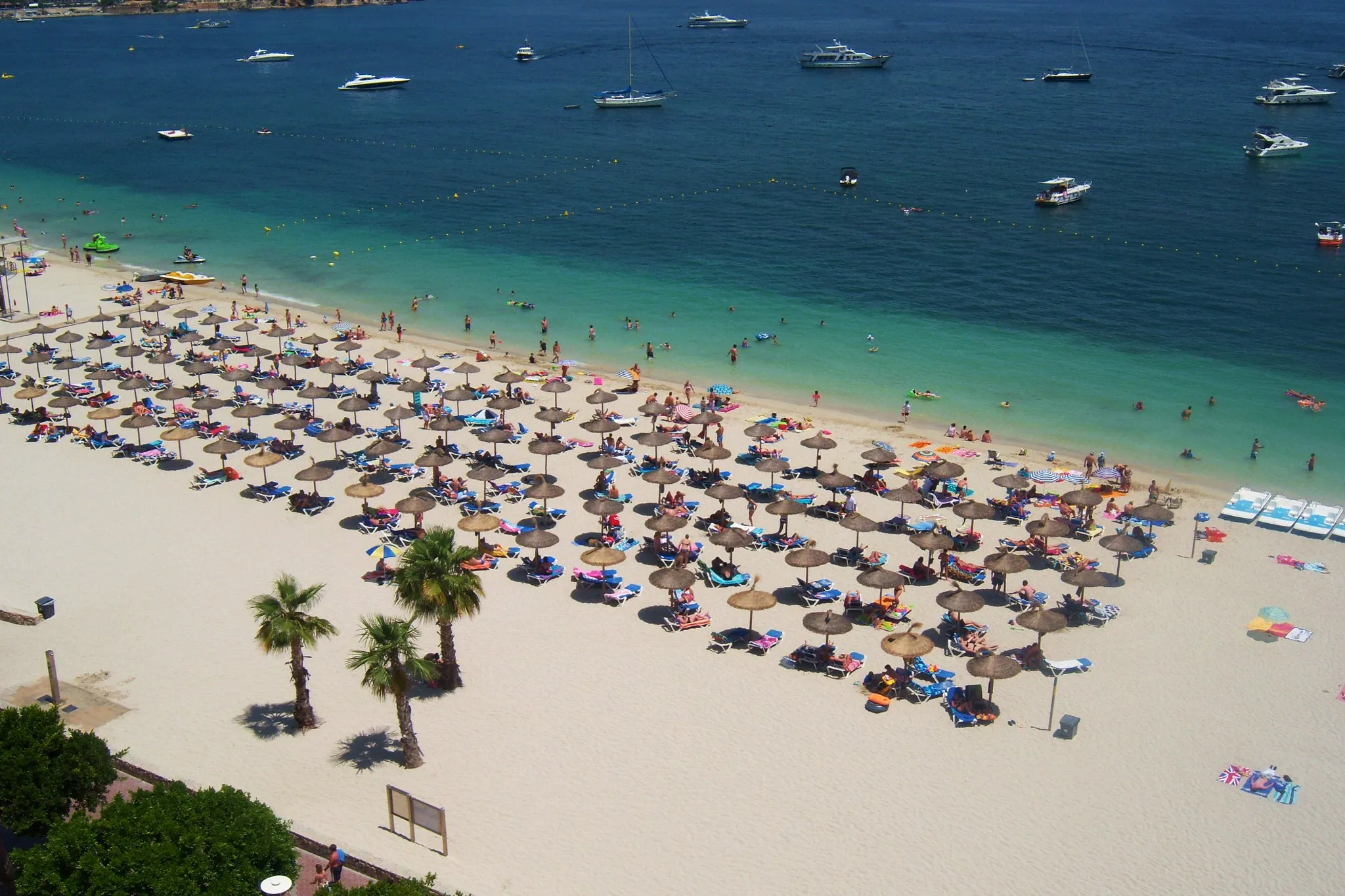
PALMANOVA PROPERTY GUIDE
Quiet family beach resort with numerous restaurants
Palmanova is a established coastal town of 7,073 registered residents in the municipality of Calvià (53,793 residents), located 15 kilometres west of Palma de Mallorca. It attracts international buyers and families with three Q-certified sandy beaches, an 80-berth harbour, top British-curriculum schools, and a diverse housing supply ranging from beachfront apartments to hillside villas.
Why are buyers and investors looking at Palmanova property?
Unlike purely seasonal holiday resorts across the Balearic Islands, Palmanova maintains a lively, self-sustaining community throughout the winter months. Wide, level avenues connect modern residential developments with established commercial centres, medical clinics, and daily conveniences. The town’s urban planning emphasizes accessibility and outdoor living, making it equally suited to retirees, young families, and remote executives seeking a Mediterranean primary or secondary residence.
Property options in Palmanova cater to varied acquisition goals. Seafront avenues host purpose-built multi-family apartment blocks offering sweeping Mediterranean views and strong long-term residential leasing potential. Moving inland towards the quiet residential streets bordering Son Caliu and Galatzo, the urban landscape transitions into semi-detached townhouses and detached single-family villas set within private gardens.
To navigate micro-market pricing, historical trends, and property availability across Calvià, real estate professionals and private investors rely on data tools such as CASAFARI Area Insights. By analysing real-time market data, buyers can accurately compare local transactions and evaluate prospective acquisitions alongside our comprehensive guide to buying property in Spain.
Where is Palmanova located and how are its beaches and marina organised?
Palmanova occupies a prime sheltered bay in southwestern Mallorca, directly accessible via exit 13 of the Ma-1 motorway. Palma city centre sits just 15 kilometres (15 to 20 minutes) to the east, while Palma de Mallorca Airport (PMI) is located 23 to 26 kilometres (20 to 25 minutes) away. Public transit links are exceptionally well developed: the TIB A11 airport bus route provides direct year-round connections between Palmanova and the airport terminals, complemented by frequent regional TIB bus lines (104, 105, 106, 107, and 123) linking to Palma’s central Estació Intermodal.
The town’s coastline features three distinct, expansive beaches spanning the bay:
- Platja d’Es Carregador: Located at the eastern end near the harbour, offering gentle slopes and calm waters.
- Platja de Palmanova (Na Nadala): The central and largest beach, backed by a landscaped promenade and active dining precinct.
- Platja de Son Maties: Stretching westward towards the rocky Torrenova headland, which naturally separates Palmanova from neighbouring Magaluf.
According to the Ajuntament de Calvià, Calvià chooses not to participate in the Blue Flag scheme; instead, all three Palmanova beaches hold the prestigious ICTES ‘Q for Tourist Quality’ certification. This standard guarantees rigorous water testing, public sanitation, life-saving services, and barrier-free access.
Nautical enthusiasts benefit from the Club Nàutic Palmanova, situated along Passeig de la Mar beside Es Carregador beach. The harbour provides 80 to 82 moorings designed for vessels up to 12 metres in length and draughts of 1 to 2 metres. Facilities include freshwater and electrical supply, a crane, slipway, 24-hour security, jet-ski berths, and an active nautical sports school.
How is dining, schooling and the regeneration of neighbouring Magaluf shaping the area?
Palmanova’s dining scene remains active twelve months a year. Restaurants and cafes along the Passeig de la Mar and Son Maties promenades serve a mix of traditional Balearic gastronomy, fresh seafood, and modern international cuisine, catering to residents long after the peak summer season concludes.
For families relocating to Mallorca, Calvià provides convenient access to premier international educational institutions located within a 5 to 10-minute drive:
- Baleares International College (BIC) Sa Porrassa: A co-educational school following the National Curriculum for England, offering IGCSEs and A-Levels for pupils aged 3 to 18.
- King Richard III College (Portals Nous): Delivering dual British and Spanish national curricula for students aged 2 to 18.
- Agora Portals International School (Portals Nous): A trilingual institution delivering the complete IB Continuum alongside the Spanish national curriculum for ages 1 to 18.
The residential reputation of Palmanova is further enhanced by ongoing urban and hotel regeneration across the southwest region. Historical perceptions of neighbouring Magaluf have evolved significantly due to legislative measures and substantial private investment. Under the Balearic Government’s Decree-Law 2/2024 on Responsible Tourism, strict regulations govern tourist behaviour until at least late 2027. Measures include prohibitions on street drinking (backed by fines of €500 to €1,500), mandatory closure of retail alcohol sales between 21:30 and 08:00, bans on drink promotions or party boats, and penalties reaching €600,000 for hazardous behaviour.
Private equity investments have restructured legacy hospitality infrastructure. For instance, the former Mallorca Rocks venue was completely transformed by FERGUS Group into the 4-star family resort FERGUS Club Mallorca Waterpark (comprising 656 units) alongside the adult-focused BH Mallorca Resort. Furthermore, municipal authorities are advancing plans to convert the long-disused Casino de Mallorca site in Sol de Mallorca into a modern 204-bed hotel surrounded by public green space, as reported by the Majorca Daily Bulletin. These broader regional upgrades continue to support long-term capital preservation for real estate in Palmanova.
What taxes, tourist licence rules and residency laws apply when buying in Palmanova?
When purchasing resale property in Palmanova, investors must account for Balearic Property Transfer Tax (Impuesto sobre Transmisiones Patrimoniales, ITP). Administered by the Agència Tributària de les Illes Balears (ATIB), ITP is calculated using a progressive tax scale applied to the higher of the agreed transaction price or the official Cadastral Reference Value (Valor de Referencia).
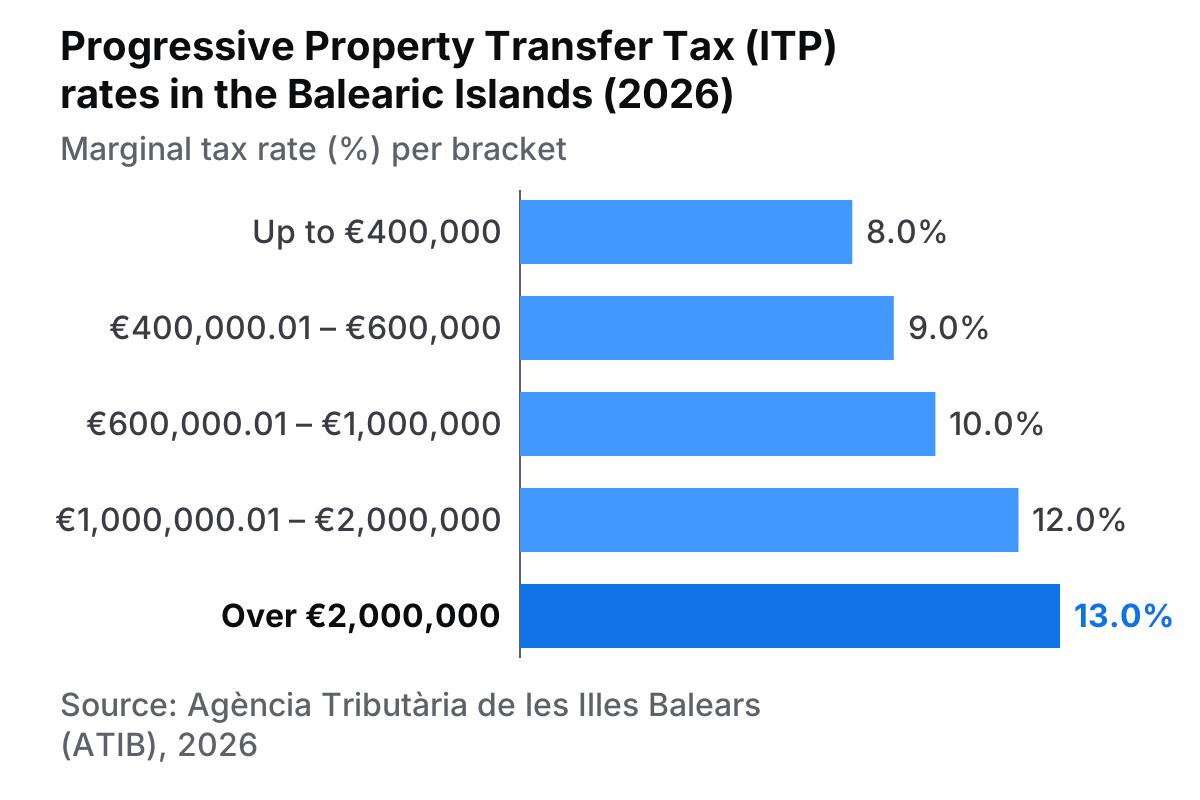
For residential resale purchases, the progressive marginal brackets are structured as follows:
- Up to €400,000: 8.0%
- €400,000.01 to €600,000: 9.0%
- €600,000.01 to €1,000,000: 10.0%
- €1,000,000.01 to €2,000,000: 12.0%
- Over €2,000,000: 13.0%
Reduced relief rates (ranging from 2% to 4%, or full 100% exemptions) apply strictly to eligible young residents purchasing their first primary home under specific income thresholds.
Short-term holiday rental investor strategies are subject to clear legal parameters. Under Decree-Law 4/2025, the Balearic Government enforces a total moratorium on new tourist rental licence registrations (ETV) in multi-family apartment buildings across Mallorca. New holiday licences in Palmanova are restricted to qualifying single-family detached or semi-detached dwellings when limited temporary bed pool allocations are opened by the Consell de Mallorca, operating under a strict zero-net-growth policy. Acquiring an existing dwelling with a valid, pre-existing ETV licence remains the primary avenue for holiday letting, as detailed in our analysis of owning a rental property in Mallorca and Ibiza.
For non-EU buyers, including UK citizens post-Brexit, property acquisition rules underwent a major shift following Organic Law 1/2025. Spain officially abolished its real estate Golden Visa scheme on 3 April 2025. Non-EU property owners are subject to standard Schengen regulations, restricting stays to 90 days within any 180-day period unless a formal residency visa is secured. Non-EU nationals intending to reside in Palmanova full-time frequently utilize alternative pathways such as the Non-Lucrative Visa (requiring proof of passive income equal to 400% of the IPREM index, or approximately €28,800 annually) or the Digital Nomad Visa.
To conduct thorough valuation analysis or explore historical transaction trends across Calvià, buyers and agents can use our professional property valuation and market study tool. To access real-time listing feeds and complete analytics, sign in to the CASAFARI platform.
Frequently asked questions
Can you get a holiday rental licence for an apartment in Palmanova?
No. Under Balearic Decree-Law 4/2025, new tourist rental registrations (ETV) are prohibited in multi-family apartment buildings across Palmanova, Calvià, and all of Mallorca. In 2026, licences are restricted to eligible single-family detached or semi-detached homes through limited temporary bed pool allocations managed by the Consell de Mallorca, unless you acquire a property with an existing valid licence.
How much is property transfer tax in Mallorca in 2026?
In the Balearic Islands, Property Transfer Tax (ITP) on resale homes is charged on a progressive scale based on the higher of purchase price or Cadastral Reference Value. In 2026, ATIB applies rates from 8% up to €400,000, 9% for €400,000.01 to €600,000, 10% for €600,000.01 to €1,000,000, 12% for €1,000,000.01 to €2,000,000, and 13% above €2,000,000. Reduced rates of 2% to 4% exist for eligible resident primary home buyers.
Is Palmanova a good place to live all year round with a family?
Yes, Palmanova offers a vibrant, year-round community of 7,073 registered residents supported by municipal services, medical clinics, and open amenities. It is situated 15 km from Palma city centre and 23 to 26 km from Palma de Mallorca Airport, with direct TIB A11 bus service. Families benefit from three top international schools within a 5-to-10-minute drive in Calvià, including Baleares International College, King Richard III College, and Agora Portals International School.
Can UK citizens still get residency by buying property in Mallorca?
No, purchasing real estate in Spain no longer grants automatic residency rights. Spain permanently abolished the real estate Golden Visa on 3 April 2025 under Organic Law 1/2025. Non-EU buyers, including UK citizens, may stay up to 90 days in any 180-day period without a visa, or apply for independent pathways such as the Non-Lucrative Visa (requiring passive income equal to 400% of IPREM, approximately €28,800 annually) or the Digital Nomad Visa.